CPJ joins call for renewing mandate of UN special rapporteur on Eritrea
The Committee to Protect Journalists on Tuesday joined 30 other non-governmental organizations in urging member and observer states of the United Nations Human Rights Council to extend the mandate of the special rapporteur on the situation of human rights in Eritrea. The special rapporteur reports on and assesses the human rights situation in Eritrea, and…
CPJ joins UN complaint on behalf of jailed Eritrean journalists
On July 21, 2022, the Committee to Protect Journalists joined the Raoul Wallenberg Centre for Human Rights in partnership with seven other rights organizations and lawyers in a complaint filed to the United Nations Working Group on Arbitrary Detention calling for accountability in the cases of Dawit Isaak and fifteen other journalists held behind bars…
CPJ joins call for Canada to impose targeted sanctions on Eritrean officials
The Committee to Protect Journalists yesterday joined 15 other rights organizations, journalists, and human rights experts in a statement calling on the government of Canada to impose targeted sanctions on senior Eritrean officials for human rights abuses, including the 20-year imprisonment of newspaper editor Dawit Isaac and other journalists. “After two decades, the devastating mistreatment…
CPJ joins letter calling on UN Human Rights Council to maintain pressure on Eritrea
The Committee to Protect Journalists joined 23 other free speech and human rights organizations in a letter sent yesterday urging the United Nations Human Rights Council to extend the mandate of the special rapporteur on the human rights situation in Eritrea.
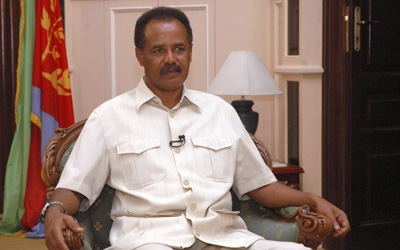
Eritrea: Let’s lift the shroud of 10 years of misery
Since Zaid Tewelde’s husband, an Eritrean freedom fighter turned playwright and journalist, was arrested in September 2001, she has spent each passing day coping with the burning questions of her two young sons, age 9 and 10, “Where is my dad? When are we going to see him?” And she is not alone. Like Zaid, the…
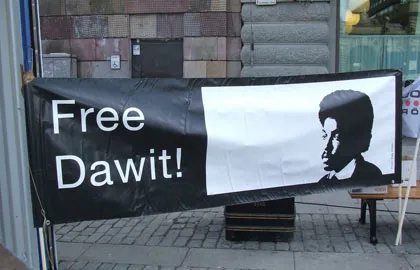
When Eritrea shut down the independent press
It was September 18, 2001. As usual, I had to do my shift as a news reader on Eritrea’s national government-controlled radio station Dimtsi Hafash. It was just minutes before 6:30 a.m. I was almost ready with all of the Tigrinya news material given to me for broadcasting and was waiting for the on-air sign…
September 18, 2001, in Eritrea: A memory that never fades
It feels like it happened just yesterday. It was 7 a.m. on an average day in September in Asmara, Eritrea. My brain was still reshuffling the information I had gathered about the terrorist attacks on the World Trade Center a week earlier. I was writing an article on it for the next issue of Setit,…

Press, politics at center of Eritrean mock trial
Articles published in Eritrea’s now-banned private newspapers are at the center of a mock political trial being filmed as an educational documentary this week at Sandra Day O’Connor College of Law at Arizona State University. Inside a courtroom on the sprawling Tempe, Ariz., campus, a judge of the High Court of Eritrea presides dispassionately, international observers lean into translation…
German media aid to Eritrea raises concerns
Dear Minister Wieczorek-Zeul: The Committee to Protect Journalists notes that the German government has decided to fund the training of journalists working for Eritrea’s state-controlled media while the nation’s independent press remains shut down and more than a dozen publishers and editors continue to be held incommunicado, many since September 2001.
Attacks on the Press 2006: Countries That Have Jailed Journalists
ALGERIA: 2 Djamel Eddine Fahassi, Alger Chaîne III IMPRISONED: May 6, 1995 Fahassi, a reporter for the state-run radio station Alger Chaîne III and a contributor to several Algerian newspapers, including the now-banned weekly of the Islamic Salvation Front, Al-Forqane, was abducted near his home in the al-Harrache suburb of the capital, Algiers, by four…