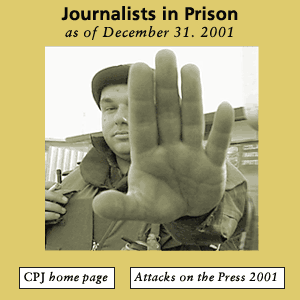
Attacks on the Press 2001: Journalists in Prison
There were 118 journalists in prison around the world at the end of 2001 who were jailed for practicing their profession. The number is up significantly from the previous year, when 81 journalists were in jail, and represents a return to the level of 1998, when 118 were also imprisoned.
Foreign journalists denied visas
Your Excellency: Given the fact that Zimbabwean authorities had threatened to bar foreign correspondents from covering the March 9 and 10 presidential elections, the Committee to Protect Journalists (CPJ) is pleased that a number of foreign news reporters have been granted accreditation. However, we remain concerned that the accreditation process was applied selectively and that some foreign correspondents have been denied entry into Zimbabwe because of their professional affiliation or critical reporting on the country’s deepening political crisis.
Four journalists believed killed
November 19, 2001—The Committee to Protect Journalists (CPJ) is outraged by the apparent murder of four journalists who were seized yesterday while traveling between Jalalabad and Kabul. The journalists have been identified by their news organizations as Azizullah Haidari, an Afghan-born photographer for the Reuters news agency; Harry Burton, an Australian television cameraman for Reuters;…
On anniversary of journalist’s disappearance, CPJ supports calls for international inquiry
New York, September 18, 2001—One year after the disappearance of Ukrainian journalist Georgy Gongadze, CPJ joins Gongadze’s widow in calling for an international investigation into the unsolved case. “President Kuchma and other cabinet officials have spent an entire year obstructing this inquiry,” said CPJ executive director Ann Cooper. “Journalists in Ukraine will not feel safe…
Attacks on the Press 2000: Poland
LEGAL AND INSTITUTIONAL REFORMS CONTINUED IN 2000, as Poland moved closer to joining the European Union. While journalists struggled under longstanding legal burdens, new court rulings favored press freedom, and legislation was drafted to improve access to information. Meanwhile, one violent attack against a journalist was recorded, and the political opposition alleged that the state…
Attacks on the Press 2000: Romania
MEDIA REFORMS INITIATED AFTER ROMANIA WAS INVITED to apply to join the European Union in November 1999 achieved only limited progress, and the country’s politicians spent much of the year debating laws that would limit, rather than promote, press freedom. The parliament also failed to eliminate or reduce criminal penalties for defamation, and journalists in…
Attacks on the Press 2000: Turkey
In December 1999, the European Union (EU) finally agreed to accept Turkey’s application for membership. Yet questions remained about the government’s committment to the human-rights reforms needed to actually join the EU. If press freedom is any indicator, Turkey has a long way to go. Government censorship, criminal prosecutions, physical attacks, and imprisonment were among…
CPJ calls for prompt independent investigation of Gongadze disappearance
Click here to read more about press freedom conditions in UKRAINE New York, December 15, 2000 — In the wake of allegations linking President Leonid Kuchma and two top aides to the September 16 disappearance of independent journalist Georgy Gongadze, CPJ urges President Kuchma and his government to avoid the appearance of impropriety by appointing…
Attacks on the Press 1999: Hungary
Hungary joined NATO in April and remained a front runner for European Union membership. However, these diplomatic victories could not mask the government’s growing contempt for the press and especially for journalists investigating stories that might embarrass the ruling Fidesz Party. In 1999, Prime Minister Viktor Orban and the Fidesz Party sought more control over…