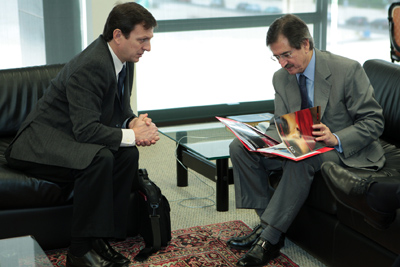
Brazilian officials tell CPJ they see judicial censorship
Government officials in the administration of Brazilian President Dilma Rousseff acknowledged that judicial censorship is inhibiting the work of the local press during meetings with CPJ on Thursday and Friday. At the same time, they said that due to the separation of powers under the Brazilian constitution, there is not much they can do to…
Cambodia orders popular blog blocked
Bangkok, February 23, 2011–The Committee to Protect Journalists is concerned by reports that Cambodian authorities have ordered local Internet service providers to block a number of websites, including the popular KI Media news aggregator and commentary blog, considered critical of the government.
Libya’s disordered Internet
Craig Labowitz at Arbor has been sifting through the evidence of how countries in the Middle East have been blocking and throttling the Internet in the last week. His analysis indicates that while both Bahrain and Yemen had periods of slowed or impaired access, only Libya seems to have taken the drastic step of shutting off the…
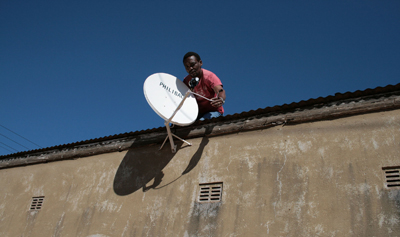
Sub-Saharan Africa censors Mideast protests
As news of Middle Eastern and North African protests swirl around the globe, satellite television and the Internet prove vital sources of information for Africans as governments fearful of an informed citizenry and a free press such as in Eritrea, Equatorial Guinea, and Zimbabwe impose total news blackouts on the developments.
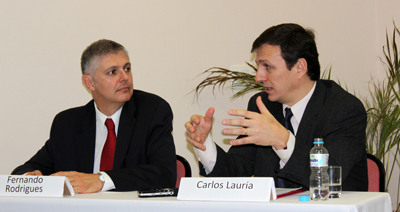
Attacks launch: Judicial censorship strikes a chord in Brazil
During the presentation of our annual survey, Attacks on the Press, in Sao Paulo, there was clear concern about the ability of the local media to report on issues of public interest without judicial interference. Journalists for three of the largest national dailies–O Estado de Sao Paulo, Folha de Sao Paulo, and O Globo–together with…

More rare news from North Korea
The latest batch of reporting–writing, photography, and video–from North Korea is available online at Asia Press Network (APN). The stories deal with apparent hyperinflation, the emergence of street markets in Pyongyang, and the reported reduction of rations for military personnel. They’re the sort of stories you seldom see out of North Korea that give depth…
Attacks on the Press 2010: Americas Analysis
In Latin America, A Return of Censorship By Carlos Lauría As the preeminent political family in the northeastern state of Maranhão for more than 40 years, the Sarneys are used to getting their way in Brazilian civic life. So when the leading national daily O Estado de S. Paulo published allegations in June 2009 that linked José…
Attacks on the Press 2010: Asia Analysis
Partisan Journalism and the Cycle of Repression by Bob Dietz and Shawn W. Crispin Lal Wickramatunga’s family and publishing house, Leader Publications, have paid dearly in Sri Lanka’s highly charged political climate. While Leader’s newspapers, including the weekly Sunday Leader, are widely known for tough, independent reporting, they have been caught up in a partisan…
Attacks on the Press 2010: Europe and Central Asia Analysis
On the Runet, Old-School Repression Meets New By Nina Ognianova and Danny O’Brien Russian President Dmitry Medvedev has often talked about the importance of a free press and free Internet, telling reporters before his election that the Web “guarantees the independence of mass media.” He explicitly tied the two together in his first State of…
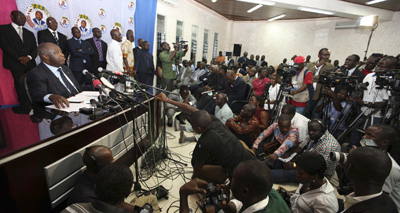
Ivory Coast using media regulation to censor critics
New York, February 10, 2011–Incumbent Ivorian President Laurent Gbagbo has moved to silence critical media under the guise of media regulation, the Committee to Protect Journalists said today, following a week in which Gbagbo’s administration tightened control over the official print media regulatory agency and ordered United Nations-sponsored radio network ONUCI FM off the air.