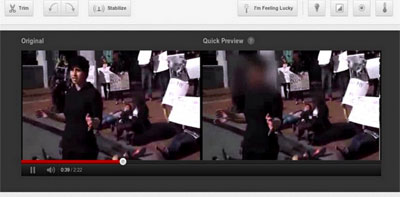
Face-blurring comes into focus for journalists
This week, YouTube announced a feature that should catch the eye of video journalists and bloggers working in dangerous conditions. After uploading a video to YouTube, you can now deploy a “blur faces” post-production tool that, in theory, should disguise the visual identity of everyone on the screen. The Hindu newspaper has an excellent how-to…


Another journalist reports sex assault in Tahrir Square
The story sounds hideously like another–one of a chaotic, predatory attack on a woman journalist in Cairo’s Tahrir Square. Clothes torn from her body, hundreds of men surging to grab her breasts and claw at her. A woman wondering, “Maybe this is how I go, how I die.” It has been almost a year and…

What to do if Google warns of state-sponsored attack
Some journalists continue to receive the warning from Google about state-sponsored attacks that we mentioned last week. The message appears on top of logged-in services like Gmail. Occasionally it will disappear for a few hours and then reappear, but there is no way to remove it.
Video: Journalists in exile
Four East African journalists who were forced to flee their countries tell about their experiences, difficulties, and hopes for the future. (3:43)Read CPJ’s report, “Journalists in exile: Crisis in East Africa,” for more information about journalists forced to go into exile.

For exiled Eritreans in Sudan, fear greater than most
With the launch of CPJ’s most recent exile report, I will have worked exactly three years for our Journalist Assistance program. More than 500 cases later, I have helped journalists who have gone into hiding or exile to escape threats; those in need of medicine and other support while in prison, and journalists injured after…
Spreading the security message
Video streaming by UstreamOn the frontlines of global reporting, knowledge is safety. CPJ’s event series to promote our new Journalist Security Guide continued Wednesday in Washington, D.C. where we teamed up with Internews for a panel discussion on journalist security on-site and online.
State-sponsored attacks: open season on online journalists
The last few weeks have offered the strongest indications yet that nation-states are using customized software to exploit security flaws on personal computers and consumer Internet services to spy on their users. The countries suspected include the United States, Israel, and China. Journalists should pay attention–not only because this is a growing story, but because…
Defining role of the press in genocide prevention
Talking about genocide prevention in the shadow of the Auschwitz-Birkenau extermination camps brings an intense and unique gravity to the discussions. The academic presentations cannot extract themselves from the looming presence of the barbed wires and grim towers surrounding the Nazis’ most infamous death factory.