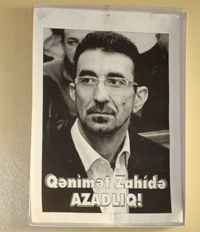
Azerbaijani editor Zakhidov freed; 3 journalists still jailed
New York, March 19, 2010—The Committee to Protect Journalists welcomes the release from prison on Thursday of Azerbaijani editor Genimet Zakhidov, who served more than half of a four-year term on fabricated “hooliganism” charges.“We’re relieved Azerbaijani officials released our colleague Genimet Zakhidov, who served 28 long months in prison in retaliation for his critical journalism,”…
CPJ urges EU leader to seek freedom for Cuban journalists
Dear President Rodríguez Zapatero: On the seventh anniversary of the Cuban government’s massive crackdown on dissidents and the independent press, the Committee to Protect Journalists calls on you as leader of the European Union to take the forefront in defending human rights by urging President Raúl Castro to immediately release 22 journalists now jailed in Cuba.
Spain must help free Cuban dissidents
Mark Twain once said, “In our country we have those three unspeakably precious things: freedom of speech, freedom of conscience, and the prudence never to practice either.” In the witty genius’ land, the United States, such irony suggests that people should not to waste the opportunities that democracy offers. But in Cuba’s case any humorous…
In Azerbaijan, Eynulla Fatullayev and family threatened
New York, March 17, 2010—The Committee to Protect Journalists called on Azerbaijani authorities today to thoroughly investigate a death threat made against imprisoned editor Eynulla Fatullayev, a 2009 recipient of CPJ’s International Press Freedom Award, and his family.
Under pressure, Kyrgyz stations halt RFE/RL programming
New York, March 16, 2010—The Committee to Protect Journalists is disturbed by reports that the Kyrgyz government has pressured several radio and television stations to stop carrying programming from the Kyrgyz service of the U.S. government-funded Radio Free Europe/Radio Liberty (RFE/RL).
Belarusian police raid news offices in defamation probe
New York, March 16, 2010—The Committee to Protect Journalists condemns raids conducted today by Minsk police at the offices of the independent news Web site Charter 97, the independent newspaper Narodnaya Volya, and the home office of freelance reporter Irina Khalip.
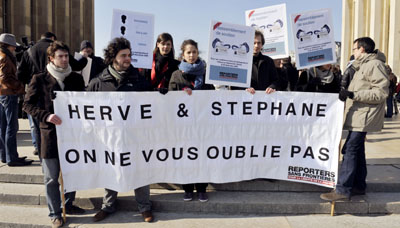
Rallying (hesitantly) for reporters abducted in Afghanistan
What can we do to help liberate our colleagues? French journalists have been struggling with this dilemma since December 30, when two reporters of the public service TV channel France 3 and their three Afghan fixers were abducted by a group purportedly linked to the Taliban in the region of Kapisa, in eastern Afghanistan.
Uzbekistan using ‘experts’ to silence journalists, activists
Having suppressed independent journalism relatively completely in the country, the authoritarian Uzbek regime has now turned to other sectors of society it perceives as threatening to its ideology. State appointed so-called “experts” on undefined Uzbek national traditions are being dispatched on a witch hunt against independent-minded individuals, including a filmmaker and an anti-HIV/AIDS activist. This dangerous policy is in…