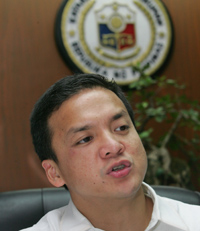
Philippine high court spokesman: Death threats ‘funny’
Midas Marquez, spokesman for the Philippine Supreme Court, has told local reporters that he considers death threats sent anonymously by text message to journalist Marites Dañguilan Vitug to be “funny” and “ridiculous.” Marquez was asked to comment in his official role because the threats began shortly after the release of Vitug’s new book, Shadow of…
In Thailand, grenades hit two state television stations
New York, March 29, 2010—The Committee to Protect Journalists condemns and calls for a thorough investigation into grenade attacks launched against two state-owned television news stations in Thailand. The attacks—one against army-run Channel 5, the other against the National Broadcasting Services of Thailand (NBT)—took place Saturday night in the capital, Bangkok.
Three journalists injured in Pakistan bomb blast
A bomb explosion injured three local journalists who were accompanying a convoy of security forces in the Lower Dir district of northwestern Pakistan on February 3, 2010, according to a statement by the Karachi-based Pakistan Press Foundation and international news reports.
New York Times to pay damages to Singapore’s leaders
The New York Times Co. apologized on March 24, 2010, to Singapore’s prime minister and his two predecessors for a February 15 article that described the island nation’s leaders as a political dynasty, according to international news reports. The company and the article’s author, Philip Bowring, agreed to pay damages of 160,000 Singaporean dollars (US$114,000) in…
Protesters hurl stones, injure four at Sirasa TV
Staffers at Sirasa TV confirmed media reports that about 200 people gathered outside the in-town office of the independent broadcaster and threw stones, breaking windows and injuring staffers on March 22, 2010. Some in the crowd carried posters in Sinhala and English protesting the station’s plan to broadcast a concert by pop singer Akon scheduled…

In Garcia-Esperat murder, a twisting path to justice
Five years ago today, a gunman strode into the home of muckraking Philippine journalist Marlene Garcia-Esperat, pulled out a .45-caliber pistol, and shot her once in the head. A columnist and radio host on the southern island of Mindanao, Garcia-Esperat had made plenty of enemies while exposing government corruption.

Google’s Chinese wake-up call
On Monday, Google made good on its promise to stop censorship of its Chinese search engine, Google.cn, by rerouting viewers to its unfettered Hong Kong site. According to the company’s chief legal officer, David Drummond, the move was “a sensible solution to the challenges we’ve faced—it’s entirely legal and will meaningfully increase access to information…

Circumventing India’s radio news ban
Violence against provincial journalists, self-censorship, and the rise of paid news were the leading press freedom concerns cited by editors and journalists that I met with during my recent visit to India. But for Shubhranshu Choudhary, known as Shu, it’s the ban on radio news that most concerns him. He believes the ban is fueling India’s long-simmering Maoist insurgency,…
Philippine editor Vitug receives series of death threats
New York, March 23, 2010—The Philippine government must vigorously pursue its investigation into a series of death threats received by Marites Dañguilan Vitug, editor-in-chief of the online news outlet Newsbreak, the Committee to Protect Journalists said today.