Latin America takes steps against criminal defamation
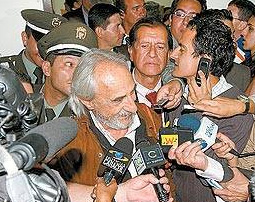
In an encouraging development, three courts in Colombia, Costa Rica, and Chile have recently followed the growing regional consensus against criminal defamation by dismissing criminal penalties against journalists accused of libel and slander.The newsweekly magazine Semana reported that a piece written by Alfredo Molano, at left, in the op-ed pages of the Bogota-based daily El Espectador in February 2007 described how…

Radio Lumière in Haiti loses three journalists in quake
Radio Lumière has officially published the names of three of its journalists who died in the January 12 earthquake in Haiti: Jude Marcellus, Marlene Joseph, and Ginord Desplumes. They died under the rubble of collapsed buildings. It took a month for Radio Lumière officials to decide to publish the names of the three victims.
Venezuela arrests former police officer in Sambrano murder
New York, February 24, 2010—The Committee to Protect Journalists welcomes the arrest on Sunday of a man believed to have gunned down journalist Orel Sambrano in 2009 in reprisal for his reporting on drug trafficking, the local press reported.

Only man accused in Brad Will murder goes free
For those following the case of Bradley Roland Will, left, a U.S. activist-journalist killed while reporting on a protest movement in the southern Mexican state of Oaxaca in 2006, a long wait ended on February 18. After 16 months in prison, Juan Manuel Martínez, a grassroots activist from an impoverished neighborhood in Oaxaca, left his cell…

CPJ launches yearly findings globally, and is heard
On February 16, CPJ held an ambitious international launch of our annual report Attacks on the Press. We coordinated events in six cities on four continents in order to expand the reach of our international headlines while also focusing on specific issues in each region. So how did we do?

Sean Penn and the paparazzi
In a thinly disguised effort to distract me during a poker game on Saturday night, a friend asked if CPJ was planning to take up the case of the photographer who was attacked by Sean Penn. Frankly, this was the first time I’d heard of the incident that took place last October in which Penn…
Peruvian photojournalist captures judge pointing gun at him
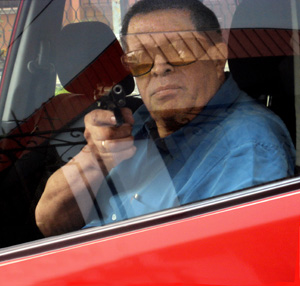
Caretas, the leading newsweekly magazine in Perú, has a shocking photograph on its February 18 cover: a local judge aiming a gun at one of the publication’s reporters. Photojournalist Carlos Saavedra was on a stakeout trying to photograph Judge Raúl Rosales Mora when the incident occurred on February 13, according to CPJ interviews and local…
Haitian state media running, but limited in scope as always
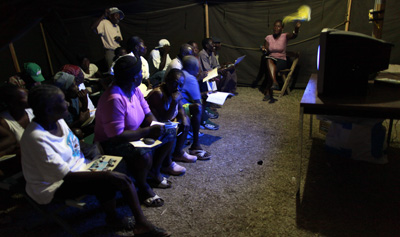
As part of three days of mourning in Haiti to remember the one-month anniversary of the January 12 earthquake, songs and prayers with melancholic voices echoing and images of a crowd mostly dressed in white were broadcast live on the state-owned National Radio and Television stations (RTNH).
Columbia J-students learn the price of reporting in Iran
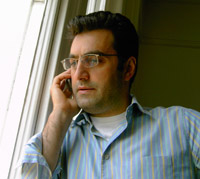
The two venues for the launch of Attacks on the Press in New York couldn’t have been more different. On Tuesday morning I was joined by Newsweek’s Maziar Bahari, and CPJ Asia Program Coordinator Bob Dietz in the hushed auditorium of the Dag Hammarskjöld Library at United Nations headquarters. The event was so well attended…