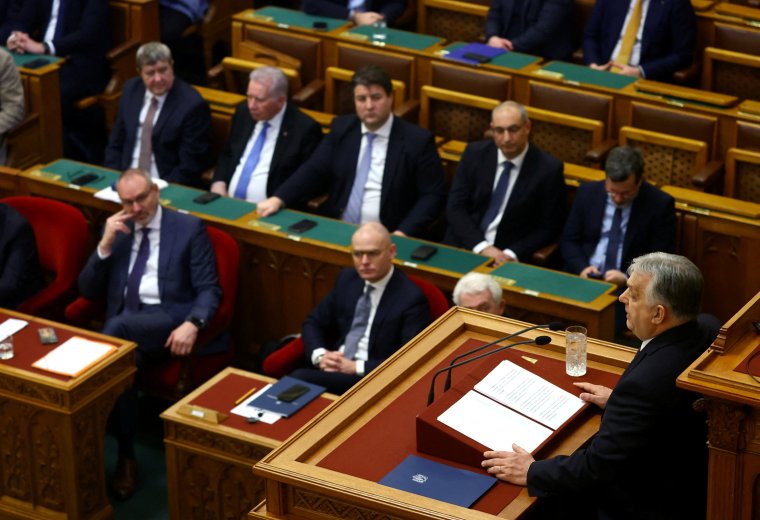
Ahead of Hungary’s parliamentary elections on April 12, the Committee to Protect Journalists is calling on all political parties to commit to restoring press freedom, starting with 10 priority issues.
Hungary’s media landscape has declined severely in the last 16 years under the government of Prime Minister Viktor Orbán. His ruling Fidesz party — which faces a serious challenge in Sunday’s election from the opposition Tisza party, under Péter Magyar — directly or indirectly controls around 80% of the country’s media market, making it one of the most sophisticated systems of media capture seen yet within the European Union.
“Independent journalists in Hungary operate in a deeply hostile climate characterized by systemic obstruction, political pressure, and public vilification,” said Attila Mong, CPJ’s Europe representative. “Whoever wins the election must take immediate, concrete action to reverse this authoritarian trajectory, dismantle the complex machinery of state control, and align Hungary with European standards on media freedom, transparency, and the rule of law. By committing to these 10 priorities — from scrapping the Russia-style “foreign agent” bill to ending state-sponsored smear campaigns — the incoming government can take the essential first steps toward restoring fundamental democratic norms and ensuring that the press can fulfill its vital watchdog role.”
The 10 key steps to restoring press freedom are:
1. Abolish the Sovereignty Protection Office and permanently shelve the “foreign agent” bill. Authorities must repeal the law establishing the Sovereignty Protection Office (SPO), which has been used to harass and delegitimize independent media by labeling them as threats to national sovereignty. Hungarian authorities have increasingly used the SPO — created under the pretext of investigating undue foreign interference into domestic affairs — to launch investigations into and smear campaigns against independent media. A pending Russia-style “foreign agent” bill, which could blacklist or defund media outlets that receive foreign support, must be completely abandoned.
2. End state-sponsored smear campaigns against journalists. Independent journalists in Hungary are systematically subjected to smear campaigns orchestrated by government politicians, state-aligned media, or state bodies. By aggressively labeling critical reporters as “foreign agents,” “traitors,” or “fake news factories,” the state seeks to delegitimize their reporting and erode public trust. This institutionalized incitement fosters public hostility that endangers reporters and severely intimidates vital sources. To reverse this, the government must stop using public funds, public service media, pro-government media outlets, or other channels to smear journalists or accuse them of serving foreign interests. The incoming political leadership should make unequivocal statements in support of protecting journalists and defending media freedom.
3. Protect journalists from unlawful surveillance. Hungary’s legal framework for national security surveillance lacks independent judicial oversight, allowing the minister of justice to authorize secret surveillance in the name of national security interests without prior judicial approval. This systemic flaw enabled the 2019 deployment of military-grade Pegasus spyware against independent journalists, creating a profound chilling effect that intimidated confidential sources and forced reporters to adopt extreme security measures. The European Court of Human Rights (ECtHR) has repeatedly condemned Hungary’s lack of procedural safeguards for protecting journalistic sources, yet the authorities have failed to execute these judgments. To reverse this, the government must:
- Reopen investigations closed in June 2022 into the use of Pegasus spyware against journalists with the highest levels of transparency, accountability, and redress for the victims.
- Establish effective and independent judicial oversight for all surveillance procedures and ensure that targeted journalists are properly notified.
- Fully implement recommendations made by the European Parliament’s Committee of Inquiry on Pegasus (PEGA), in response to Hungary’s use of surveillance in breach of EU values and fundamental rights.
4. Reform public service media to guarantee its institutional and editorial independence. Hungary’s public service media operates under a complex and opaque institutional structure primarily controlled by the state-owned Media Support and Asset Management Fund (MTVA) — a body that receives massive government funding (415 million euros, or US$485 million, in 2025) without meaningful independent oversight. The public broadcaster, overseen by the politically captured Media Council, has been transformed into a direct instrument of government propaganda, giving a majority of airtime to ruling party politicians, withholding criticism of the government and negatively reporting on the opposition.
The incoming government must immediately introduce reforms to ensure the independence of public service media is restored, halting its use as a government mouthpiece, in line with the European Media Freedom Act (EMFA).
5. Restore meaningful access to public information. Journalists trying to hold the government to account face systemic barriers to accessing information, as state institutions, municipalities, and state-owned enterprises systematically ignore, delay, or provide meaningless replies to press inquiries. The Freedom of Information Act (FOIA) has been severely weakened by legislative amendments and judicial decisions, drastically narrowing the scope of accessible data, particularly regarding public funds.
To resolve this, the government must end the systematic obstruction of journalistic inquiries by ensuring transparent, timely responses to FOIA requests, and strictly enforce binding court orders that mandate the disclosure of public data.
6. Guarantee equal and unhindered access to public events, politicians, and press conferences. Direct access to decision-makers and the firsthand observation of events are fundamental elements of journalism, without which the media cannot effectively fulfill its public watchdog role. Journalists in Hungary, however, face a systematic information blockade designed to give the government exclusive narrative control. Reporters are selectively denied accreditation to government press conferences, often under fabricated pretexts like “limited capacity” or “private property,” and face severe restrictions when trying to report from parliament, hospitals, refugee camps, or other public institutions. In extreme cases, independent journalists have been physically removed by police or local officials simply for attempting to ask politicians questions at public forums.
To ensure a functioning democratic press, authorities must stop the arbitrary and discriminatory practice of barring independent journalists from government press conferences and public institutions, bringing their practices into compliance with ECtHR standards.
7. Implement safeguards against abusive lawsuits, including those resulting from the weaponization of EU data protection laws. Hungary lacks any national mechanisms to prevent or remedy abusive litigation aimed at intimidating and silencing journalists or their sources. Defamation claims, which can be filed in parallel under both civil and criminal law, are frequently used by politicians, business figures, and state-aligned actors as Strategic Lawsuits Against Public Participation (SLAPPs) to drain newsrooms’ time and financial resources.
The government’s failure to adopt legislation establishing journalistic exemptions as required under Article 85 of the General Data Protection Regulation (GDPR), is also problematic as it means journalists are treated as standard data controllers. This subjects them to obligations incompatible with investigative journalism, such as having to notify subjects before publication or conduct pre-publication data assessments. Politically connected individuals exploit this legal loophole to file abusive privacy complaints to the data protection authority or the courts.
To resolve this, the new government must introduce legislation to create safeguards for journalism. Specifically, the government should introduce:
- Explicit legislative exemptions for the journalistic processing of personal data to prevent GDPR from being misapplied as a tool for censorship.
- Robust procedural rules (such as early dismissal mechanisms) in line with the EU Anti-SLAPP Directive and the Council of Europe’s anti-SLAPP recommendation. This would empower judges to quickly throw out manifestly unfounded claims against the press before they deplete a newsroom’s resources.
8. Conduct a full review of national legislation affecting media pluralism and independence.
Since 2010, the ruling party has enacted a series of media laws that have fundamentally reshaped the regulatory environment, allowing the state to capture large segments of the market and systematically obstruct independent outlets. The government has refused to implement the newly enacted EMFA and continues to ignore multiple binding ECtHR judgments concerning media freedom.
To resolve this, the incoming government must ambitiously seek to introduce more effective legal protection of media pluralism and independence in line with European law and standards, including the EMFA. Hungary should also fully implement ECtHR judgments relating to media freedom and pluralism, and ensure better implementation of the EU’s Whistleblower Directive.
9. Ensure the fair and transparent distribution of state advertising. The state is the dominant player in the media advertising market, accounting in 2025 for roughly a third of total advertising expenditure, which is highly centralized through the National Communications Office (NKOH).
These public funds are channeled almost exclusively into pro-government media, with the pro-government media conglomerate KESMA receiving up to 75-80% of its total revenue from state advertising. This discriminatory practice deliberately starves independent outlets of vital resources and severely distorts the market, making fair competition impossible.
To resolve this, the practice of funneling state advertising into pro-government media must be ended and replaced with transparent, equitable distribution rules.
10. Ensure the functional independence of the media regulatory authority. Hungary’s regulatory bodies (the National Media and Infocommunications Authority (NMHH) and its decision-making body, the Media Council) are entirely controlled by the ruling party, as all of their members are exclusively appointed and elected by the government’s parliamentary supermajority. This severe capture has resulted in biased, politically motivated regulatory decisions — such as blocking independent media mergers while favoring pro-government expansions — which clearly violate the independence requirements set out in the EU’s Audiovisual Media Services Directive (AVMSD).
To resolve this, the appointment processes for the Media Council and the NMHH must be overhauled to eliminate political control, ensure transparency, and review Hungary’s current compliance with the EU’s AVMSD.
Watch our video: CPJ interviewed four leading Hungarian journalists about the challenges they have faced under Orbán’s rule and their expectations for the future.