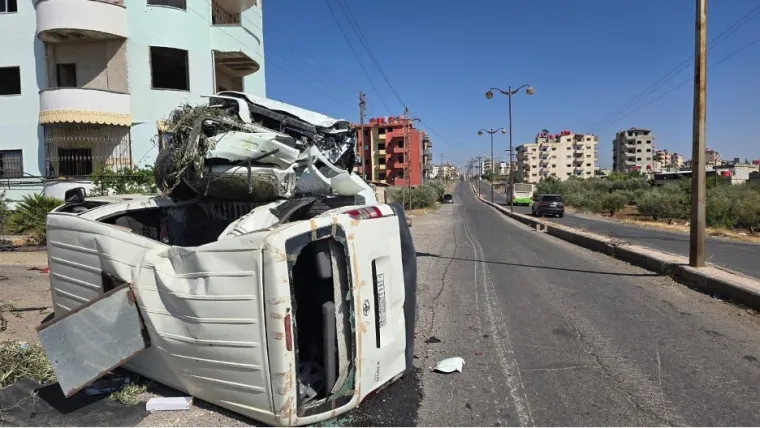
Sulaymaniyah, Iraq, July 22, 2025—Journalists were killed, wounded, shot at, and blocked from entering the southern city of Sweida as sectarian violence spread across the region last week, according to multiple journalists who spoke to CPJ. An Israeli airstrike also damaged a media outlet in Damascus.
“The violence against journalists in Sweida — including injuries, intimidation, and the ransacking of media offices — along with the attack on a media outlet in Damascus, signals a dangerous escalation in threats to Syria’s press,” said CPJ Regional Director Sara Qudah. “Authorities must investigate these incidents and ensure accountability. Journalists should not face violence or obstruction for doing their work.”
Fighting in Sweida governorate began on July 13, 2025, after a Druze merchant was assaulted by Bedouin tribesmen. The confrontation escalated into armed clashes between Druze groups and Bedouin fighters, drawing in Syrian government forces. Israeli airstrikes on July 15 and 16 followed in Sweida and Damascus, with Israel citing the protection of Druze communities. A U.S.-brokered truce temporarily halted fighting, but conditions on the ground remained unstable.
- Sari Majid Al-Shoufi, a photojournalist for Suwayda 24, was killed on July 14, 2025, while covering clashes near Sweida, Syria. He was last heard from around 6 a.m., saying the area was under attack and others around him had been killed, Suwayda 24 editor Rayan Marouf told CPJ. His death was confirmed on July 24 after a 10-day search.
- On July 15, Nadim al-Nabulsi, a reporter for Ahrar Horan, a local media collective, sustained minor injuries while covering events in Sweida after an Israeli drone strike. “I was reporting near the entrance of the city, following a [Syrian government] General Security Forces vehicle on my motorcycle,” al-Nabulsi told CPJ. “The vehicle was hit by drone-dropped explosives. I was around 25 meters (82 feet) behind and tried to hide, but some shrapnel hit my lower back.” He said he was wearing a “Press” vest at the time.
- Sari Majid Al-Shoufi, a photojournalist for Suwayda 24, was killed on July 14, 2025, while covering clashes near Sweida, Syria. He was last heard from around 6 a.m., saying the area was under attack and others around him had been killed, Suwayda 24 editor Rayan Marouf told CPJ. His death was confirmed on July 24 after a 10-day search.
- Also on July 15, freelance journalist Muhannad Abu Zaid was wounded during clashes. He said he was following a General Security Forces convoy into Sweida when gunfire broke out. “I took cover and started filming, but a sniper fired and hit my hand,” he told CPJ. “I think the bullet was meant for my chest, but a car shielded me.”
- On July 16, an Israeli airstrike In Damascus, targeting the Syrian army’s general staff headquarters damaged Al-Hadath TV’s office. According to a video posted by the channel on X, no one was injured.
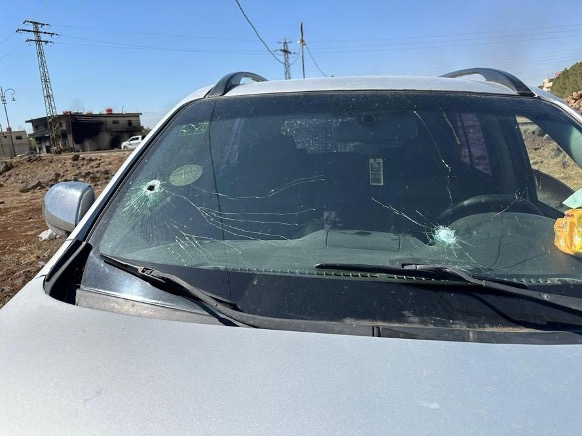
- On July 19, four journalists wearing “Press” vests — freelance photographer Ali Haj Suleiman, a Getty Images contributor; photographer Bakr Alkasem, who contributes to Agence France-Presse; NoonPost reporter Hamza Abbas; and NoonPost camera operator Qusay Abdulbari — were beside their car in Sweida when it was struck by bullets. “We were covering events in Sweida, entering at the Omran roundabout,” Haj Suleiman told CPJ. “Druze armed factions appeared to counterattack, and gunfire came from three directions. We took cover behind our car as snipers and RPGs fired. After 10 minutes, the shooting stopped.”
- Also on July 19, Karam Nachar, editor-in-chief of the privately owned outlet Al-Jumhuriya, posted that one of the outlet’s journalists, who asked not to be named for his own safety, was robbed and threatened in his home in Sweida by what the journalist said “appeared to be newly recruited members of the ministry of defense.” CPJ spoke with the journalist and confirmed that he is now safe in Damascus. “The four gunmen took $1,600 in cash, my phone, and a camera worth around $2,000,” he said, adding that he managed to escape the raid after another journalist intervened.
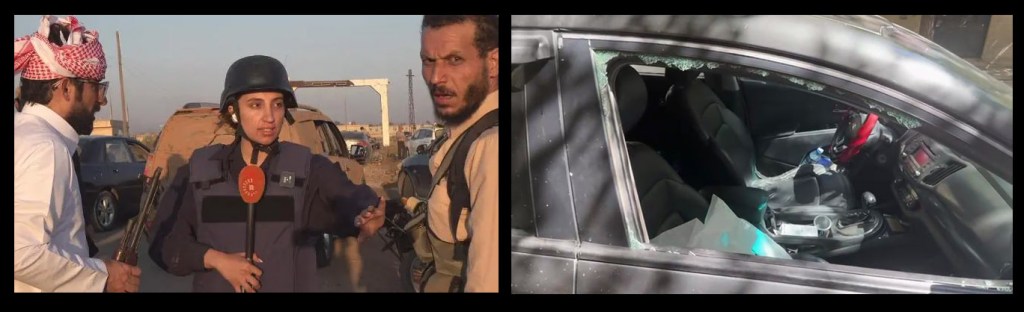
- On July 20, Rudaw TV reporter Solin Mohammed Amin was threatened and harassed during a live broadcast near Sweida by armed tribal fighters who targeted the Syrian-Kurdish journalist for speaking Kurdish. “We will come to you Kurds after the Druze and Alawites,” one man said, accusing her of being a separatist. “One of them threatened to kill me,” Solin told CPJ. “I didn’t interrupt the live broadcast so that everything would be documented.” She was eventually escorted to safety by fellow journalists and fighters. Three days later in Damascus, her car windows were smashed. Though valuables were untouched, her press ID and car documents were taken – an act she said was meant to intimidate her. She reported the incident and has since taken leave, returning to her hometown of Qamishli.
- As of July 29, access to Sweida remains blocked for international and other journalists, according to reporters who spoke anonymously, citing fear of reprisal. Since July 26, no journalists have been allowed in, with officials citing safety concerns. However, many see it as censorship amid growing press restrictions. Between July 22 and 29, Syria’s media visa portal was offline, and current permits for southern areas like Daraa and Sweida are limited to 48 hours. Foreign journalists, unlike tourists, must exit Syria monthly to reapply for entry, making sustained coverage nearly impossible.
CPJ contacted Mohammad Al-Saleh, the Syrian ministry of information’s spokesperson, via messaging app. He said authorities had not blocked journalists from working but warned them that Druze snipers were active in the area, and advised them to evacuate to avoid kidnapping or crossfire. Al-Saleh said the government holds its institutions accountable for any misconduct but currently lacks the means to pursue armed groups operating outside the law — “though that time will come.”
Editor’s note: This article was updated on July 30 to add new incidents, including the killing of a journalist.