Journalists have been silenced for covering Chechnya and its neighboring republics, Dagestan and Ingushetia. Opaque investigations into the killings have fed deep skepticism.
Anatomy of Injustice: The Unsolved Killings of Journalists in Russia
The North Caucasus has been a treacherous place—and a potentially deadly topic—for independent journalists. CPJ has documented dozens of cases of harassment and attacks committed by all sides against journalists in Chechnya, where two wars have raged, and its neighboring republics, Dagestan and Ingushetia, beset by outbursts of violence.
SIDEBAR: ‘Who Needs Your Truth?’
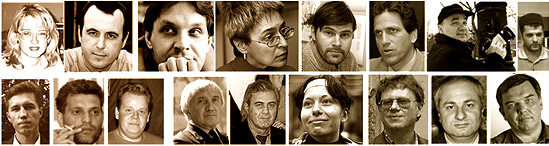
But the ultimate method of silencing journalists and other critics has come from the barrel of a gun. As many as seven journalists may have been targeted for murder since 2000 because of their reporting on the region. Preceding chapters have recounted the cases of Paul Klebnikov, Anna Politkovskaya, and Magomed Yevloyev.
Journalists Vladimir Yatsina, Magomedzagid Varisov, Telman Alishayev, and Anastasiya Baburova also covered developments in the region, and they, too, were murdered. Authorities say they have identified several suspects in these cases—and have killed some—but colleagues and relatives of the journalists are deeply skeptical about the official handling of these cases. They are troubled by the opaque nature of the investigations, the contradictory public statements made by authorities in some instances, and the general failure of investigators and prosecutors to communicate with even those closest to the victims.
In mid-July 1999, Vladimir Yatsina, 51, took a leave from his job at the Russian news agency ITAR-TASS and traveled to the North Caucasus on a freelance assignment to photograph Chechen fighters encamped in Ingushetia. According to press and family reports, Yatsina traveled with Magomed Uspayev, an ethnic Chechen and Moscow university student, who was to be his fixer.
Heidi Hollinger, a Canadian photojournalist, had passed along Uspayev’s name to Yatsina, according to her lawyer, Nicolas Plourde. Hollinger told Yatsina that she did not know Uspayev well and that his credentials should be verified, the lawyer said in a written statement to CPJ. Hollinger had no other contact with either man, the lawyer said.
After the photographer and fixer landed at an airport in Ingushetia, news reports said, Uspayev handed Yatsina to members of the Akhmadov clan, a criminal gang notorious for kidnappings, and went on the run. A month later, kidnappers called Yatsina’s wife and sought US$2 million in ransom, a demand they later made to ITAR-TASS as well. Neither the family nor the agency paid the sum, and the Russian Interior Ministry would not negotiate with the kidnappers.
In late February 2000, two former captives told Russian prosecutors they had seen Yatsina’s body in the mountains of Chechnya, Amnesty International reported. A Kazakh national, Alisher Orozaliyev, whom Chechen kidnappers had held hostage at the same location as Yatsina, said the gang members had killed the journalist while retreating from the Russian army. On February 20, a group of hostages was being transferred to the village of Shatoi, Orozaliyev said at a press briefing shortly after his release. “Yatsina had health problems—he had bad feet, couldn’t walk any longer, although only five kilometers remained. The rebels shot him dead. We arrived in the village and were to stay there. But then bombing started and we had to go down into the forest. On the way back, we saw his body.”
Yatsina’s wife, Svetlana Golovenkova, told CPJ that she and other family members learned of the death from television news reports. It was a stunning way to get the news for Golovenkova, who said she had personally appealed to 20 different officials for help in the case. All had promised to keep her informed of developments, she said.
After the captives gave their statements, the Interior Ministry sent a special forces unit to recover Yatsina’s body. The unit retrieved remains from the site where Yatsina was believed to have been killed, but tests later showed that they belonged to an animal, Novaya Gazeta reporter Vyacheslav Izmailov, a veteran of the region, told CPJ.
While the armed conflict in Chechnya might understandably impede efforts to arrest Yatsina’s killers, no such obstacle seemed to stand in the way of questioning Uspayev, who was reportedly seen in Moscow in the months after the abduction. Uspayev remained in the country until 2002, when he fled to Sweden under an assumed name, according to Izmailov, who reported on the case and who once served as a military officer in the North Caucasus.
In correspondence with Golovenkova in 2002 and 2003, local prosecutors said they were aware Uspayev had fled the country. But it wasn’t until 2005—after Golovenkova had filed a formal complaint with the Prosecutor General’s Office in Moscow—that authorities placed Uspayev’s name on Interpol’s international wanted list.
In October 2006, Swedish police arrested Uspayev, who was then using yet another name, on a disorderly conduct charge and asked their Russian colleagues to confirm his identity, according to local reports. His identity verified by Chechen prosecutors, Russian authorities filed a request for extradition on charges related to the abduction and killing, according to prosecutors. In October 2007, the Swedish government rejected the extradition request, saying it feared that an ethnic Chechen would not get a fair trial in Russia, according to prosecutors and press reports.
In a June 12 statement, the Swedish Prosecutor General’s Office told CPJ it is conducting its own investigation into Uspayev’s alleged role in the case. The prosecutor’s office said it is also examining whether it could bring its own criminal case. Uspayev could not be located for comment.
According to press reports, many of the Akhmadov brothers who led the criminal gang were killed during the Chechen conflict. One, Ruslan, was arrested in 2001 in Azerbaijan and extradited to Russia, where he was sentenced to 10 years in prison for other crimes. Authorities have disclosed no information on what role, if any, the Akhmadov brothers played in Yatsina’s murder.
Magomedzagid Varisov, 54, a political analyst for Dagestan’s largest weekly, Novoye Delo, and head of a think tank, the Center for Strategic Initiatives and Political Technologies, was shot in a contract-style assassination on June 28, 2005. At least two unidentified assailants fired on Varisov’s car near his house in Dagestan’s capital, Makhachkala, killing the journalist and wounding his driver, according to press reports. Varisov’s wife, who was also in the vehicle, was unharmed. Police said they collected 24 bullet casings from the scene.
Several sources told CPJ that Varisov appeared to have been targeted for his writing, which was critical of many people across the political spectrum. In his Novoye Delo column, Varisov examined the spread of militant Islam and scrutinized human rights abuses committed by federal forces in the region. In particular, the journalist examined a recent Russian army sweep in the Chechen border town of Borozdinovskaya, which resulted in the killing of one civilian and the disappearance of several others. Days before his murder, Varisov told the German paper Berliner Zeitung that Chechen authorities were unable to control their own territory and were responsible for the spread of violence to Dagestan. Chechen guerrillas easily cross the border into Dagestan, he told Berliner Zeitung, which published its article the day Varisov was shot.
A local Islamist group, Shariat, claimed responsibility for Varisov’s murder, calling him a mouthpiece for the Kremlin and the “Dagestani puppet regime” in a statement published on its Web site. Ten days later, police ambushed and killed Ruslan Makasharipov, the group’s reputed leader, and announced that he was a suspect in Varisov’s murder and a dozen other crimes.
The next year, on April 10, 2006, police gunned down another man they called a suspect in the slaying. Press reports said police in Makhachkala exchanged gunfire with a man named Makhach Rasulov while trying to apprehend him. Rasulov, a one-time colleague of Varisov at Novoye Delo, died at the scene. Press reports described Rasulov as a former government interpreter who had become a follower of Wahhabism, a conservative form of Sunni Islam.
Authorities have not made public any evidence to support assertions that the two men were involved in Varisov’s murder. The suspects’ precise roles in the slaying have not been spelled out; neither is it clear whether any other people were involved in the killing. Prosecutors told CPJ in February 2007 that the Varisov case had been closed.
The journalist’s son, Varis, said he is skeptical of the official account. Varis Varisov, himself a government investigator with the Dagestan Investigative Committee, said a statement from a detained Chechen guerrilla had purportedly connected Makasharipov to the murder. But Varisov said he found inconsistencies between the statement and details of the killing. He said he asked his colleagues to restart the investigation, but it was to no avail. The case will be solved, Varisov said, “only if, by miracle, we discover something new.” The Dagestan prosecutor’s office did not immediately respond to CPJ’s April 2009 request for comment.
Telman Alishayev, 39, a reporter and a host for the Makhachkala-based Islamic television channel TV-Chirkei, covered social issues such as education, AIDS, and drug addiction from a religious perspective, his colleagues told CPJ.
On September 2, 2008, two unidentified assailants shot Alishayev as he was returning home in his car. He died at the hospital the next morning. Several CPJ sources said the slaying was likely prompted by a 2006 documentary that Alishayev produced, “Ordinary Wahhabism,” which criticized the conservative form of Sunni Islam and its spread in the republic. The business daily Kommersant reported that Alishayev received threats shortly after the film was released, and that one Islamist group had placed his name on an online “death list.”
Two days after the attack, investigators identified two suspects: Vadim Butdayev and Rustam Umalatov, reputed members of a local Wahhabi group. Butdayev was also wanted in connection with the murder of a police officer in Makhachkala that occurred earlier the same day, local press reports said. The Dagestan Interior Ministry said witnesses had identified Butdayev as the gunman; it did not specify Umalatov’s role.
Butdayev never stood trial. On November 17, 2008, Interior Ministry officers seeking to arrest Butdayev and three other men in Makhachkala exchanged gunfire with the suspects and killed all four, the news agency RIA Dagestan reported. Umalatov’s whereabouts are unclear. Dagestan prosecutors did not respond to CPJ’s written request for comment on the status of the inquiry.
The journalist’s brother, Akhmad, told CPJ that he doubts there was any genuine investigation in the killing. “They named the suspects the day after the murder—and there was nothing after,” the brother said. Authorities never informed the family about developments in the case, he added.
Novaya Gazeta reporter Anastasiya Baburova, 25, was shot around 3 p.m. on January 19, 2009, on a downtown
An unknown assailant wearing dark clothes and a ski mask followed the two, shooting Markelov in the back of the head with a pistol fitted with a silencer, Kommersant reported, citing sources in the Prosecutor General’s Office. Baburova apparently tried to stop the killer as he strode past, prompting him to shoot her in the head, Kommersant reported, citing witnesses. Markelov, 34, died at the scene. Baburova died several hours later in a Moscow hospital.
A journalism student at Moscow State University who freelanced for Novaya Gazeta, Baburova had contributed reports on neo-Nazi groups and race-motivated crimes since October 2008, Deputy Editor Sergei Sokolov told CPJ. She had earlier written for the state-controlled daily Izvestiya, covering business topics.
Officials offered a mixed response in the aftermath. “The brazenness of this crime indicates that the killer was sure of his impunity,” Aleksandr Bastrykin, chairman of the Investigative Committee of the Prosecutor General’s Office, declared in a statement two days after the murder. “Society ought to be sure that the law works in this country and that no one is permitted to break it.” But the response from President Dmitry Medvedev was muted. His private condolences to the newspaper, offered about 10 days after the killings, generated little news coverage.
The investigation itself seemed to move in fits and starts. On January 23, Vladimir Pronin, then-head of the Moscow City Directorate of Internal Affairs, told a news conference that police had recovered three bullet casings and a bullet from the crime scene, the news agency Interfax reported. Three days later, Viktor Biryukov, a spokesman for the agency, told Izvestiya that no such evidence had been found.