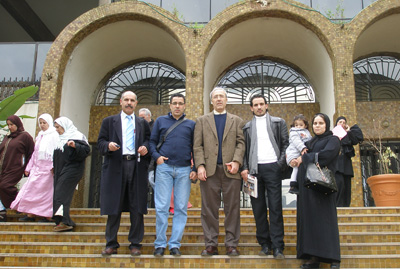
Although attacks on independent journalism in Morocco escalated in 2009, reinforcing concerns a CPJ delegation conveyed three years ago in Rabat to his predecessor, Nabil Benabdallah, and former Prime Minister Driss Jettou, Communication Minister Khalid Naciri strongly denied that Morocco under King Mohamed VI was turning its back on what he called the “democratic process.”
“It is a myth to claim that the democratic process is regressing,” Naciri told CPJ. “Press freedom is one of the cornerstones of our policy and we have absolutely no intention of wandering away from it. The enemies of press freedom in Morocco are those using their newspapers for commercial purposes and grossly violating ethics and turning critical journalism into systematic accusations and defamation.”
Naciri went so far as to allege that “red lines”—the unwritten rules on what kind of journalism is acceptable—have gradually vanished since Mohamed VI ascended to the throne in 1999 and “all issues, including the king’s private life and the country’s territorial integrity, are defiantly tackled on a daily basis by journalists determined to settles scores” in a country where “most of the 27 dailies have an editorial line opposed to the government.”
He did not sound convincing in response to findings by local and international groups, including CPJ, that the judiciary was politicized in order to imprison weekly Al-Mishaal’s editor Driss Chahtan for stories about the king’s health as well as close down his paper, the independent daily Akhbar el-Youm, and another weekly, Le Journal Hebdomadaire. He denied that the crippling damages imposed on three dailies found guilty of hurting the “dignity” of Libya’s Col. Qaddafi’s was politicized. Naciri said that “these are ordinary cases in a democratic country. There are more similar cases in other democracies.”
Naciri acknowledged, however, that 2009 was a “difficult year” for the press in Morocco. He argued that the “national dialogue” on “Media and Society” in early March initiated by different parliamentarian groups would improve the press freedom situation. The National Syndicate of the Moroccan Press (NSMP), the Moroccan Fedration of Newspapers Publishers (MFNP), the Ministry of Communication and local human rights groups have been invited to take part in this “national dialogue” behind closed doors. But many wonder how such hearings could spur hope among independent journalists when neither the NSMP nor MFNP have a reputation for protecting the country’s most critical journalists and their colleague Chahtan remains in prison.
The CPJ delegation informed Naciri, who said more than once that Morocco offered more room for freedom of expression than most countries in the region, that Egyptian journalists, for instance, were not jailed for writing in previous years far more critical stories about President Hosni Mubarak’s health and Qaddafi’s autocratic rule.
But it was the case of Le Journal Hebdomadaire, a leading government critic silenced earlier this year, and its former managing editor, Aboubakr Jamai, which spurred the most anger from Naciri. “Jamai thinks he is above the law and can get away with this by complaining to the U.S. State Department,” he said. He forgets that failure to pay taxes is one of the most unacceptable abuses in a democratic society.”
Unlike human rights lawyers and independent journalists, he argued that the case filed against Le Journal Hebdomadaire, allegedly for failing to pay social security and other debts, “was not politically motivated.” An independent journalist told CPJ on condition of anonymity that Naciri’s anger with Jamai “simply mirrored the angry reactions this highly competent, honest, and uncompromising journalist has been prompting for years among King Mohamed VI’s top advisers who enjoy more influence than any member of the government, including Prime Minister Abbas Fassi.”
Jamai and Ali Amar, co-founder and former editor of Le Journal Hebdomadaire and author of a banned book on Mohamed VI’s 10-year rule took refuge in neighboring Spain in the wake of what many call the “political assassination” of the country’s most critical newspaper launched in 1997 under King Hassan II. Both were fully aware that they would end up in jail in case the debts of their defunct paper were not paid. Their former colleague, cartoonist Khalid Gueddar, was prevented in February from traveling to Spain by Moroccan frontier police without any explanation, Gueddar told CPJ.
Naciri’s aides took us by surprise when they said Prime Minister Fassi was expecting to meet with us on February 18. “How could we go to such an important meeting without being informed by Moroccan authorities?” asked Abdel Dayem. When contacted on February 19 by CPJ, the prime minister’s office confirmed that it had awaited the CPJ delegation on Thursday, without explaining, however, why no information was conveyed to the members of the delegation or their colleagues in New York, especially in light of CPJ’s repeated requests to schedule such a meeting. Asking if we could reschedule the “missed meeting” for the coming days, we were told that it would be “extremely difficult; the prime minister has a very busy schedule.”
The request to meet with the prime minister was not the only one that went unrequited. Requests to meet with Morocco’s Minister of Justice and Speaker of Parliament also went unanswered, despite CPJ having submitted such meeting requests well over a month prior to its trip to Morocco.
Fassi never earned much of a reputation for caring about independent journalism or being in any particular hurry to implement a government promise made more than two years ago to submit to parliament a less restrictive draft press law. Twenty six articles of the country’s notorious 2002 Press Law call for prison penalties for journalistic activities deemed offensive.
Independent newspapers didn’t cover CPJ’s “missed meeting,” but they did cover the failure of authorities to officially authorize a meeting between journalists and our delegation. That meeting was slated to take place just hours after our meeting with the minister of communication. “Local authorities in Casablanca shattered to pieces Communication Minister Khalid Naciri’s allegation that it was a myth to claim that press freedom in Morocco was backsliding,” said Akhbar al-Youm al Maghrebia, which emerged from the ashes of the daily Akhbar al-Youm, closed down in September for publishing a cartoon concerning a “strictly private wedding ceremony organized by the royal family.”
Having been denied an opportunity to host a roundtable to discuss the state of press freedom in Morocco, we were forced to meet with our colleagues informally over a cup of tea to hear their concerns and to express our solidarity. The Ministry of Communication denied that CPJ was prevented from holding a meeting with our colleagues and strangely claimed that CPJ “didn’t bother to submit any application” to Moroccan authorities to authorize such a meeting. CPJ in fact submitted applications twice—on January 29 and on February 16.
Equally disappointing was the failure of officials at the Moroccan Embassy in Washington as well as officials in Rabat to secure a CPJ visit with imprisoned journalist Driss Chahtan. This despite multiple verbal and written requests from CPJ to the Moroccan Embassy, the Ministry of Justice, and the relevant prison authorities. A request for such a visit from Ahmed Herzenni, president of the government-appointed Advisory Council on Human Rights, to prison authorities following a positive meeting with CPJ’s Abdel Dayem, also failed to generate the permission necessary for the prison visit.