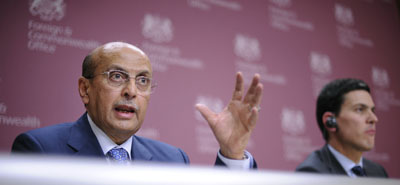
Ministers and officials representing some 20 Western and Arab governments and international financial institutions declared themselves “friends of Yemen” during last week’s closed-door meeting in London to address threats posed by Al-Qaeda in Yemen, according to news reports. Participants, including U.S. Secretary of State Hillary Rodham Clinton, offered assurances that the international community, in addition to providing military cooperation, would work with the Yemeni government to promote human rights and build democratic institutions. But skeptics fear this publicized “friendship” will also provide an opportunity for President Ali Abdullah Saleh to intensify his attacks on political dissent and independent journalism.
Saleh, who has earned a reputation as a master of political survival since coming to power in 1978, has used government offensives against the Shiite armed rebellion in northern Saada province and against peaceful unrest in the country’s south as cover to attack his critics. The abduction in September of journalist Muhammad al-Maqaleh and the ongoing detention of thousands of political prisoners give Yemeni journalists plenty of reason to fear for their safety under a regime seemingly determined to silence criticism.
The Yemeni Committee to Protect Freedom of Opinion and Expression (CPFEO) issued an alarming report in January documenting the detention of seven journalists, including Hisham Bashraheel, editor of the independent daily Al-Ayyam. Bashraheel’s arrest occurred on January 6 at his office in Aden. Two of Bashraheel’s sons also remain under arrest, according to CPFEO. The organization said it documented more than 140 press freedom violations in 2009, including death threats, assaults, smear campaigns against critical journalists, prosecutions in the new Press and
“My colleagues and I firmly believe that cracking down on the media and peaceful demonstrations serves the interests of Al-Qaeda,” Sami Ghaleb, editor of the independent weekly Al-Nida, told CPJ. Ghaleb appeared before the Press and
Critics say another recent case points to Saleh’s determination to abuse Western backing to intensify his war on freedom of expression. In January, journalist Anisa Mohammed Ali Othman was sentenced in absentia to three months in jail in connection with two 2007 commentaries examining alleged government corruption. Her work was deemed defamatory to Saleh. “The West and particularly the United States are all eyes on terrorism, while the government is taking advantage of this situation,” said Jamal Amer, a 2006 CPJ International Press Freedom Award winner and editor of the weekly Al-Wasat. He was taken to court for publishing Othman’s work. Amer told CPJ that the Information Ministry had banned his newspaper for five weeks in 2009 for “harming the country’s unity.”
Amer’s speech in accepting CPJ’s 2006 award has not lost a bit of timeliness. “In the Arab world, where I come from, rulers relinquish power only when there is a military coup or when they die. They consider a free and independent press to be their top enemy.”