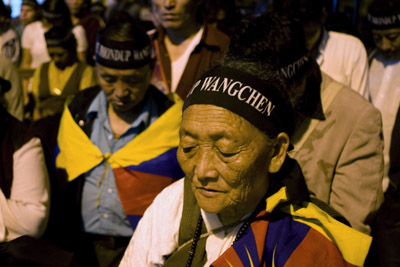
On the same day that historic protests started by monks in Lhasa began and were to sweep all over Tibet in the subsequent months, Dhondup Wangchen was nearly 3,000 kilometers away in Xian, in China’s Shaanxi province. It was the last day of filming for his documentary film project that sought to give voice to Tibetans in the run-up to the Olympic Games. As was the case throughout China, Xian was caught up in an Olympic fervor. Big red banners were hung all over the city, the Olympic mascots peered from shop windows in unspeakably bright colors. None of this however, seemed to have the slightest connection to Tibet or the discontent of the Tibetan people.
For many around the world, the protests that began March 10, 2008, were a surprise. International media were suddenly giving unprecedented coverage to a struggle that had been going on for more than 50 years. Journalists, NGOs, governments and even exiled Tibetans were given a stark reminder that a conflict was unresolved and that, in the run-up to the Olympics, Tibetans were still risking everything to be heard. It hadn’t take months of protests and a military crackdown in Tibet, however, for Dhondup Wangchen to be aware of the suffering of his people. It was something he had lived, and it was this that he was seeking to convey through film and simple testimony.
I had travelled 1,200 kilometers from Beijing to Xian to meet Dhondup Wangchen and learn about his film project. It was to be the first and only time that I would meet him. On arrival at the train station, I bought a local Chinese paper; I wanted to remember this day. Later on in the day, we even filmed Dhondup Wangchen with this newspaper as a record. Within minutes of our meeting, I was struck by his determination and drive to accomplish something that he felt was important–to depict the injustice of life as a Tibetan under Chinese rule. As one of his interviewees so eloquently said, “We Tibetans living in the PRC are like stars on a sunny day, we can’t be seen.” Just hearing the sheer scale of Dhondup Wangchen’s project was impressive, traveling through remote areas of eastern Tibet in the Tibetan winter of 2007-08 and recording under the harshest imaginable conditions the views of more than 100 ordinary Tibetan men and women, amassing more than 40 hours of video footage. All this with just a cheap video camera, no professional training in journalism or film-making, and constantly in fear of being detained for his citizen journalism activities.
Despite painful toothache that day in Xian, Dhondup Wangchen told me that he, together with his friend Jigme Gyatso, a monk, had come up with the idea to make a documentary as early as 2006. The year and a half before beginning filming, Dhondup Wangchen planned how he would make the film, even taking his parents, wife, and four children to India to safety so they would not be at risk when he returned to Tibet to make the film. Having a cousin in Switzerland meant that once the footage was safely out of the country, the documentary could be edited and prepared for an international release in time for the Olympic Games.
On August 6 2008, his documentary film, now edited into 25 minutes and titled “Leaving Fear Behind“, was screened to a select group of foreign journalists in Beijing. But Dhondup Wangchen, along with Jigme Gyatso, had already been in secret detention since the end of March. On completion of filming, they had gone back to their respective hometowns only to find the places in turmoil with almost daily Tibetan protests occurring and a huge military deployment under way. On Jigme Gyatso’s release in October 2008, it was learned that they had both undergone severe interrogations and torture in detention that included electrocution. It wasn’t until a well-known Beijing human rights lawyer took up his case early this year that Dhondup Wangchen’s sister in Xining even learned of her brother’s incarceration, another outright violation of China’s own detention laws.
Dhondup Wangchen’s trial reportedly started behind closed doors in September this year. According to Amnesty International he is being charged for “subversion and incitement to separatism” and has contracted Hepatitis B in prison for which he has received no treatment. After his Beijing lawyer was forced by the Chinese government to stop representing Dhondup Wangchen, local lawyers were appointed, leaving little hope of a fair trial.
I spent less than a day meeting Dhondup Wangchen. When we parted back at the train station, he told me to take care of myself and gave me a little bag containing some drinks and snacks for my journey. A few months ago on YouTube, I saw a video clip of pictures of Dhondup Wangchen in his teens, a casual-looking young man eager to leave behind the constrictions of his village on a quest for adventure greater than he could have known. The Dhondup Wangchen that I had met was older and thoughtful. The many months of constant traveling had clearly been physically exhausting. I had always thought of him as a kind of Tibetan hero, a citizen journalist and human rights activist but last month I was walking down the street in Dharamsala, northern India, with a friend who stopped to talk to the woman who sells bread there early every morning. The bread-seller was Dhondup Wangchen’s wife, Lhamo Tso. After spending time talking with her I suddenly thought about their separated family and of Dhondup Wangchen as a husband, a father, and also a son–and their own personal sacrifices.
Since August 2008, “Leaving Fear Behind” has been screened in more than 30 countries worldwide and translated into five languages, including Chinese. The worldwide campaign for his release continues. Looking back, it’s hard to believe that Dhondup Wangchen, with just a small camera, a motorbike, his blue backpack and the help of trusted friends, found a way of expressing himself truthfully.
The simple truth is that just spending 25 minutes watching “Leaving Fear Behind” gives all the background necessary to see that some kind of uprising was surely inevitable in Tibet. But truthfulness in a state like China is always an act of defiance and can’t survive without a struggle.
Dechen Pemba has been the spokesperson for “Leaving Fear Behind” since she left Beijing in July 2008. She is based in London.