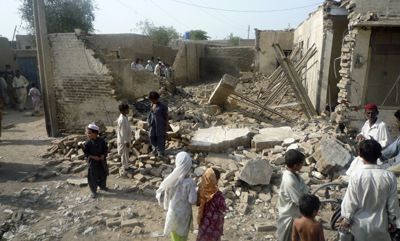

Local reporters like those in Federally Administered Tribal Areas, Swat, and Mingora are crucial to accurate, fully formed news coverage. Their importance was evident in August, when reports began to emerge that prominent Taliban leader Baitullah Mehsud had been killed by a U.S.-launched missile apparently fired from an unmanned drone over South Waziristan in the Federally Administered Tribal Areas, or FATA. As Reuters noted in the middle of the dispute, “independent verification of the claims and counter-claims is extremely difficult as the Mehsud lands where the U.S. missile struck the house of Baitullah’s father-in-law are remote and inaccessible.” It was up to local reporters to get the information firsthand. Eventually they did, confirming Baitullah Mehsud’s death.
A similar missile strike was the focus of Hayatullah Khan’s last assignment in North Waziristan. Khan, a freelance journalist well known in the region, had filed photos and a story showing a U.S.-made Hellfire missile had struck a home in the town of Miran Shah, killing senior al-Qaeda figure Hamza Rabia. The story, which appeared in the widely read Urdu-language daily Ausaf, and the pictures, distributed by the European Pressphoto Agency, contradicted the Pakistani government’s official explanation that Rabia had died in a blast caused by explosives located inside the house—the same sort of questions that surrounded the death of Baitullah Mehsud.
The next day, December 5, 2005, five gunmen forced Khan’s car off the road, abducting the journalist as his younger brother Haseenullah watched helplessly. For six months rumors swirled about who had taken Khan before the phone rang at his family’s home at 4:40 p.m. on June 16, 2006. A Pakistani intelligence officer identifying himself only as Maj. Kamal said Khan’s body had been dumped in Miran Shah’s marketplace. With that, the officer said, his responsibility to the family had ended. The corpse was thin and dirty, in the same clothes Khan had been wearing when he was abducted.
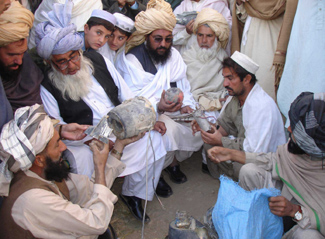
For the shaky Musharraf government, admitting in late 2005 that the United States could impinge on Pakistan’s territory was a political embarrassment. The last thing the embattled Musharraf needed was an enterprising local reporter offering photographic evidence that contradicted the government’s sanitized version of events. Worse, the photographs made their way around the world undercutting Musharraf’s international credibility, particularly in the Islamic world.
Khan’s death reverberated far beyond FATA, and remains an issue in Pakistan three years later. When I was in Pakistan in July, several journalists raised the case and its implications. “As far as reporting from the tribal areas, I don’t think much has changed,” said Muhammad Arshad Sharif, Dawn TV’s defense and foreign affairs correspondent. “As for the border areas, it’s still the military and secret intelligence agencies that call the shots.”
At the time of Khan’s abduction and murder, the Musharraf government had been conducting a running battle with Pakistan’s vibrant and increasingly defiant media. Some journalists openly accused the government of being complicit in his death. Sailab Mehsud, then president of the Tribal Union of Journalists, was blunt when he spoke with CPJ at the time: “We know that the government had a hand in this. A message has been sent that we should stop doing our work. For us, the post-Hayat period will only be more dangerous.”
Mehsud was right about future risks. Since Hayatullah Khan’s death, at least 13 more Pakistani journalists have been killed on duty, five of them murdered. None of the murder cases have been investigated to any significant degree. CPJ places Pakistan 12th on its Impunity Index, which ranks countries in which journalists are slain regularly and governments fail to solve the crimes.
Under international pressure, Musharraf agreed to have Khan’s death investigated by Peshawar High Court Judge Mohammed Reza Khan (no relation to Hayatullah). North West Frontier Province Gov. Ali Mohammad Orakzai set up three commissions of inquiry of his own. But while Judge Khan submitted his report in August 2006, the results have never been made public. Neither have the findings of any of the Orakzai commissions.
Musharraf and his successor, Asif Ali Zardari, refused to release the reports despite repeated calls from Pakistani journalists and the international media rights community. The government has yet to respond to CPJ’s most recent written request, made in September.
Journalists have long been under attack in Pakistan, no matter who is at the head of the government, and Khan’s death could simply become another milestone on a long road of unexplained deaths. In Khan’s case, though, investigative reports are stashed away in the government’s records. Making those reports public would be a small step in the direction of reversing years of impunity at a time when the government says it is starting the nation down a new path.
The series:
Part 1: During an all-out military offensive, local reporters faced grave risks. Some literally lost their homes.
Part 2: Dozens of journalists flee the Swat Valley and nearby areas, leaving independent local coverage scant.
Part 3: Coverage of the fighting was left in large part to Pakistani reporters from outside the region who had embedded with the military.
Part 4 Hayatullah Khan was murdered in 2006 in the Federally Administered Tribal Areas. The government investigated—and then kept its reports secret.
Part 5: Government, media can undertake reforms to improve security.