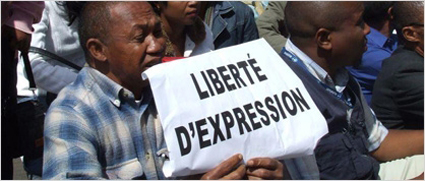
Friday’s protest, which began around 10 a.m. and lasted for two hours, began in front of the Communications Ministry, and ended at the Justice Ministry, according to photojournalist Kelly Randriamampianina. Protestors, some covering their face with gags in a show of protest, waved signs reading “No to arrests of journalists,” “Press freedom,” “Threats against journalists: no! no! no!” among others.


The protestors were showing solidarity for Ramanatsoavina, a presenter held in Antananarivo’s Antanimora Prison on charges of “incitement to rebellion” and “civil disobedience,” according to defense lawyer Fidele Rakotondrainibe. The journalist, who denies the charges, is expected to appear in court for sentencing on Wednesday.
As the bitter power struggle between military-backed leader Andry Rajoelina and rival Ravalomanana deepened this year, local Malagasy media deeply split along partisan loyalties, according to CPJ research. The two politicians turned the broadcast stations they own into outlets for propaganda and hostile rhetoric toward their rival.
In this deadly tit-for-tat media war, both men have taken turns silencing their rival’s outlets. While in power, the administration of former president Ravalomanana banned and raided Rajoelina’s broadcaster, Viva, on grounds that the station “incited civil disobedience”–prompting Rajoelina’s supporters to burn down two stations controlled by Ravalomanana.
The tables turned in March, with Ravalomanana’s ouster in a military takeover that brought Rajoelina to power. Since then, Rajoelina’s administration, the High Transitional Authority, banned Ravalomanana’s Radio Mada and jailed Ramanatsoavina on similarly vague accusations. This month, Communications Minister Gilbert Raharizatovo said Radio Mada was broadcasting illegally and accused the station of “inciting [the public] to civil war,” according to the private daily Madagascar Tribune. Déjà vu?