Congolese governor urged to ensure journalist’s safety
Dear Governor Kahongya: We are concerned about the safety of journalist Tuver Wundi Muhindo following an armed attack on his home in the North Kivu capital of Goma on April 12. The incident followed the 2007 murder of Goma photojournalist Patrick Kikuku Wilingula, which is still unsolved. We call on you to use your influence to ensure authorities conduct a thorough and transparent investigation and bring the perpetrators to justice.
World leaders note Sri Lankan press abuses
Sri Lanka got special mention in the statements of world leaders marking World Press Freedom Day, May 3. It’s not surprising. The government in Colombo has coupled an all-out effort to end its war with the separatist Liberation Tigers of Tamil Eelam with an assault on critics in the Sri Lankan media. U.S. President Barack…
Life and liberty: Press freedom’s fight on two fronts
The leading indicators of press freedom–journalists killed and journalists jailed for their work–have headed in the wrong direction for much of this decade, CPJ Executive Director Joel Simon said during a Capitol Hill conference on press security hosted by the National Endowment for Democracy, the Center for International Media Assistance, and the Congressional Press Freedom…
In Oakland, progress in Bailey murder prosecution
The murderers of journalists around the globe presume they won’t get caught. Unfortunately, they’re often right: Only one case in 10 results in any convictions; just one in 20 results in convictions of those who ordered the murder. For more than a year it seemed like the August 2007 slaying of U.S. journalist Chauncey Bailey,…
Mexico should federalize crimes against free expression
New York, April 6, 2009–The Mexican Congress must move expeditiously to approve a constitutional reform granting federal authorities jurisdiction over crimes against free expression, the Committee to Protect Journalists said today. The lower house, the Chamber of Deputies, approved a measure last week imposing penalties for crimes against “journalistic activity,” an encouraging but still preliminary…
Sri Lanka on State Department’s radar
The dire situation for journalists in Sri Lanka who have fallen out of favor with the government has not gone unnoticed at the U.S. State Department. On March 23, Secretary of State Hillary Clinton sent a letter to Senator Robert Casey, who chaired the Senate Foreign Affairs subcommittee hearing on Sri Lanka on February 24.…
Corrupt Russian police are a ‘dark force’ against press
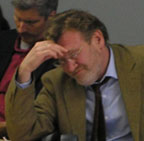
Leonid Nikitinsky has a dry sense of humor. “Unless you are killed in a very interesting way, don’t come and see me,” he told an audience at CPJ’s offices on Thursday. There are, after all, too many murders for him to cover, said Nikitinsky, right, a court reporter for Russia’s Novaya Gazeta.
Newseum honors fallen colleagues
After each name was read aloud, the ring of a bell resonated through the studio auditorium that included many relatives, friends, and colleagues of the journalists whose names were being added to the Newseum Journalists Memorial. Some, like Tom Borrelli of The Buffalo News, died unexpectedly; Borrelli fell while climbing steep stairs on his way…