French press delegation assaulted outside home of beleaguered Tunisian journalist
Click here to read more about press freedom conditions in TUNISIA. New York, April 26, 2000 — Tunisian police assaulted a group of French press freedom advocates and journalists today when they attempted to visit Tunisian journalist Taoufik Ben Brik, who was in the 24th day of a hunger strike to protest two years of…
Journalist Enters 19th Day of Hunger Strike
Click here to read more about press freedom conditions in TUNISIA. Click here to read CPJ and Human Rights Watch’s recent joint protest letter to President Ben Ali: New York, April 21, 2000—Tunisian journalist Taoufik Ben Brik today entered the 19th day of a hunger strike launched on April 3 to protest the Tunisian government’s…
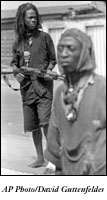
Attacks on the Press 1999: The Trauma of Sierra Leone
Introduction On January 6, 1999, rebel forces entered Freetown and launched a campaign of terror. Revolutionary United Front (RUF) fighters systematically murdered, mutilated, and raped thousands of civilians. During the three weeks that it took for Nigerian-led West African peacekeeping troops to expel the rebels from Freetown, Sierra Leone officially became the most dangerous country…
Attacks on the Press 1999: Croatia
Croatia’s new center-left ruling coalition, elected in parliamentary polls on January 3, 2000, has pledged to improve the country’s dismal press freedom and civil- rights record after a decade of abuses by the nationalist Croatian Democratic Union (HDZ). The newly elected government and president, the latter to be chosen in a runoff presidential poll on…
Attacks on the Press 1999: Democratic Republic of Congo
The civil war that began as a rebel insurgency in August 1998 continued to destabilize the entire region, with Angola, Zimbabwe, and Namibia supporting President Laurent-Désiré Kabila’s government and Rwanda and Uganda fighting on the side of Congolese rebel forces. From the beginning, President Kabila has tended to blame his military setbacks on the local…
Attacks on the Press 1999: India
India’s extraordinary diversity is often seen as its greatest strength, but religious, ethnic, and regional conflicts regularly pose significant challenges to the country’s democracy, and to its press. While the Indian press remains one of the most pluralistic and vibrant in the world, journalists are still vulnerable to attack. And under the leadership of the…
Attacks on the Press 1999: Pakistan
Former Prime Minister Muhammad Nawaz Sharif’s efforts to muzzle the press, and bring the legislative, judicial, and executive branches of government under his personal control, earned him the reputation of a tyrant and badly discredited Pakistan’s democracy. His slide toward authoritarianism ended abruptly with a bloodless coup on October 12, in which army chief Gen.…
Attacks on the Press 1999: Peru
President Alberto K. Fujimori continued his efforts to suppress critical reporting in a year that ended with the long-anticipated announcement that he would seek a third five-year term, a move widely considered unconstitutional. The Fujimori government’s systematic campaign to discredit Peru’s independent press earned him a place on CPJ’s list of the top 10 enemies…
Attacks on the Press 1999: Romania
Political shakeouts and instability once again plagued Romania, complicating its hopes for admission to the European Union (EU). In December, President Emil Constantinescu effectively ousted Prime Minister Radu Vasile from the government and replaced his entire cabinet. Often blamed for the country’s continuing economic decline, Vasile was also evicted from the ruling Christian Democratic National…
Attacks on the Press 1999: Tunisia
In a year that saw strongman Zine al-Abidine Ben Ali reelected in October with 99.42 percent of the vote, the press remained in the stranglehold of the Tunisian police state. For the second year in a row, CPJ named President Ben Ali one of the world’s top 10 enemies of the press. Since ousting “president…