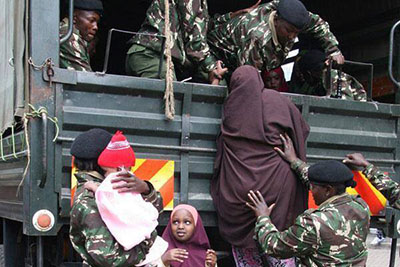
Kenya must consider plight of refugee journalists
Today, CPJ partnered with Reporters Without Borders and Rory Peck Trust in a joint open letter calling on Kenya’s Cabinet Secretary of Interior, Joseph Ole Lenku, to provide clarity on the government’s refugee policy and to exempt journalists from forced relocation to the refugee camps. On March 25, Lenku ordered all urban refugees to relocate…
Press freedom at low as Azerbaijan takes Council of Europe chairmanship
On Wednesday, Azerbaijan will assume chairmanship of the Council of Europe Committee of Ministers. The chairmanship process is automatic; the position is rotated every six months among all of the council’s members, in alphabetical order. But Azerbaijan’s chairmanship has proven more problematic than most, as it comes at a time when the country’s fulfillment of…
Little progress on journalist safety despite more attention
Late in 2013, the United Nations General Assembly adopted resolution 68/163 on the Safety of Journalists and the Issue of Impunity, in an effort to stem the killings of journalists and ensure that perpetrators of deadly violence against journalists are brought to justice. The resolution was a recognition that it has never been a more…
Ilham Tohti’s daughter fights for his freedom
At first glance, 19-year-old Jewher Ilham may seem like a typical college student. As she clutched her smart phone, the face of a cat imprinted on the cover peered through her fingers. She spoke in short sentences with little pause. Her thoughts pulled her in various directions as she spoke about her love for dance,…
Am I a traitor?
EDITOR’S NOTE: Hamid Mir, the executive editor of Pakistan’s Geo Television, survived an April 19 assassination attempt, but was badly injured. The shooting came a few weeks after the Pakistani government pledged in a meeting with CPJ to address the insecurity plaguing the country’s journalists. Shortly after the attack, some Pakistani media stated that CPJ…

Rousseff to CPJ: ‘Brazil committed to fighting impunity’
“The federal government is fully committed to continue fighting against impunity in cases of killed journalists,” Brazilian President Dilma Rousseff told a CPJ delegation during a meeting on Tuesday in Brasilia, the country’s political capital. Accepting that deadly violence against the media is a detriment to freedom of the press, Rousseff said her administration will…
Tom Lowenthal joins CPJ as first staff technologist
Journalism is increasingly mediated by the same digital tools to which we entrust the rest of our lives. In keeping with CPJ’s mission to enable and protect journalists wherever they find themselves under threat, we are pleased to announce the hire of Tom Lowenthal, our first staff technologist.

SABC betrays South Africa’s young democracy
This week, South Africans go to the polls for their fifth democratic elections since 1994, but despite constitutional guarantees of media freedom, the vast majority of South Africans who vote will do so informed only by the positive news and information carried by a public broadcaster widely criticized for its partiality to the ruling party.

Obama transparency record remains unimpressive
Nearly seven months ago, CPJ published its first in-depth report on press freedom in the United States, concluding that the Obama administration’s aggressive prosecution of leakers of classified information, broad surveillance programs, and moves to stem the routine disclosure of information to the press meant that the president had fallen far short of his campaign…
A message from son of Vietnam blogger Nguyen Van Hai
In preparation for today’s Congressional Briefing on Media Freedom in Vietnam, organized by members of the U.S. House of Representatives and featuring a panel of Vietnamese bloggers and others, CPJ has been in close contact with the family of Nguyen Van Hai, a blogger who has been in jail since 2008. We have also met…