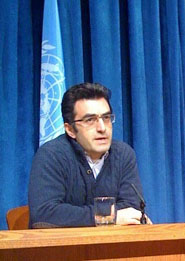
At U.N, Bahari and CPJ urge global attention
Newsweek journalist Maziar Bahari helped us launch Attacks on the Press at the United Nations in New York today. Bahari, an Iranian-Canadian citizen, was labeled an enemy of the Iranian regime and cruelly imprisoned for 118 days last year in Tehran. His very presence today, CPJ Deputy Director Robert Mahoney noted, was testament to the…

CPJ support helps an injured Haitian reporter
His collarbone severely fractured in the January 12 earthquake, Haitian journalist Yves Adler Boissonniere needed considerable medical attention—care that he could not get in his devastated country. With US$40 and a few gourdes (Haiti’s currency) in his pocket, Boissonniere decided in late January to cross the border to the Dominican Republic in hopes of getting…
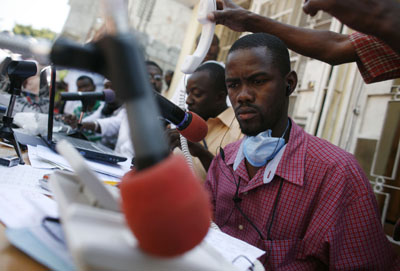
Provisional media death toll rising in Haiti
A month after the January 12 earthquake, the death toll for journalists has risen to 26, with two others injured, according to a new provisional tally released by media groups in Haiti. Under the umbrella of International Media Support, a joint mission of press groups (including the Association of Haitian Journalists, SOS Journalistes, and the…

‘Suddenly,’ Chávez is on the radio (yet again)
Venezuelan President Hugo Chávez Frías has used cadenas—nationwide radio and television addresses that preempt programming on all stations—to challenge the private media’s news coverage and amplify the government’s voice. In his radio and TV call-in program, “Aló, Presidente” (Hello, President), Chávez often lambastes critics in the media and the political opposition.
Mexican journalist said things ‘very hard’ just before murder
Over the weekend I spent several hours with two prominent journalists in Chilpancingo, Mexico, wondering who murdered their colleague Jorge Ochoa Martínez on January 29, and hearing about some of the seemingly unbearable pressures on Mexican journalists. Ochoa was shot in the face as he was leaving a birthday party for a local politician in…
Newspapers cut staff and are unable to print in Haiti
The two Haitian dailies, Le Nouvelliste and Le Matin, are still coping with the devastating effects of the January earthquake. Though these outlets continue to disseminate news via the Internet, it will take them some time to resume publishing in print.

Internews provides critical news to use in Haiti
Every evening, between 9 and 10 p.m., people in areas affected by the January 12 earthquake listen to the program “Nouvel pou nou Konnen” (News to Know). Huddled in tents or sitting in the open air, men and women cling to their transistor radios to get news on the latest decisions of the Haitian government…

Tomás Eloy Martínez, passionate press freedom advocate
Argentine writer and journalist Tomás Eloy Martínez, who died on Monday after a long battle with cancer, was ranked among Latin America’s most prominent intellectuals. Best known for his novels about former President Juan Domingo Perón and his wife Eva, Martínez cared deeply about press freedom and was a passionate advocate who helped scores of Argentine…

Radio Metropole: A station in Haiti running out of steam
Radio Metropole’s journalists, coping in a tent set up in the garden of the radio station’s office in Port-au-Prince, have not still resumed their normal pace of work because of the trauma caused by the January 12 earthquake. The station resumed its normal programming on February 1, after broadcasting news via the Internet for two…
Journalist Marcus Garcia pushes onward in Haiti’s chaos
Amid Haiti’s chaos, Marcus Garcia struggles every day to fulfill his duty as journalist. He said he routinely goes up and down the streets of Port-au-Prince in search of fuel for his car. When talking on the phone, the tone of his voice indicates the difficulties he encounters as a journalist willing to keep doing…