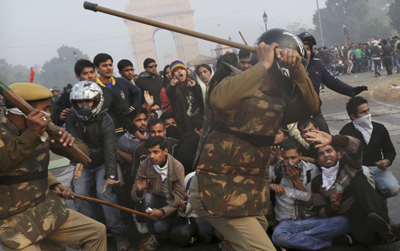
Amid deadly demonstrations, focus on India police
For the safety of journalists and other people on the streets protesting injustice, Indian police must begin in earnest to address how they respond to demonstrations. One journalist died covering protests that have been taking place across the country following the gang rape of a 23-year old female medical student on a Delhi bus on…
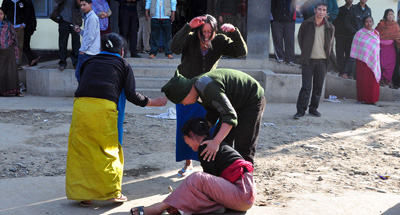
In India, police shoot dead journalist covering protest
New York, December 24, 2012–Indian authorities must immediately investigate the death of a cameraman who was fatally shot by police on Sunday while covering protests against the sexual assault of women. The Associated Press identified the journalist as Dwijamani Singh, a reporter for the news division of the satellite-distributed Prime News channel that covers northeast…
Journalists attacked, media offices vandalized in Nepal
Assailants stormed the premises of Nepal Republic Media, a media company in the capital, Kathmandu, on December 20, 2012, attacking journalists and vandalizing the offices, according to news reports. Police arrested several of the attackers, who have identified themselves as members and supporters of the rightwing Shiv Sena Nepal party.
Editor, publisher charged with sedition in Bangladesh
New York, December 19, 2012–CPJ is deeply concerned by sedition charges leveled against Mahmudur Rahman, the acting editor and majority owner of the Bengali-language pro-opposition daily Amar Desh and the paper’s publisher, Alhaj Hasmat Ali. The two were charged after publishing news stories based on leaked transcripts of conversations between a lawyer and the lead…
Indian government should repeal sedition law
Dear Prime Minister Singh: The Committee to Protect Journalists is deeply concerned by Indian authorities’ continued abuse of a colonial-era sedition law to stifle freedom of expression. CPJ calls on your government to begin taking action toward repealing the law, section 124A in the Indian penal code, which Indian lawmakers have deemed punitive and outdated.
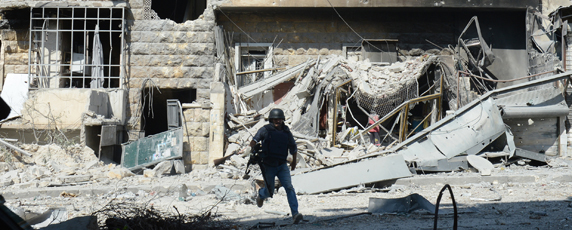

Combat deaths at a high, risks shift for journalists
Murder is the leading cause of work-related deaths among journalists worldwide–and this year was no exception. But the death toll in 2012 continued a recent shift in the nature of journalist fatalities worldwide. More journalists were killed in combat situations in 2012 than in any year since 1992, when CPJ began keeping detailed records.

Journalists still murdered where impunity reigns
Almost half of the 67 journalists killed worldwide in 2012 were targeted and murdered for their work, research by the Committee to Protect Journalists shows. The vast majority covered politics. Many also reported on war, human rights, and crime. In almost half of these cases, political groups are the suspected source of fire. There has…