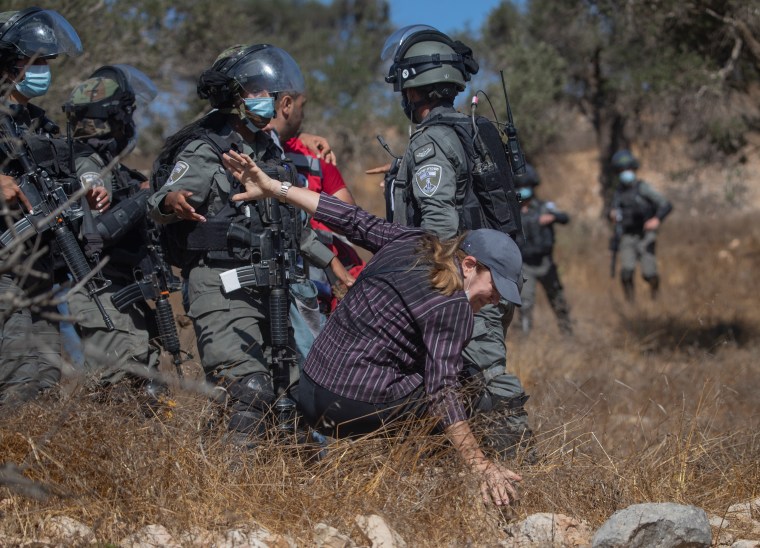
Israeli authorities barred from entering or deported at least 10 foreign journalists in Israel and the occupied West Bank in October 2026, marking the highest monthly total since the Committee to Protect Journalists began tracking such incidents in July 2025.
By comparison, CPJ documented six such incidents from January to September 2026, and three between July and December 2025.
At least four journalists were questioned about their views on Israel and the Israeli military’s actions in Gaza. Two were given vague explanations for the restrictions imposed on them, while the others received no explanation at all.
The restrictions coincided with the month of Israel’s general election, and continued military and settler violence against Palestinian and foreign journalists, particularly in the occupied West Bank during the olive harvest season including arrests and beatings.
This comes as Israel continues to block foreign journalists from entering Gaza, except on highly controlled embeds with the Israeli military, leaving Palestinian reporters inside the territory to bear the burden of on-the-ground reporting.
Entry denied
Portuguese journalist Ricardo Esteves Ribeiro was detained by Israeli authorities on October 8 while reporting on the olive harvest in the West Bank. Ribeiro, a journalist for the independent investigative podcast Fumaça, told CPJ that he was questioned by Israeli authorities over his journalistic work and social media posts, which officials alleged displayed support for “terrorist organizations.”
According to Ribeiro, he told authorities, “you are detaining a journalist doing their work in the field,” to which they replied they did not care.
He was then deported to Portugal.
Spanish journalist Francesca Cicardi, from the Spanish daily elDiario.es, had her Electronic Travel Authorization (ETA-IL) — a pre-check document for travelers from visa-exempt countries — to Israel revoked on October 19, less than 24 hours before her planned trip to cover the elections and six days after it was initially approved.
“I have contacted the [Israeli Immigration Authority] several times and they refused to offer an explanation, except that my visa was revoked ‘due to a recommendation’, I don’t know from whom,” she told CPJ.
Cicardi had previously traveled to Israel and the occupied Palestinian territory on assignment, and has published reporting critical of Israel’s human rights record.
“In elDiario.es we use the word ‘genocide’ since 2024 and I’ve been to Israel in 2024 and 2025 without facing any troubles,” she said. “Me and other colleagues have reported on human rights violations, and crimes committed by Israel against Palestinians. We have also given voice to Israelis.”
French journalist Sylvain Mercadier, from the progressive outlet l’Humanite, and Italian journalist Martina Stefanoni of Radio Popolare both had their entry permits revoked ahead of the October 27 election, without any explanation. German-Italian Serena Bilanceri, who was set to be the Israel correspondent for German daily Die Tageszeitung, had her work visa denied over two opinion pieces calling for sanctions against settler violence.
In the West Bank, Israeli authorities banned Russian-Israeli journalist Andrey Khraznovsky, known professionally as Andrey X, and American journalist Jasper Nathaniel from the occupied territory for two months after they were attacked by settlers and charged with assault, along with five other offenses.
According to Ribeiro, these practices are intended to prevent international journalists and other international participants from reporting on violations.
“Removing international observers helped enable further violence by soldiers and settlers against Palestinians,” he said.
Seasonal attacks
These incidents are especially pervasive in the occupied West Bank in October and November, during the olive harvest season.
CPJ documented at least 27 instances that affected at least 38 journalists in October 2026 during which they were arrested, wounded or hindered from doing their job in Israel and the occupied Palestinian territory. This includes at least seven settler attacks and obstructions, eight detentions by the Israeli army, and four journalists wounded by the Israel Defense Forces.
The Israeli military also obstructed journalists on six occasions, and the Israeli police detained one journalist in Jerusalem.
On October 16, 2026, The Washington Post contributor Heidi Levine was wounded by Israeli settlers when they attacked a Palestinian olive harvest she was covering. Her incident came 10 days after Agence France-Presse photographer Jaafar Ashtiyeh was also severely wounded by settlers.
In Hebron, the Israeli military’s days-long operation led to several violations against the press, including one where Al-Ghad TV’s office was raided by soldiers and allegedly used as a military barracks.
Journalists also had to deal with tear gas and laser pointing, and Al Jazeera reporter Louay Amro was wounded when a rubber bullet struck his hand.
On October 18freelance journalist Ahmad al-Safadi was briefly detained by Israeli police in Jerusalem and said he was beaten in detention before the police extended his ban from Al-Aqsa mosque for another six months.
“CPJ is deeply alarmed by Israeli authorities increasingly targeting journalists whose reporting challenges its actions and policies,” said CPJ Regional Director Sara Qudah. “From blocking foreign reporters from entering the country, to attacks, arrests, and intimidation in the occupied West Bank, these restrictions are part of a wider assault on press freedom. With foreign journalists still barred from independent access to Gaza, the international community must not allow Israel to silence independent reporting or prevent the world from witnessing what is happening to Palestinians.”