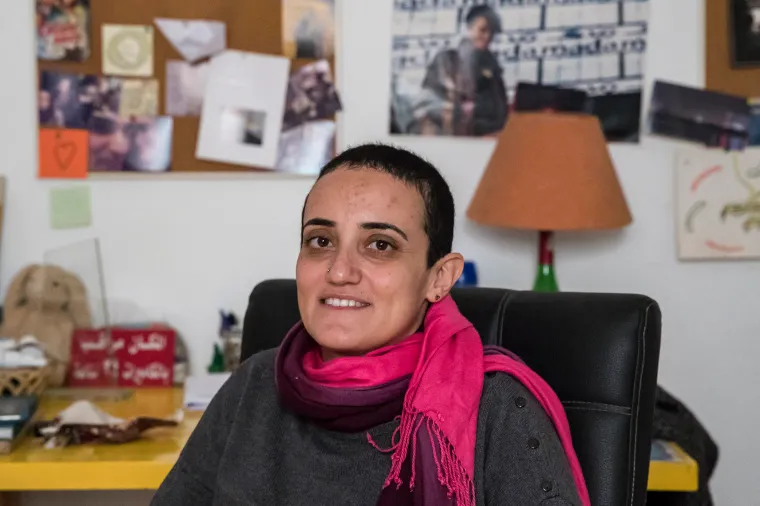
The referral of independent outlet Mada Masr’s editor-in-chief Lina Attalah to trial, alongside the recent detention of an entire newsroom and the targeting of independent journalists, signals an escalating campaign to silence Egypt’s remaining independent media.
In the space of a single month, Egyptian authorities detained all six journalists at the investigative and fact-checking platform Matsadaash, referred Attalah to trial over Mada Masr’s reporting, and summoned independent journalist Rasha Azab for questioning over her social media posts. Together, the cases reveal a widening assault on the people, practices, and institutions that make independent journalism possible.
“We have always worked in difficult conditions, but I have never been as worried about the future of journalism as I am now,” Nora Younis, editor-in-chief of the Cairo-based independent outlet Al-Manassa, told CPJ. “Independent journalism in Egypt has moved from facing restrictions and threats to facing an existential danger.”
The intensified crackdown began in late September, when security forces arrested the Matsadaash journalists. For days they were held in secret locations, with authorities withholding their whereabouts from both their families and their lawyers. After five days, they appeared before the Supreme State Security Prosecution, where they detailed alleged abuses, including being beaten and electrocuted which they described as torture, and said they had been forced to record fabricated confessions.
Within weeks, prosecutors also summoned Azab and Attalah. Azab was questioned over her tweets, while Attalah was questioned about a recent Mada Masr report on a wave of protests in prisons across the country. Both were released on bail, but Attalah was referred to trial.
Azab, who described the recent crackdown as unprecedented and systematic, said “its timing is no accident.” According to her, the arrests are clearing the ground for major political decisions that authorities want made without independent journalists asking questions — including who will succeed Egyptian President Abdel Fattah el-Sisi after 2030, and whether Egypt will join Saudi Arabia’s war against the Houthi rebels in Yemen.
“The authorities are using Matsadaash, Attalah and Azab as a message to frighten Egypt’s entire journalism community,” she told CPJ.
“Egyptian authorities are moving on multiple fronts to dismantle independent journalism: detaining an entire newsroom, putting one of the country’s most prominent independent journalists, Lina Attalah, on trial, and intimidating journalists who dare to hold power to account. The message is clear: no journalist is safe,” said CPJ Regional Director Sara Qudah. This is a coordinated assault on the press, with 25 journalists behind bars, the highest number since 2021, the question is no longer whether Egypt’s independent press is under attack, but who’s next?”
Egypt’s Public Prosecutor’s Office did not respond to CPJ’s emailed requests for comment on the recent arrests and summonses, the journalists’ allegations of mistreatment or the legal basis for referring Attalah to trial.
Journalism on trial
On October 7, prosecutors extended the detention of the Matsadaash journalists by 15 days, and issued a public statement saying the journalists face charges of joining and funding terrorism, spreading false news, and receiving monthly funding in foreign currency through bank transfers.
The statement made plain that the case rests on journalism itself. They accused the six journalists of “highlighting shortcomings in state institutions to the exclusion of all else, downplaying the roles and performance of their officials, escalating sectoral grievances, highlighting and exaggerating obstacles related to the country’s internal affairs, publishing negative coverage of various sectors and highlighting officials’ failures in dealing with them.”
In other words, the prosecution took the core work of accountability journalism, scrutinizing the state, giving voice to people’s grievances and exposing official failure, and recast it as evidence in a terrorism case.
Though Egypt’s constitution explicitly prohibits prison sentences for publication offenses, authorities bypassed this protection by using the 2015 Anti-Terrorism Law, and holding the six journalists for days under an exceptional provision reserved for imminent terrorist threats.
When prosecutors finally questioned the journalists, they asked about their journalism, their past employers and Matsadaash’s editorial policy, but did not accuse them of publishing any false or fabricated stories, their lawyers said.
The statement also cited “periodic transfers in foreign currency” from a company registered abroad.
“This is an empty accusation. There is nothing incriminating about our journalists working for an organization whose funding is well known and publicly disclosed, and was never hidden from the authorities in Egypt,” Abdelrahman Mansour, co-founder of Matsadaash, told CPJ.
According to the Egyptian Initiative for Personal Rights, whose lawyers represent the journalists, the company that owns Matsadaash contracted its Egypt-based staff years ago, submitted copies to the Egyptian banks, and received their monthly salaries for years without issue, a fact the prosecution itself acknowledged.
State-controlled media amplified the narrative of foreign influence, with talk show host Ahmed Moussa claiming on the pro-government channel Sada El-Balad that the platform had received more than US$3 million from international donors. Fact-check outlet Tafnied revealed that the figure represented the total seven-year revenue of the platform’s parent U.S. nonprofit, not money sent to the Egyptian platform. The same donors, Tafnied found, have also funded Egyptian state universities and an NGO that works on state-backed initiatives, and one of them has an 11-project cooperation portfolio with Egypt’s Ministry of Planning.
Pro-government commentator and former parliament member Abdel Rahim Ali portrayed the open-source investigation tools that Matsadaash uses as espionage on pro-government television. He singled out widely-used services such as the ship tracker MarineTraffic and the flight tracker Flightradar24, accusing their use of passing information to Israel’s Mossad spy agency.
The licensing trap
Shortly after Mada Masr joined other Egyptian and regional outlets in standing in solidarity with Matsadaash, its editor-in-chief, Lina Attalah, was referred to trial on charges of establishing and managing a website without a license. Under Article 105 of the media law, a conviction carries a fine of 1 million to 3 million Egyptian pounds (US$19,600 to 58,800), and the court can order Mada Masr closed and its equipment confiscated.
Mada Masr has applied for a license from the Supreme Media Regulatory Council twice since the media law was enacted in 2018, but received no response. In 2022, the outlet learned of the council’s rejection when Attalah was questioned in a separate case on the same charge she now faces. A lawsuit challenging the council’s failure to notify the outlet was rejected in 2023.
“Unfortunately, the charge of running a website without a license is a sword hanging over the neck of every independent platform in Egypt. None of us has been granted a license,” said Mohamed Salah, publisher of Fakar Tany, an independent Egyptian outlet whose own license application was rejected and whose appeal has gone unanswered. “It could be used against Fakar Tany, against Al-Manassa and against dozens of other websites. The rejection decision sits in an office drawer and comes out at the prosecution the moment it is needed to prove the charge.”
Targeting the syndicate and its supporters
The Egyptian Journalists Syndicate and its head, Khaled El-Balshy, faced attacks after calling on the prosecutor general to investigate the journalists’ allegations of torture. The Interior Ministry denied the allegations in a statement, dismissing them as claims “echoed” by the syndicate and by social media pages it tied to the Muslim Brotherhood, an outlawed political group which Egypt designates as a terrorist group.
Separate investigations by the fact-checking platforms Saheeh Masr and Tafnied found signs of a coordinated online campaign against the syndicate. Saheeh Masr found that hashtags accusing the syndicate of supporting terrorism appeared on X within an hour of the ministry’s statement, reaching a potential audience of about 400,000 accounts. A new Facebook page posing as a fact-checking initiative also gained more than 51,000 followers in a week, nearly all of them fake accounts registered in Vietnam.
Tafnied found that a small group of accounts posted in rapid bursts using repeated messages, first accusing the syndicate of defending “traitors,” then citing the prosecution’s forensic findings to declare the torture complaints false. Both platforms cautioned that their findings do not prove who directed the campaign.
Ahmed Gamal Ziada, editor-in-chief of the independent outlet Zawia3, said the campaign’s purpose is clear. “If it’s not possible to imprison every journalist, they can be turned into a defendant in the eyes of their audience,” he told CPJ. “That is the function of the online campaign: to finish what the prosecution’s statement began.”
The chilling effect
The crackdown has spread fear through newsrooms in Egypt and among Egyptian journalists working for outlets based abroad, forcing many to think twice before writing their next story.
A Cairo-based journalist, who spoke on condition of anonymity for fear of reprisal, put the dilemma bluntly: “If my job as a journalist is to fact-check the state’s narratives and investigate its performance, and the state has decided that this is a crime, what should I do? Continue to be a journalist, and a criminal, or abandon journalism?”
“We continue to work, but at a higher cost for every story,” Ziada said. “Every publishing decision at Zawia3 now passes through one question: What price might the journalist or the source pay if it is published?”
“What happened sparked a wave of fear and anxiety among our contributors in Cairo, and many are hesitant to write,” Diana Moukalled, editor-in-chief of Daraj Media, told CPJ.
The threat does not come from the government alone. Prominent Egyptian journalist Rasha Qandeel told CPJ she feels threatened by “the hosts of state-controlled media programs who incite against journalists and journalism,” adding that online incitement and defamation targeting women journalists has grown alongside the campaign.
The fear reaches sources even before it reaches journalists, Ziada said. “A citizen who sees an entire team detained for reporting now hesitates before sharing their complaint under their own name, so the verification process takes longer and the burden of documentation grows heavier.”
Official silence, cross-border solidarity
While the arrests drew condemnation from some individual U.S. lawmakers, including Sen. Chris Van Hollen, as well as from members of the European Parliament, U.S. and European governments have publicly remained silent.
“The weak response reinforces the impunity felt by Egypt’s leaders,” Timothy E. Kaldas, deputy director of the Tahrir Institute for Middle East Policy, told CPJ, citing the U.S. waiver of human rights conditions on military aid and the EU’s approval of 1.5 billion euros (nearly U.S. $1.7 billion) in funding despite human rights concerns.
In a joint statement, journalists’ syndicates from Egypt, Tunisia, Syria, Lebanon, Sudan, and Palestine declared their solidarity with the six detained journalists. Eight Egyptian and Arab news outlets launched a joint newsroom for six days to fact-check the data and claims presented at the Egyptian government’s “Achievements Conference,” turning the very work that put the Matsadaash team behind bars into an act of solidarity.
“If this crackdown continues and succeeds, it will affect all of us,” Moukalled told CPJ. “Our silence would make us complicit in targeting the entire regional journalism community.”