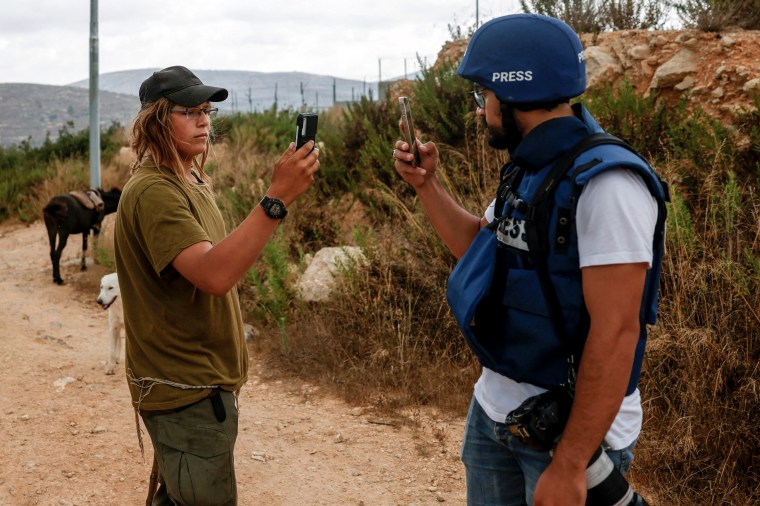
Palestinian freelance journalist Salman al-Khatib and his colleagues were filming Israeli demolitions of homes in the occupied West Bank late last month when a young settler approached them, blocked their cameras, shoved the journalists, and kicked Al-Khatib.
After another settler arrived on the scene, located between the towns of Birzeit and Atara, north of Ramallah, followed minutes later by an Israeli military vehicle, the journalists abandoned their reporting, rushed to their cars, and removed the press vests and helmets that identified them.
“We felt afraid and in real danger, and that a serious problem could happen at any moment,” Al-Khatib told the Committee to Protect Journalists of the August 31 incident.
The episode was one of at least 16 incidents reviewed by CPJ during the first eight months of 2026 in which Israeli settlers assaulted, threatened or obstructed journalists in the Palestinian territory. The incidents affected at least 35 Palestinian, Israeli and international journalists, compared with 13 incidents involving 25 journalists documented by CPJ throughout 2025.
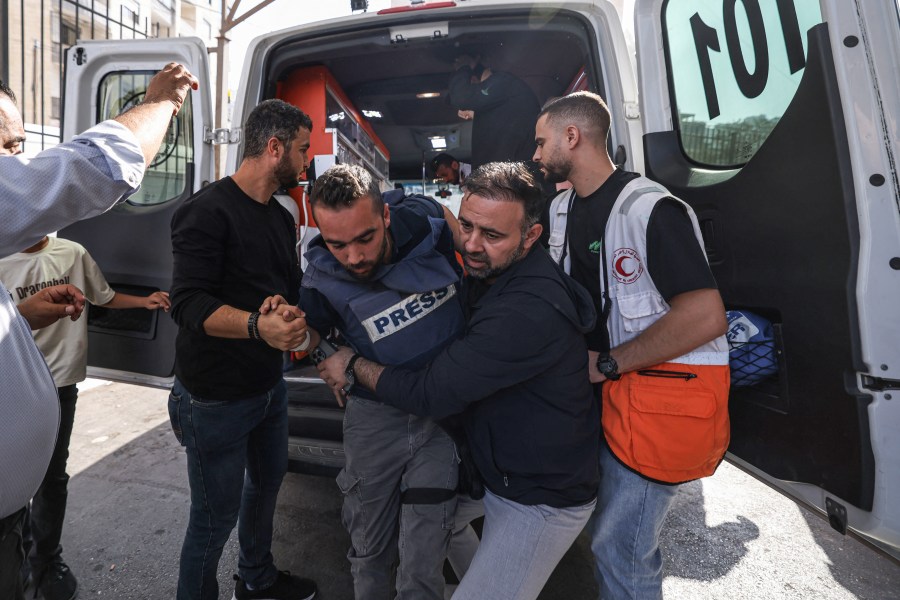
Journalists were physically assaulted in at least 11 of the 2026 incidents, including at least three in which they were kicked, six in which they were beaten, hit, or struck, and two in which they were spat on.
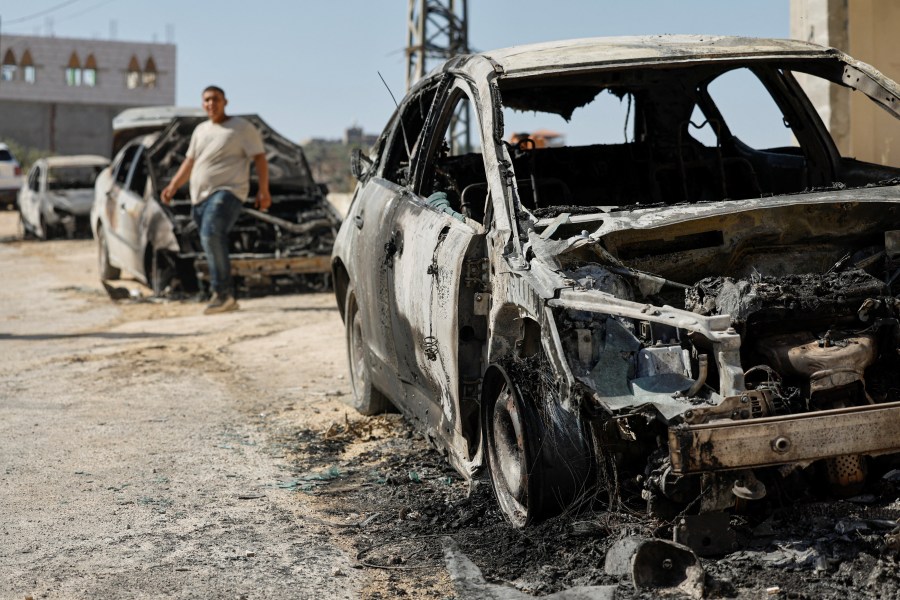
They were chased in at least two incidents, while their vehicles were targeted or damaged in at least five. At least five assignments were abandoned or cut short because of threats or violence. In one August confrontation, two journalists lay on the ground as live ammunition was fired meters away.
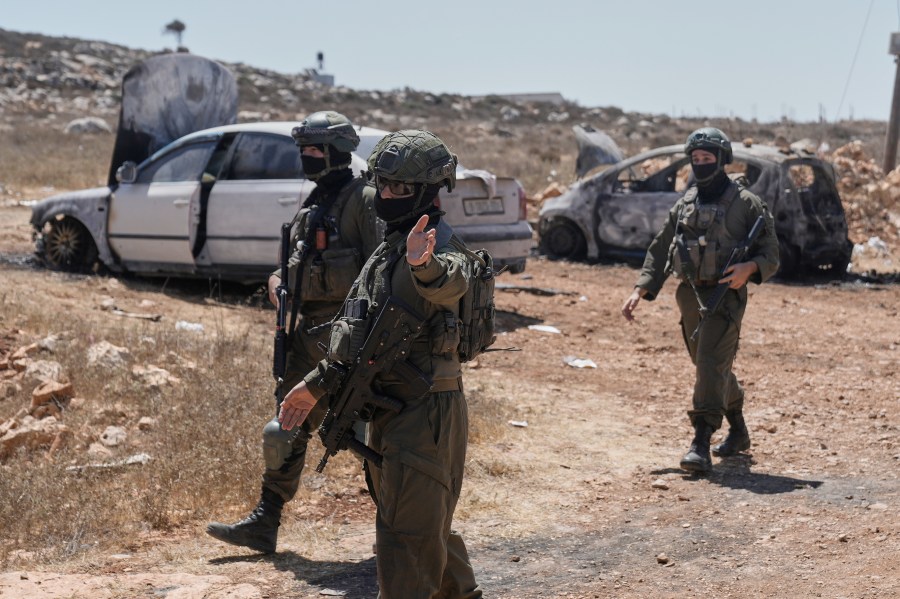
In at least five episodes, journalists told CPJ that Israeli soldiers or police officers were present or nearby but did not intervene.
Al-Ghad TV correspondent Diaa Houshiya, who was with Al-Khatib, said “the settler acted in front of the army as if the place belonged to him… He demanded that we leave and said he did not want to see any of us there.
In at least eight incidents journalists said or images showed they were wearing “Press” vests or holding items that identified them as journalists, according to CPJ research.
The accounts show how the threat of settler violence is changing the way journalists work. Reporters told CPJ they increasingly weigh how, and if, they can safely cover settler violence and other developments from the field in the West Bank, when to stop filming and leave, and in some cases, whether identifying themselves as journalists might expose them to greater danger.
“Journalists can’t be expected to do their jobs under the threats of violence, intimidation, and gunfire. This growing violence against journalists in the West Bank is not only an attack on the press, but a threat to the public’s right to know. When those responsible face no consequences, it sends a dangerous message that attacks on the press will be tolerated.”
– CPJ Regional Director Sara Qudah.
The attacks come amid a wider surge in record-high settler violence and expanding settlements, widely considered illegal under international law, across the West Bank. In June, the U.N. secretary-general said the frequency and severity of settler attacks had reached “the highest sustained levels ever recorded by the United Nations.”
International pressure intensified on September 8, when the United Kingdom announced sanctions and said it would consider Israel’s occupation of the West Bank unlawful, accusing settlers, supported by members of the Israeli government, of carrying out ethnic cleansing.
The most recent episode documented by CPJ occurred on September 5 in the Palestinian Bedouin village of Umm al-Khair in Masafer Yatta, an area of the southern West Bank experiencing regular land seizure and encroachment from nearby settlements.
Israeli freelance photographer Omer Manor said an armed settler ran toward him and physically attacked him as he filmed Palestinian children at a playground.
The journalist said he was carrying two professional cameras and a press card and was clearly identifiable as a journalist. The settler, he said, carried an M16 rifle and raised the weapon during the confrontation.
“This was not the first time that a settler had attacked me. But this settler was carrying a weapon, which made the incident more serious and more frightening,” Manor told CPJ.
Manor said police and border officers were at the scene but did not act against the settler. When he asked an officer for the settler’s name so he could file a complaint, the officer refused. Instead, officers ordered Manor and three other journalists — an independent photographer and two journalists working for French newspaper Le Monde — to leave, threatening them with arrest if they did not depart within three minutes.
“Not only did they fail to assist me,” Manor said, “but they also removed us from the area.”
Gunfire meters away
Toshiyuki Fukushima, Jerusalem bureau chief for Japan’s Yomiuri Shimbun newspaper, and Palestinian freelance journalist Ghassan Bannoura were on assignment on August 14, covering an action organized by Combatants for Peace, an Israeli-Palestinian human rights organization, to remove Israeli flags from a building that had been seized by settlers.
“Suddenly I heard gunfire, so I lay on the ground and took cover behind the wall,” Fukushima told CPJ. “Then a settler appeared on the other side of the wall, a few meters away from me, shouting and firing more shots.”
He said he later reviewed a video that, in his assessment, showed a settler firing live ammunition into the air from a few meters away.
Bannoura told CPJ that a settler was firing “randomly and toward the heads of those present,” including Fukushima.
Both journalists said the gunfire within meters forced them to the ground.
“The sound of the gunfire still sometimes echoes in my ears,” Fukushima said. “The images come back to me, and I wake up because of them at night.”
When reporting becomes the story
On August 10, Haaretz reporter Matan Golan and photographer Itay Rom were trying to reach Palestinian families on the outskirts of Qusra, south of Nablus, when settlers blocked their vehicle.
Golan told CPJ that settlers surrounded the vehicle and one tried to deflate a tire before kicking and spitting on her. Israeli soldiers, she said, were nearby but did not intervene.
“It was the first time someone spat in my face,” Golan said. “I didn’t know which was more humiliating: the spit or the soldiers standing there without intervening.”
Israeli public broadcaster Kan journalist Yoav Borowitz described another confrontation after filming a group of what he estimated to be 20 to 30 “hilltop youth,” most of them masked, at the settlement Havat Gilad on July 18.
Borowitz said several demanded that he delete the footage. When he refused, they surrounded and threatened him. Later, he said, masked youths returned to his car, and one took his phone while another restrained him.
“Everything happened within two seconds,” he told CPJ. “I didn’t chase them. They were dangerous […] Confronting them was, for me, a risk to my life.”
Borowitz filed a police complaint.
On August 29, masked men attacked an NBC News crew in Jalud, a village south of Nablus, as the journalists interviewed Palestinian woman Aida Ahmed Abdullah, whose family had been driven from their home by settlers.
Video showed at least four masked men emerging from a vehicle with Israeli license plates and attacking Abdullah and members of the crew with sticks and stones.
“They jumped out, beat us, then jumped back in the car,” international correspondent Matt Bradley said in an NBC News report on the attack.
Bradley suffered an arm injury and received treatment. Producer Lawahez Jabari and camera operator Khaldoon Eid were also treated for injuries, and equipment and a vehicle were damaged. Jabari said she saw a firearm carried by one of the attackers but did not see it used.
Fear before the assignment
For several of the journalists who CPJ spoke to, the risks of violence has prompted them to reconsider reporting from flashpoint locations, often Palestinian towns, villages, and farmlands near Israeli settlements.
Five of the 16 incidents occurred in the Nablus area in the northern West Bank, including two in Jalud. Four occurred in the Hebron/Masafer Yatta area in the southern West Bank, including two in Umm al-Khair. Three other incidents occurred around Ramallah, two around Bethlehem, and one each in Tubas and the Jordan Valley.
CNN Senior Producer Abeer Salman, said while working with Chief International Correspondent Clarissa Ward in the Ush Ghrab area of Beit Sahour, an armed settler prevented their team from approaching an outpost, and became more aggressive after learning that she was Arab. There was no physical assault, but she said encounters like this have made her more cautious about where she goes and how closely she approaches .
“Today when I go to the West Bank, I try as much as possible to stay away from armed settlers,” Salman told CPJ. “I no longer know what to expect. Everyone is armed, and that in itself changes the way you deal with the place.”
Salman, who has four children, said: “I think about them a lot. When I go to work, I think that I want to return to them.”
Al-Kofiya TV reporter Zaid Abu Arra, who said settlers beat him unconscious in February, told CPJ he has since stopped going to locations where armed settlers are present.
“I felt that I had seen death with my own eyes, particularly when I lost consciousness after being struck on the head,” he said.
American freelance journalist Jasper Nathaniel described two confrontations with settlers while staying in Umm al-Khair in early July, where he was both reporting and taking part in “protective presence” alongside Palestinian communities. In one incident, he said, a man carrying a club struck him in the stomach and kicked his leg.
“I feel that the situation is getting worse. The settlers are angrier and more aggressive, and they bring more weapons,” Nathaniel told CPJ. “There was one person carrying an automatic weapon. The feeling is that if just one thing happened differently, someone could start shooting. I feel something like that could happen soon.”
Questions over accountability
As of early September, CPJ is aware of charges being filed in only one of the 2026 incidents it has documented.
Police said four suspects were detained in relation to a July 11 attack on a convoy of journalists, including CNN correspondent Jeremy Diamond, Nathaniel, freelance journalists Adel Shoko, Andre X, Italian journalist Daniele Raineri, and photographer Gabriele Micalizzi, who blocked the cars and attacked them with stones and clubs.
Israeli media later reported that one of the suspects was charged with making threats, causing damage to a car, and unlawful possession of a knife.
Police said they opened an investigation into a separate August 25 attack on a three-person AFP team, east of Bethlehem, where settlers allegedly threw stones, struck a journalist with a stick, and damaged a vehicle. An Israeli soldier temporarily seized a video journalist’s camera, which the Israeli military told AFP was also under review.
“There is no law enforcement in the West Bank against violent settlers, nor against members of the security forces who attack Palestinians and foreign journalists,” Israeli human rights and international law attorney Michael Sfard told CPJ. “This is not incidental or a malfunction, but a feature of the system of control imposed by this government in the West Bank.”
Nonetheless, Sfard said journalists should continue to demand investigations into attacks. He also urged media organizations to consider legal action over harm to their staff that they believe resulted from Israeli law enforcement authorities’ failure to provide adequate protection
The Israeli police did not respond to CPJ’s request for comment, sent via a messaging app, about complaints, investigations, arrests and prosecutions related to alleged settler attacks on journalists in 2026, or allegations that police officers failed to intervene during such attacks.
Other incidents:
- On July 20 in Al-Tuwani village, a settler obstructed Al-Ghad TV reporter Raed al-Sharif during a live broadcast. Camera operator Jamil Salhab was with him, and the crew left after more settlers arrived.
- On July 3 in Khirbet Abu Falah village, Al Jazeera’s Tharwat Shaqra, Anadolu Agency’s Issam Rimawi, Mohammed Awad, a freelancer for Agence France-Presse (AFP), and Reuters’ Mohammed Turkman were pushed and threatened by masked settlers carrying clubs, forcing them to withdraw.
- On June 18 near the Yitzhar settlement, Al-Fajr TV journalist Hiba Qeetneh said settlers chased her vehicle, insulted and spat at her, blocked the road, and took two phones, her identification card, and driver’s license.
- On March 22, in Jalud village, MS NOW NEWS reporter David Noriega and his crew retreated to their vehicle after settlers, some carrying sticks and stones, chased them.
- On February 5 in the Khirbet Ibziq area, east of Tubas, Al-Kofiya TV reporter Zaid Abu Arra said two armed settlers confronted him while he was covering attacks on a local school. Abu Arra, who was wearing press clothing and carrying a camera, said an Israeli military liaison officer later handed him over to the settlers, who questioned him about why he was filming and beat him. “The final blow was to my head, causing me to lose consciousness for approximately three or four minutes,” he told CPJ. Abu Arra said he was detained for about two hours and later received medical treatment for his injuries. “Since then, I have stopped going to locations where armed settlers are present,” he said.
- On January 28 in Al-Halawa, an area in Masafer Yatta, Karama Radio reporter Salman Abu Aram and photographer Areen Abu Aram were assaulted while covering settler attacks on local residents.
- On January 9 in Ras Ein al-Auja village, freelance photojournalist Wahaj Bani Mufleh was assaulted and a settler attempted to take his camera, while journalist Ahmad Samara said settlers obstructed his filming.