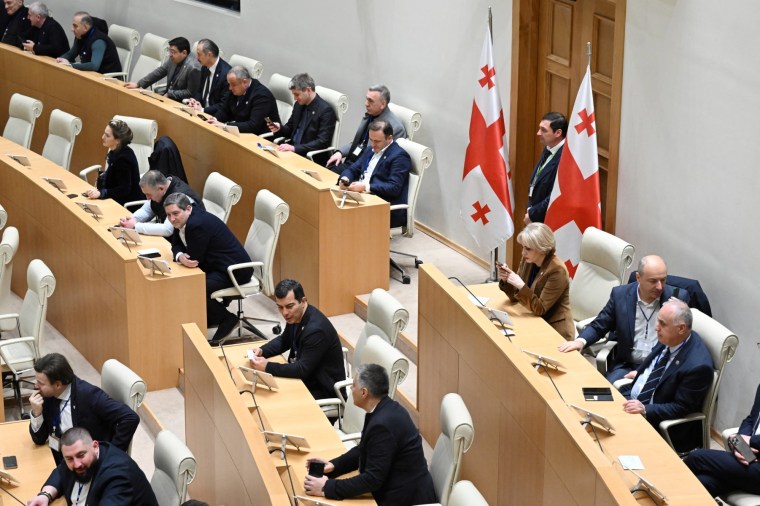
New York, February 2, 2026—The Committee to Protect Journalists calls on Georgia’s parliament to reject proposed amendments to media and civil society funding laws that would further restrict the country’s shrinking space for independent reporting.
The proposals, which follow last year’s passage of a punitive “foreign agent” law and legislation requiring government approval for foreign grants, widen the definition of a “grant” to cover virtually any form of remuneration or assistance from abroad if it serves vaguely defined political goals. Receipt of grants without official approval, currently punishable by fines, would become a criminal offense with a maximum penalty of six years in prison.
“The latest funding law amendments underline the breathtaking speed with which Georgia has traded its previously liberal media laws for draconian policies inspired by its authoritarian neighbors Russia and Azerbaijan,” said Gulnoza Said, CPJ’s Europe and Central Asia program coordinator. “The ruling Georgian Dream party seems intent on ensuring that the Georgian people have no access to any news besides its own propaganda. Georgia’s democratic partners must make clear that this is not acceptable.”
Under the proposed amendments, any funds “transferred in cash or in kind” by a foreign entity and used to exert “any influence on the Georgian government, state institutions, or any part of society” to impact state policy would be considered grants and subject to state approval — including the provision of technical assistance and expertise in either direction between a foreign entity and a Georgian recipient.
The law would also make state approval a requirement for funds transferred from a foreign organization to its Georgian affiliate and foreign funds or assistance received by a legal entity registered abroad but whose work “essentially includes activity on issues related to Georgia.”
In addition to the prison term of up to six years for violating the law on grants, the amendments would introduce a new criminal charge: “money laundering for the purpose of activism on political issues of Georgia,” punishable by up to 12 years in jail.
Georgian Dream has justified the amendments by saying they would close loopholes in existing legislation, and accused Western donor groups of funding “revolutionary processes” in Georgia.
The proposed restrictions come at a time of heightened international scrutiny of Georgia’s press freedom and human rights record. On January 29, more than 20 member states of the Organization for Security and Cooperation in Europe invoked the organization’s Moscow Mechanism in relation to Georgia, allowing them to send a mission of experts to assess growing constraints for independent media, among other issues.
Editor’s note: On March 4, President Mikheil Kavelashvili signed the grant law amendments into law.