Spain has welcomed hundreds of former Cuban detainees and their families. But economic woes and bureaucratic problems have made the transition difficult for exiled Cubans. Many say Spain will be but a temporary stop. By Borja Bergareche
Published July 6, 2011
MADRID
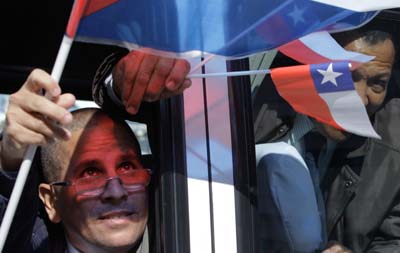
Spain is host to more than 100 Cuban political prisoners—and hundreds more of their relatives—who were freed as a result of a July 2010 agreement between the Castro regime and the Catholic Church, a deal supported by the Spanish government. Eighteen journalists were among those who agreed to exchange their prison cells for enforced exile in Spain, although four have since moved to other countries. For those journalists still in Spain, the challenges have been significant.
More in this report
• Cuba’s new repression
In print
• Download the pdf
In other languages
• Español
On the CPJ Blog
• Stories of prison
and liberation
“Until now, we´ve received enough help for housing, public transportation, clothes, and health care,” said Víctor Rolando Arroyo Carmona, an independent journalist who, after being freed in September 2010, lives in Madrid with six family members. “But we live in a legal limbo and cannot find jobs because our work permits have to be renewed every four months, and no potential employer wants to take that risk. There are several other needs—and I am not speaking of luxury—that we can no longer count on, like calling our relatives back in Cuba, having computer equipment with which to write, or traveling to coordinate with other families.”
In interviews with CPJ, most journalists said their basic needs have been addressed through a patchwork of government and private assistance. With health care provided by a national public system, the many journalists who had serious illnesses in prison have had access to basic treatment. School-age children are enrolled in local public schools. An assistance program funded by the Spanish government and channeled through the Red Cross and other nongovernmental agencies, provides a monthly housing benefit of 540 to 740 euros (US$770 to US$1,050) and a separate monthly living allocation of up to 850 euros, depending on the number of dependents. Nongovernmental organizations have also provided up to 300 euros in clothing aid. Aid is granted for one year, renewable every six months afterward.
“The government is determined to facilitate the integration of released Cubans and their families in Spanish society until they can afford self-sustained lives,” said Juan Carlos Sánchez, general director for Latin America at the Spanish Ministry of Foreign Affairs.
But establishing self-sustained lives has been elusive for many exiled Cubans, who have found great difficulty joining a Spanish labor market battered by three years of economic woes. Spain’s economic growth has ground to a halt and its unemployment rate stands at 20 percent. Thousands of foreign workers who had found jobs in the country in the boom years have now left Spain. Many Cubans have complained that their professional certificates and educational degrees have not been authenticated by Spanish and Cuban authorities, a bureaucratic barrier that is hampering their aspirations to join the work force.
Spanish officials have resettled the former detainees in a dozen cities and towns across the country, locating most outside Madrid. Some Cuban exiles claim the government undertook nationwide relocations to prevent the emergence of a strong, unified—and diplomatically uncomfortable—political voice hammering the Cuban regime from Spain´s capital. Government officials say the relocations were based on a strategy to channel aid through humanitarian groups nationwide. “In order to assist such a large group, the government has signed several covenants with humanitarian organizations such as the Red Cross,” Sánchez said. “It is these organizations and not the government that decide how assistance is provided, considering the available resources and the fact that those resources are not concentrated in Madrid but across the country, coming mostly from agreements with regional governments.”
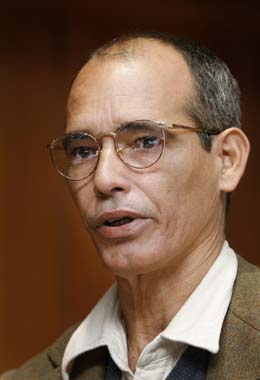
Before the wave of exiles over the past year, Spain was already home to Cuban writer and journalist Raúl Rivero, who was freed from prison in 2004, and the independent Cuban journalists Alejandro González Raga and José Gabriel Ramón Castillo, who were released in 2008 along with two other Black Spring detainees. Overall, Spain has welcomed at least 120 Cuban dissidents, with several hundred of their relatives. But the country’s open-arms approach has been tempered by the economic crisis, which is forcing the central, regional and local governments to cut spending on all manner of services—including assistance to the exiled Cubans. Several Cubans told CPJ that housing aid had recently been cut.
Last year, the conservative regional government of Madrid, with close ties to Cuban dissidents, took on the responsibility from the central government for those living in the capital and supported them with housing aid, clothes, and school supply subsidies. But forced to adopt austerity measures in response to the economic crisis, even Madrid officials have cut subsidies to Cuban families.
“For the first time, I have not been able to pay my telephone and house bills,” said González Raga, an independent Cuban journalist who has lived in Madrid with his wife and two children since his release in February 2008. He said only his daughter-in-law was able to find work, and that was a short-term stint in a restaurant. González Raga and his wife, Bertha, an accountant, have been looking for jobs for more than two years. He and a group of other dissidents tried to establish an organization to monitor human rights in Cuba, but initial offers of public funding evaporated. “I am worried for many of those who arrived since July
The Spanish government has granted asylum to 53 Cubans, including dissidents and their relatives, and is considering six other applications, according to figures provided to parliament in June by Juan Antonio Yáñez-Barnuevo, deputy foreign affairs minister for Latin America. Nearly 400 other Cubans have been granted “subsidiary protection,” according to his figures, a legal status that offers permanent residency and work permits but presents fewer obstacles if the exiled Cubans decided to return to their homeland.
Three of the journalists freed in the deal between Cuba and the Catholic Church—Héctor Maseda Gutiérrez, Iván Hernández Carrillo, and Pedro Argüelles Morán—refused to leave the island. Released on a form of parole that leaves them vulnerable to re-arrest, the three face the prospect of ongoing harassment at home. But those who chose exile face their own uncertain future.
Among the journalists exiled to Spain, José Ubaldo Izquierdo has since moved to Chile while Omar Ruiz Hernández, Juan Adolfo Fernández Sáinz, and Normando Hernández González have gone on to the United States. Many more have expressed a desire to move to the United States, where authorities have opened a special visa program for Cubans released in the July 2010 agreement that would allow them to become U.S. residents.
For those still in Spain, the lack of economic opportunity could make the country just a way station. Said Arroyo Carmona: “We live with a total uncertainty over our future.”
Borja Bergareche, a Spanish journalist, is CPJ’s European consultant.