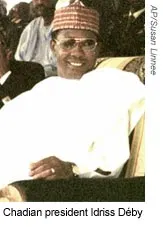
Washington, October 3, 2005—After meeting today with a delegation from the Committee to Protect Journalists, a top Chadian diplomat promised to convey concerns over press freedom violations in Chad to his country’s president, Idriss Déby.
In a session with Mahamoud Adam Bechir, Chad’s ambassador to the United States, CPJ representatives called on Chadian authorities to repeal the criminal charge of “defaming the president,” which was used to jail several journalists in recent weeks. Delegation members said the charge inhibits free expression and prevents journalists from holding the government accountable.
The CPJ delegation also called on the Chadian government to introduce safeguards to ensure that laws criminalizing “incitement” cannot be misused to suppress critical reporting and commentary. Those laws were also used in a series of cases in which journalists were imprisoned.
The CPJ delegation included CPJ board member and Chicago Tribune columnist Clarence Page, CPJ Africa Program Coordinator Julia Crawford, and CPJ Washington representative Frank Smyth.
In July and August, four Chadian journalists were sentenced to lengthy prison terms in connection with their work. An appeals court overturned three of the convictions; a fourth was allowed to stand, but the journalist was freed based on the prison time he already served.
On September 25, Chadian authorities arrested another journalist, radio director Tchanguis Vatankah, and threatened to expel him from the country. Vatankah is founder of Radio Brakos, a station in the remote southern town of Moissala. CPJ has documented a pattern of harassment targeting him for the station’s critical reports and commentary.
See more information on these cases.
In today’s meeting, CPJ officials pointed to the Johannesburg Principles, a set of international standards outlining the limited circumstances in which national security can be invoked to curtail free expression. The principles, which demand proof of a direct and immediate link between a given expression and imminent violence, were drawn up by a panel of international experts following the 1994 Rwandan genocide.
Anti-censorship organizations brought together these experts in international law, national security, and human rights in 1995. While not legally binding, the Johannesburg Principles have gradually been accepted as an authoritative standard for protecting free expression in the context of national security laws.
“CPJ welcomes Ambassador Bechir’s commitment to communicate these concerns to his government,” Crawford said. “We urge Chadian authorities to demonstrate a commitment to press freedom by withdrawing their threat to expel Tchanguis Vatankah, and by working to reform Chadian laws so they are in line with international standards of free expression.”
