|
| New York, May 3, 2001 – The Committee to Protect Journalists (CPJ) today named the Ten Worst Enemies of the Press for 2001, focusing attention on individual leaders who are responsible for the world’s worst abuses against the media. This year, repeat offenders Supreme Leader Ayatollah Ali Khamenei of Iran and President Jiang Zemin of China are joined by Liberian president Charles Taylor at the top of CPJ’s annual accounting of press tyrants.
Khamenei, the religious leader who exercises enormous influence over key institutions in Iran, is the instigator of a relentless campaign that has shuttered the country’s vibrant reformist press by closing dozens of newspapers and jailing outspoken journalists. In Liberia, Taylor has used censorship, prison, and threats of violence to silence virtually all independent media. China’s Jiang appears on CPJ’s list for a fifth straight year, for maintaining the Communist Party’s obsessive control over information, enforced in part via harsh prison sentences that have now made China the world’s leading jailer of journalists.
In addition to Taylor, three other press offenders, each using very different methods to intimidate media in their countries, are also new to CPJ’s list this year: President Robert Mugabe of Zimbabwe, President Vladimir Putin of Russia, and Colombian paramilitary leader Carlos Castaño. CPJ put Ukrainian president Leonid Kuchma back on the list (he last appeared in 1999), and once more named perennial press freedom offenders President Fidel Castro of Cuba (a seven-year veteran of the press enemies list), President Zine Al-Abdine Ben Ali of Tunisia (listed for four years), and Malaysian prime minister Mahathir Mohamad (listed for three years).
“Although three of last year’s worst press enemies – Sierra Leonean rebel leader Foday Sankoh, Peru’s Alberto Fujimori, and Slobodan Milosevic of Yugoslavia – were ousted from power in the past year, there was no shortage of candidates to replace them,” said CPJ executive director Ann Cooper. “Whether they are sly or blatant, the goal of each of these leaders is to hold on to political power by controlling information and muffling criticism,” Cooper said.
“President Putin, for example, pays lip service to press freedom in Russia, but then maneuvers in the shadows to centralize control of the media, stifle criticism, and destroy the independent press. Others, like Mahathir in Malaysia, don’t even bother to try to hide their abuses behind a screen of empty rhetoric,” said Cooper. “We hope that by naming these ten press tyrants, we can focus world attention on their deeds and, by exposing them, bring about change.” |
Enemies of the Press 2001
Illustrations by Mick Stern / CPJ
|
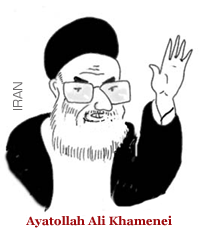
| Ayatollah Ali Khamenei, Supreme Leader of the Islamic Republic of Iran. Ayatollah Ali Khamenei’s fiery April 2000 sermon against the press inspired an unsparing campaign of repression against Iran’s reformist media that continues to this day. To date, the conservative courts have banned more than 30 papers and jailed the country’s best-known liberal journalists. When parliament debated reversing harsh provisions of Iran’s notorious press law, Khamenei stopped things cold, declaring that any easing of the rules was not “in the interests of the system and the revolution.” Today, the press law remains untouched, and at least nine journalists (including CPJ 2000 International Press Freedom Award winner Mashallah Shamsolvaezin) languish in jail.
|
 |
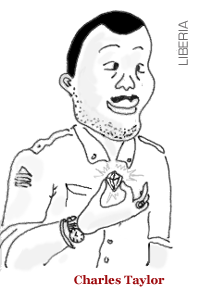
| Charles Taylor, President of Liberia. Since he became president of this war-plagued nation in 1997, Charles Taylor has been single-minded in clamping down on the independent press. He has jailed outspoken journalists on trumped-up charges, censored some media outfits at will, and forced others out of business through abusive tax audits. The popular Star Radio was effectively banned in March 2000. Since August, at least eight journalists have been jailed in Liberia on baseless charges of espionage. In September, Taylor, known for his erratic and bloody tactics, pledged to become “ferocious” with local media that did not toe his line. Several papers immediately closed down and their staffs fled the country en masse.
|
 |
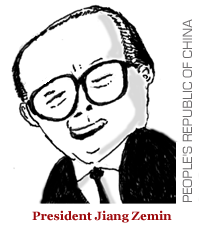
Jiang Zemin, President of The People’s Republic of China. Jiang Zemin presides over the world’s most elaborate system of media control. Twenty-two journalists were jailed for their work in China at the end of last year, more than in any other country. Wary of the Internet’s potential power to break the state’s information monopoly, Jiang has poured huge resources into policing online content. His campaign to strengthen “ideological conformity” has led to closings or reorganizations at several media outlets that had begun operating with unacceptable editorial independence.
|
 |
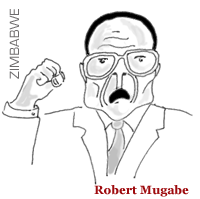
Robert Mugabe, President of Zimbabwe. Robert Mugabe’s government has launched an all-out war against independent media, using weapons that range from lawsuits to physical violence. Since January 1999, two local journalists have been tortured and two foreign correspondents expelled, while the secret service screens e-mail and Internet communications to preserve “national security.” Bomb attacks twice damaged the premises of the independent Daily News; the second bombing followed close on the heels of a call from Mugabe’s information minister to silence that paper “once and for all.” Meanwhile, Mugabe makes liberal use of his courts to prosecute independent journalists for criminal defamation.
|
 |
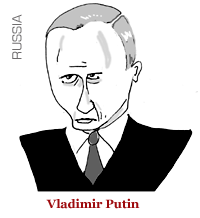
| Vladimir Putin, President of Russia. Since taking office last year, Vladimir Putin has presided over an alarming assault on press freedom in Russia. The Kremlin imposed censorship in Chechnya, orchestrated legal harassment against private media outlets, and granted sweeping powers of surveillance to the security services. Despite Putin’s professed goal of imposing the rule of law, numerous violent attacks on journalists have been carried out with impunity across Russia. In an ominous and dramatic move this April, the Kremlin-controlled Gazprom corporation took over NTV, the country’s only independent national television network. Within days, the Gazprom coup had shut down a prominent Moscow daily and ousted the journalists in charge of the country’s most prestigious newsweekly. Despite Gazprom’s insistence that the changes were strictly business, the main beneficiary was Putin himself, whose primary critics have now been silenced.
|
 |
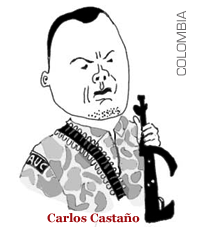
| Carlos Castaño, Leader of The United Self Defense Forces of Colombia (AUC). Even against the violent backdrop of Colombia’s escalating civil war, in which all sides have targeted journalists, Carlos Castaño stands out as a ruthless enemy of the press. The leader of the United Self Defense Forces of Colombia (AUC), the ultra-violent right-wing paramilitary organization, Castaño has been formally charged with ordering the 1999 murder of commentator and political satirist Jaime Garzón. His AUC has been implicated in the murders of at least three other journalists. Castaño’s vicious public relations strategy is to grant frequent interviews to journalists who defend his actions, while using violence and threats of violence to terrorize those whose coverage he dislikes.
|
 |
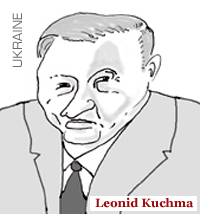
| Leonid Kuchma, President of Ukraine. Leonid Kuchma’s government has stepped up its habitual censorship of opposition newspapers and increased attacks and threats against independent journalists. The disappearance and presumed murder of Internet editor Georgy Gongadze late last year brought the plight of Ukrainian journalists into sharp focus. Allegations that Kuchma himself may have directed the elimination of Gongadze sparked a political crisis that threatened to bring down his government, and police security services made numerous attempts to muzzle publications that carried coverage critical of the Gongadze scandal.
|
 |
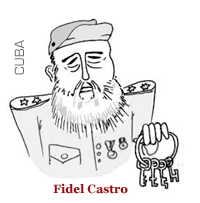
Fidel Castro, President of Cuba. Fidel Castro’s government continues its scorched-earth assault on independent Cuban journalists by interrogating and detaining reporters, monitoring and interrupting their telephone calls, restricting their travel, and routinely putting them under house arrest to prevent coverage of certain events. A new tactic of intimidation involves arresting journalists and releasing them hundreds of miles from their homes. Meanwhile, foreign journalists who write critically of Cuba are routinely denied visas, and early this year Castro threatened some international news bureaus with expulsion from Cuba for “transmitting insults and lies.” Cuba is the only country in the Western Hemisphere that currently holds a journalist in jail for his work. Bernardo Arévalo Padrón continues to serve a six year sentence for reporting critical of Castro and the Communist Party.
|
 |
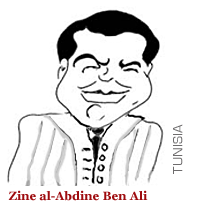
| Zine al-Abdine Ben Ali, President of Tunisia. For more than a decade, Zine al-Abdine Ben Ali has brought Tunisia’s press to almost total submission through censorship and crude intimidation. Newspapers were closed. Journalists have been dismissed from their jobs, denied accreditation, put under police surveillance, and prevented from leaving the country. Some have been subjected to physical abuse. With the exception of a few courageous journalists, the totalitarian tactics of Ben Ali’s police state have produced one of the most heavily self-censored presses in the region, while his propaganda machine churns out endless paeans to the dictator’s supposed achievements in democracy and human rights. Last year, incredibly, Ben Ali chided local journalists for self-censorship. “What are you afraid of?” the president asked.
|
 |
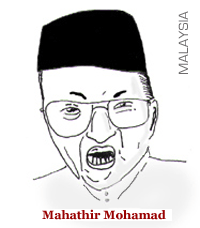
| Mahathir Mohamad, Prime Minister of Malaysia. Mahathir Mohamad is openly contemptuous of press freedom. He has manipulated Malaysian media to cement his hold on power and has signaled plans to introduce even more stringent controls on a severely constricted media. Officials are now considering legislation to regulate the Internet, a crucial venue for independent news and opinion in a country where traditional media outlets are overwhelmingly controlled by Mahathir’s political allies. Notoriously thin-skinned, the prime minister regularly demonizes the foreign media for reporting he considers unfair. This past year he repeatedly blocked the circulation of international news magazines that featured articles about Malaysia.
|
 |
| |
|