Middle East & North Africa
2011
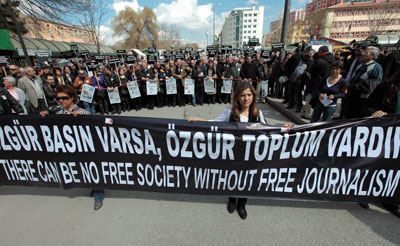
Responding to Turkey’s appalling press freedom record
Prime Minister Recep Tayyip Erdoğan would like to take credit for Turkey’s economic growth and increasing regional influence, but when challenged on his country’s abysmal press freedom record he tends to blame others, including the media itself which, he says, exaggerates the problem. But the facts speak for themselves, as I noted in a letter…
Several tallies, one conclusion on Turkish press freedom
Press freedom in Turkey is under assault. Thousands of criminal cases have been filed against reporters, the Criminal Code and Anti-Terrorism Act are used routinely to silence critical news coverage, and Kurdish journalists face constant persecution. Today CPJ released its annual prison census, which tracks cases of journalists jailed for their work globally. (The list…

Awardees to their colleagues: Buck the system
The Grand Ballroom of the Waldorf Astoria might seem like an odd venue to stage a call for resistance. Nine hundred people in tuxedos and gowns. Champagne and cocktails. Bill Cunningham snapping photos. This combination is generally more likely to coax a boozy nostalgia than foment a revolution. But the journalists honored last night at…
Defending the middle ground of online journalism
It’s easy to use polarizing descriptions of online news-gathering. It’s the domain of citizen journalists, blogging without pay and institutional support, or it’s a sector filled with the digital works of “mainstream media” facing financial worries and struggling to offer employees the protection they once provided. But there is a growing middle ground: trained reporters…
Video: Egyptian soldiers storm Al-Hurra studio
When Egyptian security forces stormed the Cairo offices of U.S. government-funded Al-Hurra television station Sunday night, the studio was live on the air, covering clashes just outside its building between the military and civilians that left dozens dead (including Al-Tareeq cameraman Wael Mikhael). During the raid, Al-Hurra anchor Amr Khalil continued to broadcast as he…
When a bug fix can save a journalist’s life
One of the most exciting aspects of working on Internet technologies is how quickly the tools you build can spread to millions of users worldwide. It’s a heady experience, one that has occurred time and again here in Silicon Valley. But there’s also responsibility that attaches to that excitement. For every hundred thousand cases in…
Farsi guides to the surveillance attack in Iran
As we’ve reported before, there’s strong evidence that forces with widespread access to Iran’s internet infrastructure have been engaged in large-scale surveillance of https traffic in July and August, certainly of Google traffic, and perhaps many more websites, including Facebook and Yahoo! If you used the Internet in Iran during this period you should, at…
NATO responds to CPJ, but questions remain unanswered
On August 4, CPJ wrote to NATO Secretary General Anders Fogh Rasmussen requesting information about the July 30 attacks on broadcast facilities in Libya in which NATO aircraft destroyed three broadcast dishes. As we noted in our letter, CPJ is concerned any time a media outlet faces a military attack. Such attacks can only be…