Go »
  Go »

Asia

2012

Pages: 1 2 3 4 5 6 7 8 9 10 11 12 13 14 15 16 or All


Danlambao: We will not be silenced

A screenshot of the home page for Danlambao, a collective blog recently singled out by Vietnam's prime minister as untruthful.

On September 12, Vietnamese Prime Minister Nguyen Tan Dung issued an administrative order--number 7169--accusing us, Danlambao, of "publishing information that is false, fabricated, and untruthful to slander the leadership of the nation, to agitate the people against the Party and the State, to cause doubts and create bad publicity reducing the people's trust in the state leadership." The order directed the Ministry of Public Security and the Ministry of Information Communication and Media to investigate and discipline any groups or individuals who affiliate with Danlambao.

Japan's independent journalism on trial with Tanaka

Journalist Minoru Tanaka is being sued over a piece on Japan's nuclear industry. (Nathalie-Kyoko Stucky)

It doesn't take a baseball bat to silence a reporter in Japan--increasingly the blunt weapon being wielded by corporations, power brokers, and politicians is the court gavel.

In May of this year, a writer for the weekly magazine Shukan Kinyobi was sued by one of Japan's most powerful nuclear industry figures, for a total of 67,000,000 yen (US$858,000). The thrust of the lawsuit is that the term used to describe the plaintiff is libelous. 

Chinese Vice President Xi Jinping has not been seen in public since Sept. 1. (Reuters/How Hwee Young)

It was only a matter of time before Chinese Vice President Xi Jinping's physical absence from the public view was accompanied by his disappearance from cyberspace. The characters "Jinping" from his name were censored today from searches of Sina's microblog service Weibo, according to the Fei Chang Dao blog. Where else but China does a deficiency of information about a nonappearance become a story worth deleting?

So is there a story or isn't there? International news reports say that Xi, President Hu Jintao's expected successor, has not been seen in public since Sept. 1, and missed a Sept.  5 meeting scheduled with U.S. Secretary of State Hillary Clinton. That was either a snub, a swimming injury, a stroke, or an assassination attempt, depending on who you talk to. Xi has missed other appointments too, though the full extent of his truancy remains unclear. 

CPJ has been monitoring the investigation into the shooting attack on Arunachal Times journalist Tongam Rina outside her office in Itanagar, capital of Arunachal Pradesh state, which left her hospitalized in critical condition this July. Her recovery is progressing, slowly but surely. The police inquiry, however, is not. 

Denmark's Prime Minister Helle Thorning-Schmidt is in China this week to meet with top leaders, according to international news reports. CPJ's Advocacy and Communications Associate Magnus Ag and Senior Asia Program Researcher Madeline Earp co-wrote an op-ed calling on Thorning--as she is called in the Danish press--to raise the issue of press freedom. An edited version ran in the Danish newspaper Politiken today.

Speaking truthfully to China on its repression of human rights can be a tricky endeavor in diplomatic affairs, but Helle Thorning-Schmidt has a prime opportunity to raise press freedom on her trip to China. Germany's Chancellor Angela Merkel and U.S. Secretary of State Hillary Clinton did not give the issue public priority during their visits earlier this month, but as Thorning meets with top Communist Party leaders and addresses a World Economic Forum meeting in Tianjin, the opportunity must not be wasted.

When I first met Sandhya Eknelygoda in May 2010 in her home outside Colombo, she was a distressed mother of two young boys whose husband had gone missing. He was last seen four months earlier, just prior to the elections that returned President Mahinda Rajapaksa to power after the end of the decades-long war with Tamil secessionists. She still has no inkling of the whereabouts of her husband Prageeth, a cartoonist and columnist for the opposition website Lanka eNews (which has since ceased to operate in Sri Lanka because of arson attacks and legal harassment of its staff, but is maintained overseas).

A protester holds a poster depicting jailed journalist Shi Tao. (AP/Miguel Villagran)

Chinese dissident Wang Xiaoning was released today after serving a 10-year prison term on charges of "incitement to subvert state power," a case built in good part on client information supplied by Yahoo. Wang had used his Yahoo email account and the discussion forum Yahoo Groups to spread ideas the government deemed dangerous. His case closely parallels that of journalist Shi Tao, another Yahoo user who fell afoul of the Chinese government. In 2005, Shi was convicted of "illegally leaking state secrets abroad" and given a 10-year sentence. Yahoo had helped authorities identify Shi through his account information.

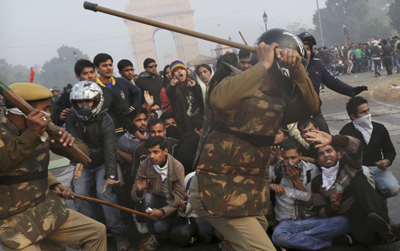
Indian police detain a Kashmiri protester in Srinagar. (AP/Mukhtar Khan)

Early this month, newspaper offices in Indian-controlled Kashmir received a note warning journalists to be more supportive of the Kashmir independence movement, according to the leading national daily, The Times of Indiaciting a news agency in the state's summer capital, Srinagar. No militants took responsibility this time, but in mid-March insurgent groups issued a joint message that urged journalists to "highlight the pain and suffering of Kashmiris because of oppressive state policies." 

Chut Wutty's son stands near a picture of his father during a commemoration ceremony. (Reuters/Samrang Pring)

Here's a quick pointer to a piece in the Daily Beast by freelance reporter Olesia Plokhii, who worked at The Cambodia Daily in Phnom Penh until May this year. Plokhii's moving story, "Death of a Forester," describes the death of Chut Wutty, a Cambodian activist who was shot a few feet away from Plokhii and another journalist, Phorn Bopha, while he accompanied them to an illegal logging site in a protected forest in Koh Kong province. 

Residents of India's northeast crowd a railway station as they flee ethnic violence. (AP/Anupam Nath)

Indian Internet advocates and journalists are in an uproar this week over the news that the government has blocked access to around 300 websites, pages, and social media accounts in an effort to quell communal violence in the turbulent northeast. The rationale is that inflammatory online content has fanned tensions between Muslims and non-Muslims in states including Assam, Karnataka, Tamil Nadu, and Maharashtra, contributing to a mass exodus from the region and violence in other cities. The offending content included fabricated images of violence against Muslims, apparently circulated to incite retaliatory attacks, according to news reports.

2012

Pages: 1 2 3 4 5 6 7 8 9 10 11 12 13 14 15 16 or all
« Previous Page   Next Page »

« Previous Year: 2011 | Next Year: 2013 »

  Go »
Text Size
A   A   A
Attacks on the Press 2012

252 Journalists killed since 1992

Country summary, global, and regional analysis »

Contact

Asia

Program Coordinator:
Bob Dietz

bdietz@cpj.org

Tel: 212-465-1004
ext. 140, 115
Fax: 212-465-9568

330 7th Avenue, 11th Floor
New York, NY, 10001 USA

Twitter: @cpjasia
Facebook: CPJ Asia Desk

Blog: Bob Dietz

Subscribe

Asia Atom Feed