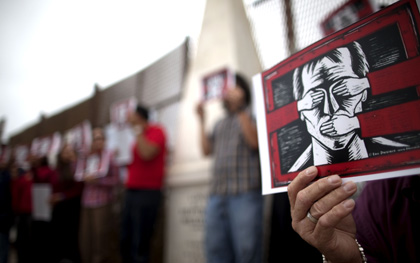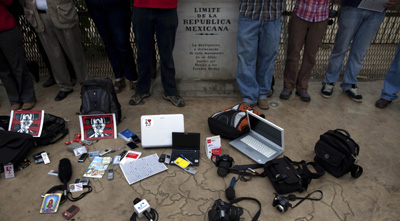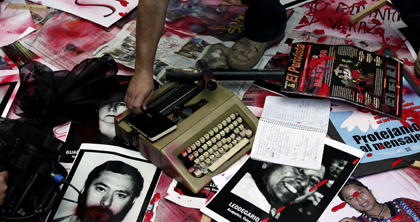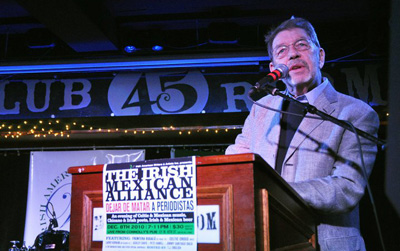
While a first glance, The Irish-Mexican Alliance might seem like an unorthodox partnership, last night's poetry and music fundraising event for CPJ at Connolly's Pub near Times Square proved otherwise.


While a first glance, The Irish-Mexican Alliance might seem like an unorthodox partnership, last night's poetry and music fundraising event for CPJ at Connolly's Pub near Times Square proved otherwise.

Two years have passed since the killing of El Diario journalist José Armando Rodríguez Carreón, known to his friends as "El Choco," and no legal process has begun to shed light on the crime committed on November 13, 2008. Faced with the reality of impunity, his widow, Blanca Martínez, asserted that her only hope lies in God.
On Monday, the Woodrow Wilson Center in Washington hosted a panel discussion on the press freedom crisis in Mexico. Carlos Lauría and I spoke about CPJ report "Silence or Death in the Mexican Press" and the results of our meeting in September with President Felipe Calderón. Dolía Estevez described the event in a blog she posted yesterday. I was struck by the remarks made by Dallas Morning News correspondent Alfredo Corchado, one of Mexico's bravest and best reporters. Excerpts from his prepared remarks are below:
On
Monday, before a large audience of government officials, representatives of
NGOs, reporters, and students, CPJ's senior program coordinator for the Americas,
Carlos Lauría,
said that the level of crime violence, and corruption facing the press in
Mexico, where more than 30 journalists have been murdered or have gone missing
since Felipe Calderón took office in December of 2006, is destroying the
country's journalism and forcing many reporters into self-censorship or exile.
"Not only the drug trade and corruption are not being covered, but basic daily
sensitive issues are being ignored as well," he said. "Self-censorship is
pervasive."

The Mexican government is currently putting together a program, it says, that will help reduce one of the most brutal problems for journalists: their lack of protection from death threats from drug cartels, government officials, and ordinary criminals. Senior officials at the Ministry of Interior told CPJ that they expect to offer at-risk journalists a range of protective measures, including bodyguards, armored cars and/or stipends to relocate to other parts of the country.

Last week marked the fourth anniversary of the murder of Brad Will, a 36-year-old American activist and journalist who was shot while covering anti-government protests in the southern Mexican state of Oaxaca. His murderers remain at large.
The line of people at the stairs leading down to the Great Hall at Cooper Union in lower Manhattan formed early and turned into an audience of 500. They came to hear prominent Mexican and U.S. writers and free expression advocates assess, denounce, and seek solutions to the wave of violence wracking Mexican media.
"Tell them not to kill me!"
pleads a man in the opening lines of a fascinating tale of violence with the same
title by one of

Mexican President Felipe Calderón Hinojosa had a message to deliver and it wasn't about press freedom. After hearing the
concerns presented by a joint delegation from CPJ and the Miami-based
Inter American Press Association last week, the president wanted us to know something: He
didn't go looking for a fight against the drug cartels.

CPJ's meeting in Mexico on Wednesday with President Felipe Calderón cannot be more timely. A joint delegation with the Inter American Press Association will discuss Mexico's fast-deteriorating press freedom climate.

CPJ Senior Program Coordinator for the Americas Carlos Lauría was live on Fox News’ “Strategy Room” today talking about the deadly environment for journalists in Mexico. Video is above.

CPJ’s Senior Program Coordinator for the Americas Carlos Lauría was live on the national radio show “The Takeaway” this morning talking about the ongoing deterioration of the media environment in Mexico. Lauría was joined by New York Times correspondent Elisabeth Malkin from

CPJ’s Joel Simon will be live on Wednesday on
“The Kojo Nnamdi Show,” a daily
news public radio show in
On June 7, we wrote to Mexican President Felipe Calderón Hinojosa about a series of attacks perpetrated against local journalists by federal law enforcement since the beginning of the year. The office of the Mexican president responded on June 16.
In a letter to CPJ Executive Director Joel Simon, Calderón informed us that our letter was submitted to the attorney general’s office and the Mexican Ministry of Interior so the issue can be addressed as “soon as possible.”
Each year, UNESCO honors a courageous international journalist with the UNESCO/Guillermo Cano World Press Freedom Prize, named in honor of the Colombian editor murdered in 1986 by the Medellín Cartel. The prize is chosen by an independent jury and over the years I've attended several moving ceremonies in which some of the most daring journalists of our generation have been honored.
Last week, I attended an unusual event called the Courage Forum at which half a dozen speakers, from tightrope artist Philippe Petit and Sudanese rapper Emmanuel Jal to Virgin founder and chairman Richard Branson, talked about about overcoming fear.
We will not make significant advances in the battle against crimes against journalists and the impunity surrounding them without the creation of a sense of unity and solidarity among a country’s news media and journalists. Nor will the cause advance without a strategy by international press freedom organizations to provide support for those two values.

For those following the case of Bradley Roland Will, left, a U.S. activist-journalist killed while reporting on a protest movement in the southern Mexican state of Oaxaca in 2006, a long wait ended on February 18. After 16 months in prison, Juan Manuel Martínez, a grassroots activist from an impoverished neighborhood in Oaxaca, left his cell after a federal appeals tribunal exonerated him of murdering Will.
Over the weekend I spent several hours with two prominent
journalists in

On Thursday, I wrote about the murder of reporter Valentín Valdés Espinosa on January 7 and how the Mexican media has silenced its own coverage of the killing. Today, I will get into how journalists and drug cartels have entered into a dangerous, symbiotic relationship.

Twenty-nine-year-old reporter Valentín Valdés Espinosa was picked up by gunmen in two SUVs from the streets of downtown
No reporter in the city has published a story that touches on why their colleague was killed. In fact, Valdés’ newspaper, Zócalo de Saltillo, is going in the other direction. It will stop reporting on anything about organized crime, according to a senior editor who asked to remain anonymous for his own safety. The paper, he said, is not going to investigate the murder of its reporter.
In the course of investigating the December
22 murder of newspaper owner José Alberto Velázquez López, CPJ discovered allegations
of corruption that often hover over crimes against journalists in