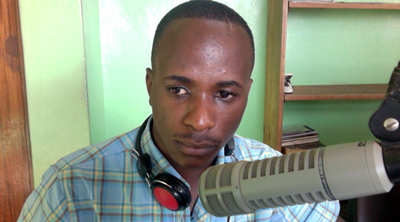
As Ugandan journalists prepare to cover presidential elections on February 18 amid political tensions and security concerns, uncertainty and fear are on the minds of reporters. That’s particularly so after a year in which 52 press freedom abuses–ranging from physical and verbal intimidation to state censorship and murder–were recorded, according reports by Ugandan press freedom group Human Rights Network of Journalists (HRNJ-Uganda). Journalists Arafat Nzito and Eddie Frank are suffering lasting effects of 2010 harassment.
On November 3, 2010, four armed men kidnapped Nzito, a 23-year old Radio Simba reporter who covered crime and occasionally opposition parties, and threw him into a pickup truck with tinted windows. “I spent 10 days locked in a dark room with my hands and legs handcuffed and remained on the floor. I was not given any real meals or food. The army men would come and scare me in the night,” he told CPJ. Assailants using the same truck eventually dumped Nzito outside the capital, Kampala, according to local journalists. His release came a day after HRNJ-Uganda filed a habeas corpus in court compelling the army commander, the attorney general, and the head of a security agency to produce the journalist. HRNJ-Uganda said its investigations determined that the journalist had been in the custody of Uganda’s Joint Anti-Terrorism Task Force.
Nzito told CPJ he frequently experiences nightmares now. “I have been dreaming about dark rooms, beatings and being held at gunpoint,” he said, adding “I am just scared for my life, and I can’t communicate, work or move freely.” Nzito’s ordeal forced him to move in with his family and take a pay cut, just to have the flexibility of leaving the station before it gets dark outside. In our phone conversation he mentioned that he still receive phone threats. “I should watch my movements, steps, actions, and stop receiving international calls,” Nzito recalled one caller telling him.
Frank, a reporter with the U.S.-based online station Radio Free Buganda, suffered a similar misfortune in August 2010 after covering the 17th anniversary of the coronation of Ronald Muwenda Mutebi II, the ruler of Uganda’s most powerful traditional kingdom representing the Baganda, the country’s largest ethnic group. Tensions between the government and the increasing assertion of the kingdom in political affairs ahead of the elections had led to outbreaks of deadly violence and the state’s closure of the kingdom’s broadcast newtwork, the Central Broadcasting Service. In response to the censorship, the founder of Radio Free Buganda, Boston-based Ugandan-American Robert Kabuye, assigned Frank to cover the royal celebrations for the Ugandan diaspora. “It was my pleasure to do it,” Frank recalled, adding that “it gave the outside world an opportunity to know what is happening on the ground.”
The government was not happy to hear that Radio Free Buganda was broadcasting the festivities. After the local newspapers Ggwanga and Buganda Post published stories about Frank’s live broadcasts, he said he began to receive anonymous phone calls. Then, four men stormed Frank’s home who took away his wireless Internet modem and computer. The next day, men Frank believed to be security agents detained him for six hours, seized his mobile phones, and pressed him to reveal whom he worked with and how much was paid. “I am scared for my life because all of my contacts were in my phones and other crucial information.”
Contacted by CPJ about these accounts, a spokesman of the Office of the Prime Minister of Uganda responded broadly. “Conditions are fair and there hasn’t been any journalist denied access,” said the spokesman, Cris Magoba. “There are no complaints about harassment and the conditions for journalists are truly OK.” He said “the biggest problem we have is self censorship; people have information but won’t tell because of fear.”
Magoba was right: Fear is on the minds of journalists such as Nzito and Frank. “I am not sure what will come the next day, I am thinking at anytime I will be killed or imprisoned again. Why? Because even now I am still receiving phone calls telling me if I don’t stop sending Robert news from Uganda, then I will find myself in danger,” Frank said. “But I cannot quit my work, I love it and I have to go on with my career.”