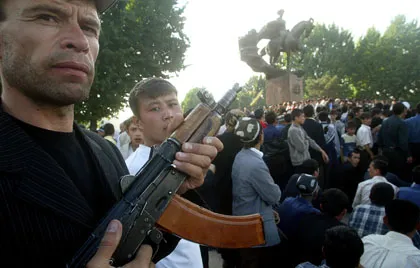
Five years ago today, Dilorom Abdukadirova, 44, managed to escape the heavy spray of bullets in her native Uzbek city of Andijan. On that day, government troops shot and killed hundreds of civilian protesters on the orders of President Islam Karimov. Leaving behind her husband and four children, Abdukadirova found a refuge in Australia, where she counted the days until she could again embrace her family.
Fear of a potential arrest in Uzbekistan stopped her from boarding a plane to Tashkent as rumors about the prosecution of returned refugees spread among the massacre survivors. But a desire to see her loved ones, as well as reassurances from the Andijan police that they would not arrest her, blinded Abdukadirova. She flew home in January. She indeed joined her family, but the joy was brief—ignoring their promises, Uzbek security agents have detained and interrogated her since the day of her arrival, and on March 12, she did not return home from Andijan prosecutor’s office.
It is unlikely Abdukadirova will hug her husband or kids anytime soon. Following her March 12 arrest, Andijan City Court charged Abdukadirova with illegally crossing the Uzbek border, attempting to overthrow the constitutional order, and participation in riots, and sentenced her to 10 years in jail.
Only a few in the country and abroad, mostly rights activists and massacre victims, know of Abdukadirova’s ordeal. The reason is simple—Karimov’s regime booted foreign broadcasters out of the country in revenge for their coverage of the massacre, and purged the remnants of the local independent press by jailing and intimidating reporters. Authorities continue to block access to critical online publications, such as the independent regional news Web site Uznews, which covered Abdukadirova’s arrest at length.
No other case depicts the regime’s hatred toward critical journalism as that of Dzhamshid Karimov—the Uzbek president’s nephew, who has been locked in a psychiatric ward in retaliation for his critical reports. Although Uzbekistan holds six other journalists in jail, unlike them, Karimov did not hear his court verdict, not even behind closed doors as happened in some cases.
In September 2006, security agents kidnapped the journalist, who, at the time, freelanced for the London-based Institute for War and Peace Reporting, from the street in his native city of Jizzakh, and threw him into a psychiatric hospital in the neighboring Samarkand region. Abandoned by his relatives after the death of his ailing mother in 2008, the journalist remains in custody. His right to a lawyer and to receive visitors has been denied. In fact, sources told CPJ that the journalist’s relation to the Uzbek dictator prevents him from receiving legal counsel—disputing the illegal detention, sanctioned by the president, is a suicidal mission.
These are only two stories that serve as reminder of the Uzbek regime’s brutality. But there are thousands of other documented cases of men, women, and children—victims of the massacre in Andijan and repression elsewhere in the country—who await their due justice. And calls for such justice must be made in all the capitals where governments publicly pledge allegiance to democracy and rule of law, cities where Tashkent seeks to repair relations with the West, including Washington, Brussels, Geneva, Berlin, Paris, and London. The Andijan massacre must be remembered.
World leaders have a moral obligation to demand justice for Dilorom Abdukadirova, Dzhamshid Karimov, and all others who are jailed on trumped-up charges, tortured, and intimidated by the Uzbek police, or continue to live in fear of the Uzbek regime.
When commemorating World Press Freedom Day on May 3, U.S. President Barack Obama included Uzbekistan into the list of countries that jail journalists for their work, which was a small step toward recognizing the problem. But more needs to be done to free the country’s jailed journalists. The Uzbek regime has proven to be immune to condemning statements or symbolic actions, like sanctions imposed by the European Union in 2005, which did not stop the regime from jailing its critics.
Maybe it’s time to publicly engage Uzbek envoys, like Ambassador to Spain Gulnora Karimova and Ambassador to UNESCO Lola Karimova—both daughters of the Uzbek president—and demand that they explain the detention of their cousin? Or perhaps it’s time that Pentagon officials, who have been frequent visitors to the Uzbek capital, voice—on the record—Obama’s concerns with Uzbekistan’s human rights and press freedom records. After five years, is it not time for justice?