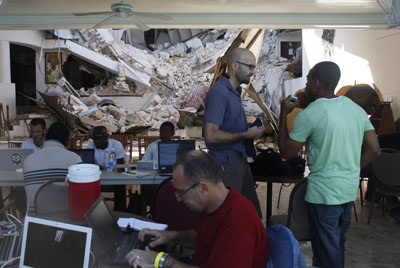

The earthquake that rocked Haiti didn’t spare anyone, including the media. Like every institution in the troubled country, the media has had its share of challenges. They cannot pay decent salaries to reporters and the reporting most often doesn’t go beyond the headlines. International organizations have developed training programs for Haitian journalists, but those journalists tend to leave Haiti after gaining some experiences, leaving a vicious brain drain and a permanent training cycle.
What the earthquake has done is destroy the physical infrastructure that will limit the reach of the media, particularly radio, which is the primary source for Haitians to get their news and information.
The day of the earthquake, miraculously, one radio station, Signal FM, remained on the air, after not suffering any damages to its buildings and antennas in the mountains of Boutilliers. The station did a commendable job by keeping people informed. Elected officials, business owners, and regular people used their airwaves to communicate. The station remained open around the clock and did its best to keep the population informed. It wasn’t until a few days later that other stations return to the airwaves. To this day, many still remain silent, hoping to resume broadcasting soon.
Before the earthquake, there was a vibrant radio scene here—it seems as though every dial is taken on the FM band. Le Nouvelliste and Le Matin, the daily newspapers, have not resumed during the earthquake and it is unclear when the oldest daily in Haiti will be able to begin publishing again.
I’m quite concerned about the future of the media in Haiti because they are not part of the discussion of the rebuilding of the country. But the reality is that the media was affected as much as any part of civil society during the earthquake. As a struggling democracy, Haiti may not understand the role of the media, but everyone agrees that it is necessary since the catastrophic events of January 12. I believe that funding for media should be part of the equation of rebuilding. Journalists, like everyone else in this tragedy, lost their homes, family, and friends. The notion of a separation of church and state is noble, but these are not normal times and should not be applied in the case of Haiti’s media.
I think the international community, which should understand the role of a free press, must not leave Haiti’s media in tatters. The media should be a part of the reconstruction because of its ability to inform and mobilize people.
Right now, the government has a serious public relations problem, largely because President René Préval has not been seen in public enough. His comments have not connected with people; part of that reason is that he hasn’t spoken enough. So his pronouncements are dissected in minutia. By using the media for its ability to inform the public, the government could solve its problem. But in its current shape, the media cannot continue to broadcast and print information. Resources are desperately needed and should be provided.
Garry Pierre-Pierre is the editor and publisher of the Haitian Times, a Brooklyn, New York-based weekly. He has been reporting from Haiti in the earthquake’s aftermath.
Editor’s Note: If you have any information on journalists and media outlets in Haitiplease post a comment below or notify us via e-mail [email protected], or Twitter: @HelpJournalists. We are collecting funds that will go directly to Haitian journalists. If you’d like to make a contribution, please click this link and enter “Haiti” in the “Notes” section on the second page.