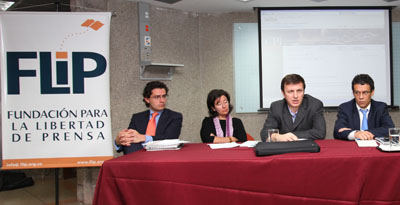
Shortly after arriving in Bogotá to launch Attacks on the Press, I realized the Colombian government was well aware of our concerns about illegal espionage against the media. Top government officials, including President Alvaro Uribe Vélez, had confirmed meetings with a delegation from CPJ and the local press freedom group Foundation for Freedom of the Press (FLIP) to discuss the findings of our annual report on the government’s interception of phone conversations and e-mails (including some involving CPJ) and its surveillance of Colombian journalists.
Together with our new board member María Teresa Ronderos, one of Colombia’s most prominent journalists, former CPJ awardee Ignacio Gomez, president of FLIP, and FLIP Executive Director Andres Morales, we had a full day of meetings on Monday with officials.
In the morning, we met with Minister of Interior Fabio Valencia Cossio, who emphatically repudiated illegal spying on the press, and stated that the government is committed to prosecuting and punishing all those responsible. At the request of the CPJ-FLIP delegation, the Ministry of Interior issued a press release today stating that “the government rejects and does not tolerate illegal spying on the press, which is a clear violation of the press freedom and transparency needed by democracy.”
We left the ministry after a two-hour-long meeting to go to the headquarters of the national intelligence service, knows as DAS. More than 40 DAS officials are being investigated for their participation in the spying scheme; seven were indicted in January and accused of phone and e-mail interception, surveillance, and intimidation. DAS Director Felipe Munoz acknowledged that the scandal was a “shame” for Colombia, and insisted that it was not state practice. The DAS director said that our reports were important in highlighting the scandal, but disagreed with both CPJ and FLIP by saying that spying did not continue in 2009. “That practice is no longer tolerated,” he said. DAS also reacted to CPJ and FLIP by issuing a statement.
In the afternoon, we headed to the attorney general’s office to meet with Guillermo Mendoza Diago. The attorney general was vague about the investigation, saying it was very complicated. Mendoza Diago confirmed the indictments of the seven DAS officials and the investigation of around 40 others. He said that part of the investigation into illegal spying was so technically complicated that they have requested assistance from the FBI.
During the three meetings, the CPJ-FLIP delegation repeated that illegal espionage is one of the most serious threats to press freedom in Colombia, that journalists are taking extraordinary steps to prevent their phones from being intercepted or their e-mails hacked, and that confidential sources have been endangered. We also called on the officials to prosecute all those responsible for illegal spying to the full extent of the law. We urged them to abstain from accusing members of the media of having links to armed groups without any evidence because it endangers the lives of reporters.
We repeated the same argument during a crowded press conference with more than 50 reporters in attendance this morning at the main auditorium of the Javeriana University in downtown Bogota.
We are meeting with President Uribe tonight at the presidential palace. On February 10, a letter left at FLIP’s offices clarified what I might expect in this upcoming meeting. The president’s secretary, Helena Bermúdez, congratulated me on behalf of CPJ for the report on illegal spying, adding that the president would not be able to attend the press conference.