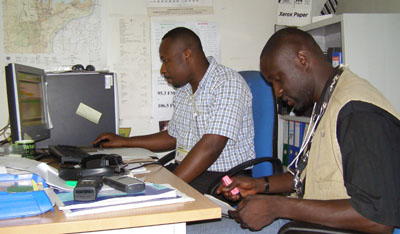
I shall never forgive myself for having initiated and encouraged my younger brother, Didace Namujimbo, to take up journalism. Working for 21 years in Bukavu, a city nestled on the picturesque shores of Lake Kivu, led me to cover every aspect of the brutal conflict and humanitarian catastrophe in this part of eastern Democratic Republic of Congo, but a year ago nothing prepared me to deal with the news that my brother had been killed.
If I had known that such a fate awaited him, I think I’d have advised him to continue his studies at the Higher Institute of Rural Development in Bukavu, or pursue his passion for basketball. We were again in November, but in 1996 after Rwanda-backed rebels of Laurent-Désiré Kabila seized Bukavu in their march to end the more than 30 years of reign of Mobutu Sese Seko. I was among the few journalists who remained in Bukavu after the city fell into the hands of the Alliance of Democratic Forces for the Liberation of Congo (AFDL) of Kabila. To call people to return to the city, the rebels had come for me to be editor in chief of their propaganda station, “The People’s Radio.” Faced with the daunting task that awaited me, I appealed to Didace and other young people to help me air news and messages of ADFL, or announcements for those seeking missing children and relatives. I still remember how we nervously worked under the watchful presence of heavily armed Rwandan soldiers in the studio. Didace gained a taste for journalism and permanently filed away his textbooks.
Didace launched into journalism knowing it was a high-risk occupation in my country, especially in our city of Bukavu. His fellow Radio Okapi reporter Serge Maheshe was murdered in June 2007 in circumstances unsolved. Investigations into the murder, and not one, but two trials by military courts have been widely criticized for leaving many questions unanswered with irregularities—the same kind of irregularities that Maheshe denounced in the 2006 murder trial of Bukavu human rights activist Pascal Kabungulu Kibembi.
Just days after the murder of my brother, it already seemed like it would be déjà vu. Not only did military prosecutors take over the case, removing it from the hands of police and the criminal justice, but military investigators became almost hysterical whenever we raised to them the possibility that members of the Congolese armed forces could be involved in the killing. I was forced to quickly launch my own investigation and clues I communicated to military investigators helped them arrest a dozen suspects.
However, everything changed on April 8, 2009. I was in Paris to receive the international Golden Pen Award for mastering the French language. I was sure to spend several weeks resting, away from the vicissitudes and anxieties since the assassination of Didace. Reporters Without Borders had released just two weeks earlier an investigative report on the murder of Didace, a report which I had contributed to as their correspondent in Bukavu. My head was full of reporting projects on my return to Bukavu planned for July 5. But it was not to be. When I opened my e-mail inbox that day, I almost fainted after reading a message sent from a fictitious address and entitled: Keba na yo Zoba (“Beware silly” in Lingala). This e-mail detailed death threats against my wife, my children, and myself.
Bukavu, the same city where I found shelter in July 2004 when the men of the former warlord Gen. Laurent Nkunda were looking for me over a story about the rebel atrocities against the population in the region, was becoming synonymous with deadly insecurity for journalists. Another journalist, Bruno Koko Chirambiza was killed in August and death threats were made against three women journalists two weeks later. There has not been a single arrest in any of these cases.
In the absence of justice and amid growing insecurity, my family and I were forced into exile. Over the past year, military prosecutors repeatedly announced the imminent start of the trial of the suspected killers of Didace, only to postpone it to a later date that never comes. Meanwhile, some suspects have already escaped from custody. It would not surprise me if there was an authority behind this murder or if the judges have been bribed or intimidated in one way or another. I challenge them to contradict me by finally starting this process!
While we await justice, Didace will live in the pages of my upcoming books recounting my experience covering the war in eastern Congo, “Everybody Is killed…And It Starts Over,” and “Merde in Congo.”
Déo Namujimbo is vice-president of the Congolese National Press Union and president of the Congolese Writers Union in South Kivu. He was also a correspondent of France-based Syfia Great Lakes, and Belgium-based InfoSud news agencies in eastern DRC.