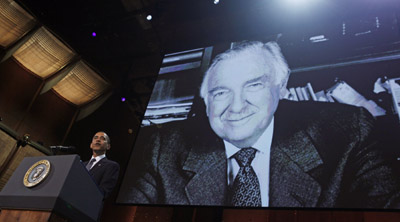
The projected image of Walter Cronkite smiled out at a crowd of hundreds of journalists, family, and friends at a memorial in Manhattan today. From a lectern beneath this image, President Barack Obama spoke about the late CBS anchor’s steadfast professionalism, a quality never more needed than today, in the midst of severe political and financial pressures on journalism.
“This democracy, Walter said, cannot function without a reasonably informed electorate,” Obama told the audience at Lincoln Center’s Avery Fisher Hall. “That’s why the honest, objective, meticulous reporting that so many of you pursue with the same zeal that Walter did is so vital to our society. Our future depends on it.”
That commitment to informing the electorate was deeply held by Cronkite. His belief that a free press is integral to a free society led him to become honorary chairman of CPJ—not that it was effortless to bring the legendary anchor onto our board in the nascent months of the organization in 1981. “It was a long shot,” CPJ founder Michael Massing told me before the memorial. But once he was on board, as Executive Director Joel Simon wrote on our blog, “there was nothing honorary about Cronkite’s involvement with CPJ.”
He was hands-on, working to gain the freedom of journalists in places such as Argentina and Turkey. Cronkite’s name alone, Simon wrote, was enough to direct the attention of government leaders to the dangers journalists face. His name, as so many who paid tribute to him today, stood for integrity and humanity and, as Katie Couric put it, “a complete and utter lack of pretense.” Tom Brokaw recounted how, years ago, when reporting in Israel he was asked if he was as famous as Walter Cronkite. “No,” he answered. “And I never will be.”
Cronkite’s son, Chip, told the audience today that his father felt “it is neither too much to ask for a free press nor too much for the government to give”—a position embedded in CPJ’s principles. Former President Bill Clinton, astronaut Buzz Aldrin, and numerous journalists also spoke of Cronkite’s deep well of curiosity and his ability to lead, with “60 Minutes” correspondent Andy Rooney calling him “a force for good.”
“He thought that if we were vigilant and courageous enough, it would all work out,” said journalist Nick Clooney, a longtime friend of Cronkite’s. “I never saw him pessimistic. Even at his great age, he still believed in it all.”
Cronkite’s name remains at the top of our masthead. Its presence reminds us, as his projected image did today, that a free press matters greatly in a dangerous world.