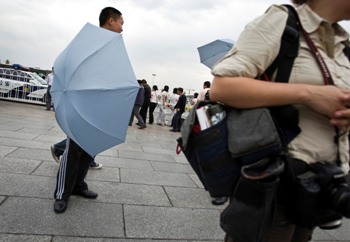
It’s hot in Beijing this time of year. An umbrella can serve as a convenient protection from the sun. Back in the spring of 1989, hundreds of umbrellas filled Tiananmen Square like makeshift shelters–until the army deployed tanks and guns against the anti-government protesters holding them.
Today, security officials brandished umbrellas themselves, fending off foreign journalists trying to visit the square on the 20th anniversary of the Tiananmen crackdown. Though China is renowned for its advanced censorship technology, reporters from CNN, the BBC and Agence France-Presse were all obstructed by men wielding the humble handheld rain protection device in front of their cameras. Footage from all three news outlets can be accessed on the Shanghai-ist blog.
One year ago today, The Wall Street Journal blog “China Journal” described an equally anachronistic phenomenon: Readers of National Geographic magazine in China found parts of the May issue hard to find–because they had been glued shut. “This is the first we’ve heard about censors trading their black pens and scissors for glue sticks,” journalist Geoffrey Fowler wrote on Journal‘s blog.
It’s hard to believe these clumsy techniques are really from the minds behind the notorious Golden Shield project, an online censorship and surveillance system that CPJ Asia Program Coordinator Bob Dietz has described on this blog as “so expansive and sophisticated that countries such as Vietnam, Zimbabwe, and Thailand have adopted its practices.”
That China’s aggressive but unpredictable censorship apparatus deploys both cutting-edge and primitive technologies is one of its strengths, domestically. For example, while the government maintains a highly developed online filtering system to follow Internet discussions remotely, they also hire Internet commentators to blog the party line at 50 cents a post. (Discussion of the so-called “Fifty Cent Party” can be read on the China Digital Times Web site.) Individuals trying to make an extra buck can plug the gaps left by a machine.
But using old-school censorship tactics on an international audience only highlights China’s abysmal record of restricting the press. It does nothing to stop the world from remembering the unarmed citizens who were killed or wounded in the streets of Beijing 20 years ago. An estimated 150,000 people turned out to a commemorative vigil in Hong Kong today, according to international news reports. It going to take more than rain gear to stem that tide.
The targets, as often with China’s censorship strategy, are not really foreigners. Rather, they are the many Chinese people who grew up not knowing the Tiananmen demonstrations ever happened. Though it is the topic of lively debate among dissidents and curious minds in China, it is kept entirely from the domestic news and limited in discussion forums online. One fewer international news report is one fewer threat to that status quo. Apparently, an extra report or two about media censorship is not a concern.
The Chinese government views the global media attention around the anniversary today as a storm: It is fierce, but temporary, and will soon blow over without lasting damage. In the meantime, their umbrellas are up.