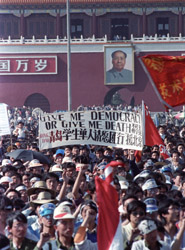
The events of 1989, which culminated on June 3 and 4 when the army opened fire on civilians trying to block its approach to the main site of protests at Tiananmen, the “gate of heavenly peace,” are dismissed as riots in official state media accounts. Propaganda officials interpret references to the events as a sign of antigovernment sentiment and censor them in the Chinese media and online.
Former Communist Party leader Zhao Ziyang’s memoirs are no longer accessible through the authorized online channels, The New York Times reports. News outlets are writing about “stability preservation” and police action, according to the Hong Kong-based China Media Project. Hong Kong newspapers reporting on the anniversary are not delivered to the mainland, while Hong Kong TV broadcasts are interrupted with commercial breaks within China if they raise the topic, Radio Free Asia says.
Any conjunction of the digits 6 and 4 is essentially banned from the news as 6/4/09 approaches, according to Hong Kong’s Ming Pao newspaper. After last year, when the Nanfang Dushi Bao (Southern Metropolis Daily) newspaper published a seemingly innocent headline about “four” freak weather occurrences in “June,” censors are taking no chances, Ming Pao reports.
The silencing project speaks volumes about the Chinese Communist Party’s fears. Not least is the threat the 1989 generation of dissidents, rights activists, journalists and intellectuals still pose to one-party rule. Public security officials arrested one of them, the veteran writer Liu Xiaobo, in December 2008, in the belief that he drafted “Charter 08,” a public call for political reform signed by hundreds of people around China; he remains under house arrest, according to international news reports. Another, journalist Shi Tao, is serving a 10-year prison sentence for sending documents dictating Chinese media coverage of the 15th anniversary of Tiananmen overseas by e-mail.
Social unrest, which fused with political issues in 1989, is also far from unusual in modern-day China. Today’s rising unemployment and economic hardship threaten to push small-scale demonstrations out of control. As writer and commentator Philip J. Cunningham puts it on his Web site, “China’s Public Security Bureau routinely releases shocking statistics that suggest China hardly goes a day without dozens of demonstrations or “mass incidents” erupting somewhere or else in the provinces, to the tune of thousands of little insurrections a month.”
Finally, though some international reports point out that today’s students don’t identify with the demands of the June 4 generation, the specter of the youth-led movement still haunts the authorities in China. For good measure, some campus-based Internet forums have been closed for “maintenance” until June 5, according to Global Voices Online.
The media has the potential to unite these myriad concerns. That was the role they played in 1989–even before the age of the Internet.
A 1990 analysis of the Chinese media in the spring of 1989, available on the Web site of The Gate of Heavenly Peace, a documentary and archive project about the protests, argues that the student movement framed their demands in terms of media coverage from the start. Many were angered when newspapers didn’t report an April 18 demonstration, according to the analysis, written by Linda Jakobson. When an official People’s Daily editorial on April 26, 1989, accused the protesters of creating national turmoil, they asked for a retraction. A few days later, national broadcasters televised two key dialogues between student leaders and top officials.
During this brief period, official media guidelines became ambiguous, Jakobson writes. Journalists capitalized on disarray within the party to tentatively publish factual reports on protests, and to quote selectively from government figures they agreed with, like Zhao, who denied that the protests were a serious security threat.
Journalists were also the first non-student group to use the protests to advance their own agenda, according to Jakobson’s analysis. “On May 4th [1989], about 200 journalists marched for the first time carrying banners with texts saying: “Don’t force us to spread rumors,” “Our pens cannot write what we want to write” and “News must report the truth,”” she writes. Other professional and intellectual groups were emboldened to join the demonstrations.
With no immediate remonstrance, many imagined the new openness had been officially sanctioned. News outlets spread sympathetic stories of the demonstrators around the country, readying others to mobilize behind them. The momentum was similar in 2008, when editors responded to demands from journalists and readers to publish accounts of the Sichuan earthquake that far outstripped the propaganda guidelines in the days immediately following the disaster. In that instance, the independent reporting gradually tapered off as propaganda units reasserted control of the story. Twenty years ago, the response, when it came, was less nuanced: The government declared martial law on May 20, and the openness ceased, according to Jakobson.
In the time they were allowed, however, Chinese journalists used the movement begun by the students as an exercise in the theory and practice of press freedom. Their demands for expression mobilized others to voice discontent; their more open reporting provided the means. Small wonder that censorship today has been intensified. The government’s attention to sixes and fours is no anachronism: As much as anything, the anniversary is a reminder that the media’s potential to unify disparate hopes and frustrations is as strong as ever, with the speed and accessibility of the Internet posing an added challenge to the censors.
Ming Pao says many Chinese journalists are viewing the sensitive period as an unofficial vacation, preferring to wait until the anniversary passes before reporting anything negative, even about the volatile economy. The government’s security apparatus, bolstered for the sake of international visitors in advance of last year’s Olympics, is now serving to restrict not only dissent but also the exchange of information in ways that could influence the rest of the world. In a year that has already seen economic disruption and a public health scare on a global scale, this degree of media repression is particularly unjustifiable. China’s aggressive propaganda measures distorts the present, as well as the past.