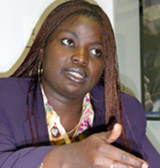
Franchou Namegabe Nabintu, an award-winning journalist from the Democratic Republic of Congo, operates in one of the most dangerous regions for journalists in Africa. She is a founding member of the South Kivu’s Association of Women Journalists (AFEM), which has trained female journalists and presents radio programs spotlighting women’s issues, especially in rural areas. CPJ interviewed Nabintu, at left, on Tuesday, on the heels of her stirring testimony before the U.S. Senate last week to discuss the challenges of reporting in the volatile eastern province of South Kivu, where violence against women is commonplace.
When did you start your career in journalism?
I started journalism in 1997 after secondary school and worked for Radio Maendeleo [a community station in South Kivu]. From there I was trained how to write, present, use a studio, etc. I spent 10 years there.
How was your experience reporting there?
As you know, it was during a conflict in eastern Congo. Radio Mandeleo was closed down three times–in 1996, 1998 and 1999. And from 1999 it was shut for three years. The rebel occupation under the RCD [Congolese Rally for Democracy] kept it closed at that time–they were in the area for over five years.
The Bukavu people resisted against the occupation. Radio Mandeleo is a community radio station; people expressed their discontent on the air and the rebels saw the station as a resistance movement. We had open-line shows where citizens could speak openly, for instance.
What gave you the idea to start AFEM?
I noticed that women never held good positions at radio stations. At the station Radio Mandeleo there were only two female journalists, including myself, out of a staff of 21. At other radio stations women were given secondary roles and female journalists were facing many problems, so we thought together we could do something to empower us. It was a time when women were often raped and sexually abused, so we started to use the microphone as a weapon. We started in 2003. When we started there were only four female journalists, but then we began to train ourselves, essentially learning on the job, and now we have reached 42 members.
Was it easy to get women involved in journalism?
It was not seen as a good thing at first. Women are not supposed to talk in front of men; it was difficult to get started. Any female journalist talking to different personalities and in contact with many people, they were accused of being prostitutes, etc. I remember when members of the ministry came to South Kivu. They started to invite me to join them as if I was supposed to spend the evening with them. Many people didn’t accept the idea that a young lady could speak to a larger audience. It was certainly a challenge to get people to understand that Congolese women had a right to free speech. Due to our experience, other young ladies started to join us.
What kind of coverage does AFEM do?
AFEM tries to report on women’s issues and advocate women’s rights. We do testimonies of women who were victims of sexual violence and we try to educate rural women. It covers all of South Kivu, all eight territories.
Have you faced any censorship of your programs with AFEM?
The worst thing that has happened was a targeted theft one weekend in August last year. We feel that it was politically targeted since none of the money in the office was stolen, only the journalist material. We lost a laptop, a camera, and roughly 400 testimonies of female victims of rape and sexual violence. We never kept copies of these–can you imagine? After that we became more careful.
We made a complaint and asked for a police investigation. But the police demanded roughly $1,000 to carry it out. Police officers usually receive about $20 per month. So there’s no justice, and people end up paying for their own police services. Two foreigners visited our office just one day before so there is some suspicion that they may have tried to block our reports from getting disseminated abroad.
Who hears the AFEM service?
We collaborate with six radio stations. So, in our small office, we produce the shows and then disseminate them to the stations. But we have to pay the stations for our programs. We pay $50 per program and $300 per week to air our programs. It is a considerable sum given that an average salary of a journalist in South Kivu is $100 a month, if anything. We tried to get radio stations to accept the programs for free but none of them accepted except for Radio Mandeleo.
Do you often receive threats for your work?
The threats come occasionally, often through phone calls and text messages. One time I had one anonymous caller ring me the entire night. I was worried. But all journalists in Bukavu receive such threats in their work. It becomes normal.
Since 2007 two journalists have been killed in murky circumstances in Bukavu: Serge Maheshe and Didace Namujimbo. Has this affected your work?
Didace Namujimbo was a good friend of mine. Until now we don’t know the motive behind the murders of Didace and Serge. AFEM has made reports on the need for security for journalists working in Bukavu. It certainly affects us and our reporting since we do not know what to expect next. There isn’t really any protection for journalists, not even from the U.N. security forces.
What are your plans for the future?
I would love to see more women involved in professional journalism and eventually a radio station for AFEM. A lot of work needs to be done to improve the plight of women in eastern Congo and for the journalism profession as a whole.