From his prison cell, veteran Chinese journalist Jiang Weiping wrote a poem to his daughter, Jennifer, which included the lines: “Though the road home has many twists and turns / Your daddy believes that we will be reunited soon.” She was little more than 10 years old when he was imprisoned in 2000 for reporting on a high-profile corruption case that rocked northern Liaoning province, where the family lived.
Last week, Jiang’s hopes were finally granted–but the road was twisted indeed. The family was reunited at Toronto’s Pearson International Airport, courtesy of an intervention by Canadian Immigration Minister Jason Kenney, who signed a permit allowing Jiang to leave China for Canada on humanitarian grounds. There he rejoined his wife, Li Yanling, and daughter, Jiangyue. They emigrated there in January 2004 and use their English names Stella and Jennifer. Jiang had not seen them since.
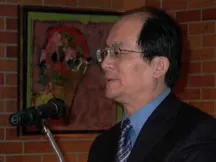
Stella was with him when Jiang appeared in public for the first time today to address journalists at a press conference sponsored by PEN Canada held in downtown Toronto. Jennifer, a University of Toronto sophomore, was in class.
“I believe journalists have a duty to report the truth about society,” Jiang said in his determined, but soft-spoken voice. “I don’t regret what I’ve done. What I observed in prison strengthened my beliefs.”
Jiang sat down with me to describe the trials his family has faced since his incarceration. While packing his belongings before leaving China (and trying to avoid the attention of local officials who had set up watch opposite his house) he found Jennifer’s diary from 2003. When her father was already in jail, police then detained her mother for a month, warning her to stop talking to foreign media or she would face the same charges as her husband.
Jennifer was 12 years old when both her parents were behind bars. An aunt looked after her, and she took to carrying contact information for her father’s friends in Hong Kong in her school backpack, which she never took off in case the police searched her house again. In her diary, she wrote that she would get in touch with them and ask for help. And she finished every entry with the line “Hoping mum and dad can come home safely.” Stella told me that when she was released, her daughter wouldn’t talk to her inside the house in case it had been bugged. She told visitors to lower their voices. Jiang said how proud he was to see his beautiful daughter once again, now 19 and studying commerce. She doesn’t want to be a journalist, she said–too dangerous.
Jiang served a total of five years for revealing state secrets and subverting state power. Those charges are a double whammy; they are the two most commonly used to imprison critics of the communist state.
CPJ recorded 28 journalists in prison in China as of December 1, 2008. At least three of those were accused of possessing state secrets, or, like Shi Tao–who is serving a 10-year sentence for using his Yahoo e-mail account to send internal propaganda department information to an overseas-based Web site–of leaking them overseas. Well over half of that total, around 17, were charged with inciting subversion of state authority. These charges are vague enough, and harsh enough, to be convenient for prosecutors looking to hang an inconvenient journalist out to dry.
Unlike recent high-profile subversion cases, like that of Hu Jia–an activist who frequently spoke with foreign journalists and wrote multiple articles online–Jiang was a journalist of the old school. He filed for state news agency Xinhua and worked as northeast bureau chief for a Hong Kong pro-Beijing daily during his 20-year career. He earned local and provincial awards for journalism excellence.
Even so, he knew the stories he was researching as a freelancer for a July 1999 special “anti-corruption edition” of Hong Kong-based Qianshao (“Front Line”) magazine were sensitive. As he slammed the corrupt practices of officials in Liaoning’s capital of Shenyang, including the provincial governor Bo Xilai, son of veteran revolutionary politician Bo Yibo, he disguised his identity with a pen name. Addressing then-President Jiang Zemin in a letter written after his conviction, Jiang said that his work expressed his “confidence and determination in the party’s anti-corruption efforts.”
The Shenyang graft scandal was massive in scale, and widely covered. At least one public official was executed for his role in gambling away millions of dollars’ worth of civic funds–one was also accused of maintaining 29 mistresses. At the time, human rights activist Yang Maodong, who writes under the pen name Guo Feixiong, analyzed the scandal in a magazine that did not have the proper paperwork. When he continued to be a thorn in the side of Chinese officials, they retroactively charged him with illegal publishing (in 2006, after the deadline for filing the charges had passed) and sentenced him to five years in prison. He is still serving that time.
As Jiang now knows, neither his confidence in the party’s anti-corruption drive, nor his caution in obscuring his identity, were enough. On December 5, 2000, he was detained. His wife wasn’t told of his whereabouts for a month.
She told me today that she felt desperate the night he went missing. He never came home that evening after having dropped her at work and their daughter at school that morning as usual. They’d made dinner plans, and she frantically called hospitals and police stations when he failed to come home. The next day, when public security officials summoned her home from work and told her not to bring her daughter home that night, she knew something serious had happened.
She wasn’t allowed to attend the 2001 trial in which Jiang was sentenced to eight years in prison. Stella was not able to visit her husband until February 20, 2003, Jiang said, the date still clear in his mind nearly six years later. That was when they moved him from the detention center, where family visits are not allowed, to one of the prisons in Dalian. Even then, their conversations were closely followed by officials who took notes. Trying not to reveal too much, Jiang pressed his wife and daughter to leave the country, he said. Without telling him what she planned, Stella obtained a Canadian visa and signed her and Jennifer up for a tourist tour of Seoul. From there they emigrated, without saying goodbye.
Jiang said he had a feeling at their last meeting in 2003–when Stella tried to give him medicines, which the attendant prison guards refused to let him accept–that she had a plan to escape. But the first he heard of it was a week after they left. A prison guard told him, “Your wife’s done a runner, didn’t you know?” From that point on, he said, knowing his family was safe, he had nothing left to fear.
The hardships he has undergone since then are difficult to imagine. He has spent periods in solitary confinement without heating, in freezing northern China. He was denied medical treatment for a stomach condition. He was denied books.
Both local and international journalists united in proclaiming Jiang’s innocence. CPJ delivered petitions from prominent U.S. journalists to the Chinese government in 2002. “Putting a journalist behind bars for doing his job and reporting the truth is wrong,” signatory Walter Cronkite wrote. “We call on China to let Jiang Weiping out of jail.”
Jiang received a CPJ International Press Freedom Award in 2001, which, he said today, had encouraged him “immensely.” But the award also left him “deeply humbled, knowing many other journalists were working in extremely dangerous situations in other parts of the world.”
On January 4, 2006, after two years were knocked off his original eight-year sentence on appeal, Jiang was finally released. His time was commuted a further year for good behavior. It wasn’t much of a concession, however: In 2005, CPJ wrote that he should have qualified for parole under Chinese law since 2003.
But the reunion he had promised Jennifer was not yet at hand. His sentence came with an extra three-year deprivation of political rights, a not uncommon way for authorities to prevent critics from writing about them in the years immediately after their release. During this period, Jiang was not eligible for a passport, and could not join his family in Toronto. His communications with his wife were electronic, probably monitored, and frustratingly guarded. He moved back to Dalian in Liaoning, worked as a calligrapher, and privately began drafting a book recounting his experiences. He bided his time.
The three-year purgatory came to an end in January this year. He made a tentative trip to the local public security bureau and was able to obtain the necessary travel documents. When Canadian Immigration Minister Kenney learned of his case, they agreed to provide him with a rare emergency entry to the country on humanitarian grounds. He traveled secretly to Beijing, hoping to avoid police notice, and was escorted to the airport by Canadian Embassy officials. He phoned Stella after he had made it safely through security. He was finally on his way.
For staff at CPJ, many of whom have met Stella and vividly remember the details of Jiang’s case, the news of his safe arrival in Toronto was sweet. But a shadow is cast by just how exceptional his story is. Besides the 28 individuals who are still separated from their families and still awaiting their release after an unjust sentence, there are the ones who, after getting out, are still living in a hinterland with no political rights. Another CPJ International Press Freedom award-winner, Gao Qinrong, an anti-corruption career journalist from Shanxi province who was released after eight years in prison in December 2006, was denied a passport and couldn’t attend CPJ’s 2007 awards ceremony in New York. With prison records, no Chinese newspaper will hire Gao or Jiang and provide them with the government-issued journalist ID cards that would allow them to report again.
Jiang once promised his daughter from his prison cell that he would never be deterred, writing in his poetry, “He will certainly pick up his pen once again!” Today, Jiang spoke of how he’s been losing sleep as he considers what he can do to help other prisoners of conscience, expressing his desire to pick up his pen and fight for their early release.
(Reporting from Toronto)