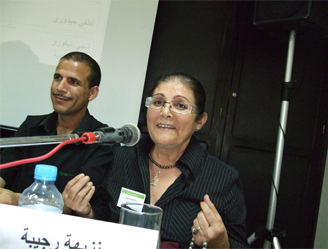
Naziha Réjiba, one of Tunisia’s most critical journalists, is editor of the independent online news journal Kalima—which is blocked in her own country. Réjiba, also known as Um Ziad, has been the target of continual government intimidation and harassment: Her home is under constant surveillance, her phones are monitored, and she has been summoned for repeated police interrogations.
Réjiba co-founded Kalima in 2000 with prominent journalist Sihem Bensedrine, herself a frequent government target. A year later, the two founded the press freedom group Observatoire de la Liberté de la Presse, de L’Edition et de la Création (OLPEC). Both Kalima, which went online after being denied the right to publish a print edition, and OLPEC are banned in Tunisia.
In 2007, after ignoring a series of anonymous threats against her and her family, Rejiba was subjected to a vile smear campaign featuring obscene, fabricated photos of her husband, lawyer and former Member of Parliament Mokhtar Jellali. In 2008, vandals hacked into Kalima and shut down the site. When Réjiba wrote an article accusing the government of involvement in the vandalism, she was summoned to appear before a public prosecutor. Although she has not been charged, lawyers said that under the press law she could still face up to three years in prison for publishing “false news.”
Here are Naziha Réjiba’s prepared remarks for the International Press Freedom Awards ceremony:
Good Evening, I am very happy to be with you.
I would like to express my gratitude for your support of a free press in Tunisia.
I, of course, am delighted by this award, because it comes from a respected organization. It is a testament to the efforts and the courage of the men and women journalists of my country.
I am neither a hero nor a victim, but a journalist who wishes to work under normal conditions. The degree of repression in Tunisia is such that it transforms normal activities into something exceptional.
Numerous journalists are jailed and others have fled the country because of persecution.
Following our coverage of the recent electoral charade, a relentless and vicious campaign has been waged against us. Amongst us, there are those whose movements have been restricted; others have been beaten, abducted, subjected to politicized trials, imprisoned, or placed under constant surveillance.
If these measures fail to silence us, the government resorts to underhand tactics. In my case, as CPJ has documented, they fabricated a tape which claimed to show that my husband was unfaithful to me.
I would like to reassure you that I have gotten over the matter without the help of a shrink. I simply told myself that I am a strong and honorable woman, and that I have not put the political police in charge of watching over my husband’s fidelity. Their attempted trickery backfired.
As I speak to you now, my house is surrounded by plainclothes police, but I am nonetheless here to celebrate.
I am not being reckless, nor am I exceedingly brave. Rather, I do not see the point of dramatization.
There is a time for everything, and now is a time to be happy and to be honored…not just me, but also my colleagues and my country.
I am determined to enjoy this ceremony, leaving tomorrow’s work for tomorrow.