Bilal Hussein, 37, made his mark as a photographer for The Associated Press during the 2004 battle of Fallujah. The city, a stronghold of al-Qaeda in Iraq and its Sunni allies, had become exceptionally dangerous for journalists.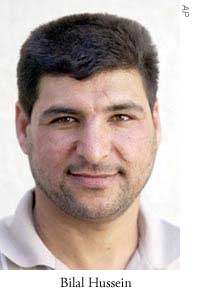 Born in Fallujah, Hussein used his local knowledge and keen intelligence to cover the critical U.S. assault on the city. His photograph of insurgents firing on U.S. soldiers helped a team of AP photographers win a Pulitzer Prize. Born in Fallujah, Hussein used his local knowledge and keen intelligence to cover the critical U.S. assault on the city. His photograph of insurgents firing on U.S. soldiers helped a team of AP photographers win a Pulitzer Prize.
The fury of the fighting shocked Hussein. “Destruction was everywhere. I saw people lying dead in the streets, wounded were bleeding, and there was no one to come and help them,” he said at the time. “There was no medicine, water, no electricity or food for days.” Fallujah was left in ruins and fighting moved west of Baghdad to Ramadi. It was there that the AP sent Hussein to cover deteriorating security, and it was there that he was arrested on April 12, 2006.
Although the military never explained the reason for Hussein’s detention, his then-famous 2004 shot of insurgents fighting in Fallujah may have led to his detention. Arrested by U.S. Marines, he was held for two years without charge. His case illustrated the U.S. military’s alarming tactic of holding Iraqi journalists in open-ended detentions without due process. CPJ has documented dozens of these detentions without charge, but no journalist spent as long in prison as Hussein.
In April 2008 two Iraqi judicial amnesty committees ruled that Hussein would not face trial on any accusations. After confirming those decisions, the U.S. military’s detention command said Hussein “no longer presented an imperative threat to security.” Throughout the two-year-long ordeal, the military never disclosed any evidence to support Hussein’s detention. On April 16, Hussein walked free.
“I have spent two years in prison even though I was innocent. I thank everybody,” said Hussein. He later left Iraq.
Click here to view Bilal’s video from the 2008 IPFA dinner.
|