The first year of Vladimir Putin’s presidency has been a trying time for Russian civil society generally and for the media in particular. The new president has steadfastly worked toward Soviet-style centralized control over the vast country, battling Yeltsin-era oligarchs, wayward regional leaders, and non-governmental organizations. All this activity has been undertaken under the Orwellian slogan of creating “manageable democracy,” although it would be more accurate to call it “managed.”
“When the nation mobilizes its forces to achieve some task, that imposes obligations on everyone, including the media,” Kremlin spokesman Sergei Yastrzhembsky told the newspaper Kommersant in January. Yastrzhembsky was referring to the Russian war against separatist rebels in Chechnya, but pressure to toe the Kremlin line has spread throughout Russian political life.
Putin has waged a highly selective war against powerful business tycoons (locally known as “oligarchs”) and regional politicians. Pro-Kremlin oligarchs such as Roman Abramovich and Rem Vyakirov have prospered under the new regime. Corrupt and dictatorial regional leaders have been tolerated if they demonstrate proper servility in their dealings with the center. In January, 2001, the Duma adopted a Kremlin-sponsored bill that would allow many of its regional allies, notably Tartarstan president Mintimer Shaimiyev, to run for a third term.
Corruption in Putin’s inner circle has been ignored, meanwhile. Putin’s chief of staff, Aleksandr Voloshin, is currently the subject of three criminal investigations. On December 13, well-documented corruption charges against former Kremlin property manager Pavel Borodin were inexplicably dropped and the incriminating evidence declared a state secret. The Swiss investigator working on the case said bluntly, “In my view, a double standard of jurisprudence has been established–one for friends, one for opponents.”
Putin has worked hard to bring all political activity under his own control, making heavy-handed use of the Kremlin bureaucracy and the security organs. In the spring, he divided up the entire country into seven federal districts and appointed his personal representatives to oversee them. Six of these representatives were selected from the security organs or the military, and all have endorsed the creation of what they euphemistically call “unified information space” within their districts.
Eat the press
These representatives will have primary responsibility for local implementation of the national Information Security Doctrine that the Security Council adopted in September. This doctrine argues that Russia faces a number of foreign and domestic threats in the sphere of information and advocates strengthening state-controlled media throughout the country by increasing direct financial support, creating a pool of loyal journalists, and giving favored media better access to information.
Putin’s drive to centralize control of political life and the media has met with little resistance from the Russian people, who are largely fed up with the irresponsibility and corruption that permeated Yeltsin-era Russia. Neither oligarchs nor local autocrats are very popular, so there is little public resistance to having Putin take them down a notch.
 Particularly outside Moscow and St. Petersburg, most Russians are profoundly distrustful of private initiative generally and private media in particular. Surveys regularly show that hinterland residents trust state-controlled newspapers more than private ones, although regional elites tend to prefer private newspapers. In July, a national survey revealed that a full 29 percent of provincial Russians think “the existence of non-state media is harmful.” Another poll showed that only 33 percent of Russians living outside Moscow agree that freedom of the press is presently under threat. In September, yet another poll found that 38 percent of Russians believe “increased state control of the media would be good for Russia,” while another 25 percent said such control would not matter one way or the other.
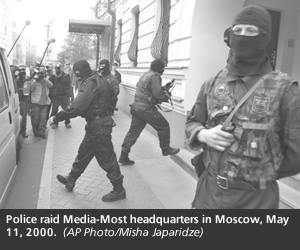
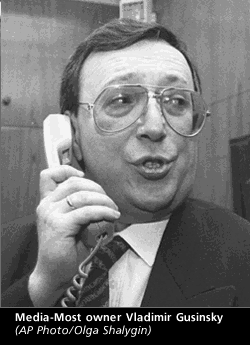
In June, Putin charged that commercial media had become “mass misinformation outlets and…a means of struggle against the state.” The conglomerate Media-Most (which controls the national NTV network, the national radio network Ekho Moskvy, and the daily newspaper Segodnya) worked tirelessly throughout 2000 to persuade the public that Putin was plotting a return to a Soviet-style regime of information control. This argument has made little impression. Instead, the Russian public has generally endorsed Putin’s relentlessly stated view that the private media are irresponsible and unpatriotic.
 Press control: a primer
Kremlin efforts to centralize media control have proceeded on two distinct tracks. One has been the struggle with the oligarchs, most visible in the ongoing tussle with Vladimir Gusinsky over control of Media-Most, and with over the partially privatized public television network ORT. Both oligarchs fled abroad in 2000, facing criminal investigations in Russia and the likelihood of losing control of their media properties.
The second track, which has been pursued quietly so far, involves weakening the control of regional political forces over local mass media. The first step in this effort was the gradual shifting of control over press subsidies from local authorities to a centralized Media Ministry. The efforts of the seven presidential representatives to create additional, federally controlled regional media outlets and the adoption of the Information Security Doctrine in September are also crucial to this effort.
Russian authorities finance thousands of media outlets via an impenetrable net of regular and discretionary subsidies (including direct cash payments, rent and utility subsidies, tax breaks, in-kind newsprint contributions, and many others), established through national, regional, and local laws. Because private newspapers are eligible for and desperate to receive many of these privileges, the subsidies tend to blur the distinction between state and non-state media.
No more Kursks
 For Putin, the most damaging media event of 2000 was the August sinking of the nuclear submarine Kursk in the Barents Sea. The privately NTV and ORT networks both castigated the military, the government, and Putin personally for their handling of the crisis. The state-controlled RTR network, which was the only media outlet allowed to send a correspondent on board the Kursk rescue ship, was noticeably more docile. When Putin met with the families of the drowned seamen, he blasted the press for its allegedly insensitive and unpatriotic coverage, while his government moved to prevent similar publicity meltdowns during future crises.
Moscow’s clumsy handling of the submarine tragedy contrasted sharply with the muted and strictly managed flow of information from the war zone in Chechnya. When Russian troops invaded the breakaway republic once again in the fall of 1999, the Kremlin immediately set up the Russian Information Agency to accredit and control the Chechen press corps. Human rights advocates say this agency has prevented the Russian public from learning about the Russian military’s “reign of terror” (to quote the medical relief organization Medicins sans Frontières) in the region–including bribe-taking, widespread looting, and torture of civilians.
For more than a year, the Russian Information Agency has kept a tight lid on the flow of information about Chechnya. The effects of this policy are clear: repeated polls show that the Russian public strongly supports the war effort.
Franchising censorship
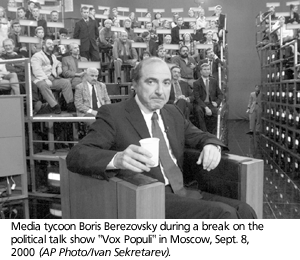
In October, the Kremlin tried to build on the success of its Chechnya information policy by setting up branch offices of the Russian Information Agency throughout the country. In August, Berezovsky’s Moscow daily Nezavisimaya gazeta argued that the regional information agencies were meant to “undermine the political position of the governors in their regions and, simultaneously, create a mass tribune for explaining the positions of the president and the government.”
 During 2000, which saw a spate of regional elections covering roughly two-thirds of the country, the Central Elections Commission also emerged as a major tool of media control. The Law on Elections grants the elections commission broad powers, including the right to censure media outlets and disqualify political candidates. Such was the fate of Kursk governor Aleksandr Rutskoi, who was stricken from the ballot on the eve of the election. This move was widely interpreted as punishment for Rutskoi’s criticism of Putin during the Kursk submarine crisis. Even Press Minister Mikhail Lesin stated that under the Law on Elections, “the mass media basically have no right to even mention the name of any candidate or party.”
During the various local election campaigns, the Central Elections Commission promoted Kremlin-approved candidates by manipulating press coverage. In Ulyanovsk, for instance, local media were kept from reporting that human-rights groups were calling for the war crimes prosecution of Gen. Vladimir Shamanov, who was accused of atrocities against civilians in Chechnya during the recent campaign. Shamanov won the governorship in December. As more and more Kremlin surrogates take over regional governorships, which in turn control local state media outlets, the process of centralizing the flow of information nationally will certainly gain momentum.
There’s power in a union
The Russian Union of Journalists, a state-subsidized organization that has never been particularly fervent in its support of independent media, watched this unfolding process with alarm, growing increasingly radicalized as the year wore on. The union participated actively in the media-manipulation campaign that brought Putin victory in the March presidential election. But by July, it had declared that Press Minister Lesin was Russia’s “Press Enemy No. 1.” (Putin came in second, tied with Prosecutor General Vladimir Ustinov.)
In an open letter to Prime Minister Mikhail Kasyanov in November, the union called for criminal charges against Lesin for allegedly conspiring with the Elections Commission to shut down a private television station in Sochi. Neither Kasyanov nor Lesin responded openly to the union’s demand.
Media-Union, a new association clearly intended to undercut or even replace the Union of Journalists, was formed in late November by the head of the state news agency ITAR-TASS, Vitaly Ignatenko, and by RTR television personality Aleksandr Lyubimov. Media-Union’s stated goals include “precluding the selective ‘human-rights defense’ of journalists that favors only ‘democratic’ journalists” and “the worthy presentation of the body of Russian journalists on the international stage, partly in order to end the constant, daily foreign control over the activity of our journalists.”
In December, Lyubimov traveled to St. Petersburg to join forces with the local League of Journalists, an organization best known for its unsubstantiated charge that hundreds of Russian journalists are in the pay of foreign security agencies.
Looking ahead
 In December 2000, the government announced that the state-controlled RTR network would be restructured and partially privatized. Initial Press Ministry indications were that ownership of broadcast facilities would be separated from that of production studios, although the state will maintain majority control of both. The Press Ministry also announced its intention to introduce licensing requirements for magazines and newspapers beginning in 2001. Such licenses would be issued (and, of course, withdrawn) by the Press Ministry itself, providing a powerful lever of central control over print media around the country.
The fate of the national television channels ORT and NTV should also be decided in the course of 2001. In February 2001, Berezovsky sold his 49 percent stake in ORT to the Kremlin’s new favorite oligarch, Roman Abramovich, who immediately announced that he would allow the Kremlin to name all 11 members of the ORT board. Immediately, the Kremlin announced it would appoint Lesin, Putin’s chief of staff Vladislav Surkov, and three other senior officials to the board. In short, ORT has now joined RTR as a wholly state-controlled television network.
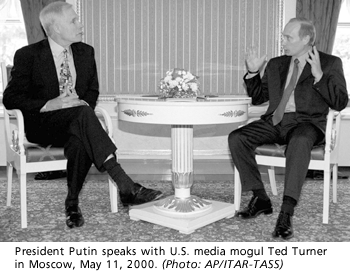
NTV, which currently is still part of Gusinsky’s Media-Most conglomerate, will also see new ownership in 2001, although it is far from clear how that story will end. In December 2000, it was announced that Gusinsky was negotiating to sell his shares to American television magnate Ted Turner (who was acting in his private capacity, not as vice chairman of AOL-Time Warner). But the Kremlin and Gazprom, a massive state-controlled conglomerate that also has a large stake in Media-Most, seemed to be doing their best to sabotage that deal and scare off any other foreign investors.
Putin’s Information Security Doctrine explicitly states that foreign countries threaten Russian society by strengthening their own media presence in Russia and by “taking control over” domestic media. Some analysts believe Media-Most will most likely end up in the hands of Gazprom, with the possible involvement of Video International, an advertising firm that was founded by Lesin and maintains close ties to him. In early February, 2001, meanwhile, Berezovsky complicated matters even more by offering to loan his longtime rival Gusinsky up to US$50 million to help keep Media-Most out of Gazprom’s clutches.
Observers also expect Putin’s seven regional representatives to participate actively in the restructuring of RTR in their regions and to continue launching newspapers and news agencies controlled by their offices. In northwest Russia, for example, Presidential Representative Viktor Cherkesov has been setting up a regional television station that will, in Cherkesov’s words, provide only “government-approved coverage.” In an interview in December, journalist Pavel Sheremet, special projects director at ORT, summarized the media’s gloomy prospects: “Today, the state dominates the information sphere. In my opinion, this is a dangerous tendency because the very concepts of ‘state’ and ‘society’ are becoming interwoven in people’s minds….The interests of the individual have been subordinated to those of the state; the people work for the state and not vice-versa.”
Throughout 2000, Putin expanded Kremlin control over political, economic, and social life in Russia. Media manipulation helped Putin to power, and has helped him crush political challenges since he became president of all the Russias. The former KGB colonel is not likely to relinquish this effective instrument voluntarily.
Robert Coalson is the opinion page editor of The Moscow Times.