New York, September 28, 2009—The interim government of Honduras must immediately allow two private broadcasters loyal to ousted President Manuel Zelaya to return to the air, the Committee to Protect Journalists said today. Officials, acting under a new decree that suspends civil liberties, shut down Radio Globo and Canal 36 television early today, according to local and international news reports.
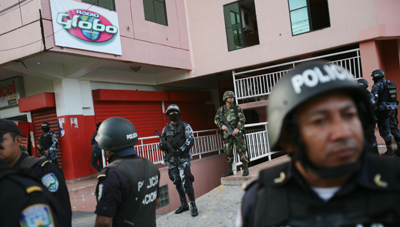
Police outside Radio Globo. (AP)
“Honduran citizens have the right to be fully informed about what’s going on in the country at this very sensitive moment,” said Carlos Lauría, CPJ Americas senior program coordinator. “We urge the interim government to withdraw restrictions on the media, immediately reopen the suspended broadcasters, and respect journalists’ right to report the news freely.”
At around 5:30 a.m., dozens of soldiers and police raided the offices of Radio Globo and Canal 36, according to international news reports. Officials confiscated material and equipment from the outlets, according to the Honduran daily El Heraldo. Two journalists covering the raid for the Guatemalan television station Guatevisión were assaulted by Honduran police, the daily La Prensa reported.
The two broadcasters are considered sympathetic to Zelaya and very critical of the interim government led by Roberto Micheletti. Radio Globo and Canal 36 have been forced off the air several times since Zelaya was ousted three months ago.
The media outlets were taken off the air today under the provisions of a government decree, announced late on Sunday, that suspends constitutionally guaranteed civil liberties for 45 days, government spokesman René Zepeda told reporters. The government said the suspensions were aimed at quelling unrest among Zelaya supporters, who had planned a rally today in the capital, Tegucigalpa. The government did not say how long it intended to keep the stations off the air.
Article 4 of the decree, authorizes the National Telecommunications Commission to suspend any broadcaster that “attacks peace or public order,” or that broadcasts messages that “offend the human dignity, officials, threatens the law or government resolutions.”
Tensions have escalated in Honduras after Zelaya, who was overthrown in a military coup on June 28, secretly returned from exile a week ago and sought refuge in the Brazilian embassy. Zelaya’s return has sparked a tense standoff with the interim government. Zelaya has demanded that he be allowed to return to office, while the de facto government has promised instead to arrest him. The Micheletti government said presidential elections in November will bring an end to the crisis.
Press freedom conditions have seriously deteriorated since Zelaya was overthrown, CPJ research shows. Honduran security forces shut down local broadcasters, blocked transmissions of international news networks, and briefly detained journalists in the aftermath of the coup, according to CPJ research. As political tension, protests, and violence have intensified, coverage has been skewed at times. Unidentified assailants have attacked media outlets and harassed journalists covering both sides of the political crisis. The offices of the national daily El Heraldo have been attacked by unidentified assailants on August 15. A reporter was shot dead on July 4. CPJ is investigating whether his death is linked to the political crisis or to his reporting.