Journalist under house arrest
New York, April 12, 2001 — Cuban authorities placed local journalist Ricardo González Alfonso under house arrest on April 9, according to the local independent news agency CubaPress. González Alfonso, 49, is the Cuba correspondent for the Paris-based press freedom organization Reporters sans Frontières (RSF). National Revolutionary Police (PNR) officers detained the journalist after his…
Reporter’s murder still unsolved
Your Excellency: The Committee to Protect Journalists (CPJ) requests information about the status of the investigation into the murder of Mylvaganam Nimalarajan, a Jaffna-based journalist who was killed in October 2000. Nimalarajan covered the civil war for various news organizations, including the BBC’s Tamil and Sinhala-language services, the Tamil-language daily Virakesari, and the Sinhala-language weekly Ravaya.
On eve of “National Day of Forgiveness,” CPJ urges full investigation into murder of editor Norbert Zongo
Your Excellency: The Committee to Protect Journalists (CPJ) remains deeply concerned that justice is not being served in the murder case of Norbert Zongo, late editor of the weekly L’Indépendant in the capital, Ouagadougou. Your government has declared tomorrow an official Day of Forgiveness for all citizens to reflect on Burkina Faso’s painful recent history. While this is a laudable undertaking, it will inevitably fail if suspected human rights abuses by your administration, such as the grisly murder of Zongo, are not fully investigated and their perpetrators brought to justice.
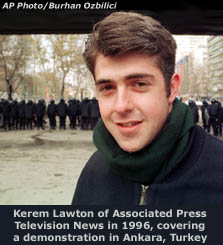
Journalist killed on Kosovo-Macedonia BorderCPJ Calls For Investigation Into Source Of Attacks
New York, March 29, 2001 — CPJ deplores the death of a British journalist this morning in the Kosovo village of Krivenik, near the Macedonian border. Kerem Lawton, 30, a British national and producer for Associated Press Television News, died from shrapnel wounds sustained when a shell struck his car. At least two other civilians…
Israeli journalists barred from Arab summit
New York, March 28, 2001 — Six Israeli journalists were prevented from covering this week’s Arab summit in Amman after Jordanian security authorities requested that they leave the country, citing threats on their safety, CPJ has learned. Roey Gilad, a spokesman for the Israeli embassy in Amman, told CPJ that Jordanian authorities asked the journalists…
JOURNALIST MURDERED
New York, March 27, 2001 — CPJ is deeply concerned about the recent murder of Saúl Antonio Martínez Gutiérrez, deputy editor of the daily El Imparcial, based in Matamoros, Tamaulipas State. CPJ is investigating the murder to determine whether Martínez Gutiérrez was killed because of his professional work. At around 4:30 p.m. on March 24,…
Broadcaster’s murder still unsolved
New York, March 27, 2001 — CPJ is investigating the January murder of Roland Ureta, program director of the radio station dyKR, an affiliate of the Radio Mindanao Network. Ureta was gunned down on the night of January 3, when two motorcycle-riding men waylaid him en route from Kalibo, the capital of Aklan Province, to…
CPJ submits amicus brief in Matus criminal defamation case
New York, March 23, 2001 — CPJ today submitted an amicus curiae brief to the Inter-American Commission on Human Rights (IACHR) in the case of Chilean journalist Alejandra Matus. Matus faces criminal defamation charges in Chile stemming from the April 1999 publication of The Black Book of Chilean Justice, her muckraking investigation of the Chilean…
Jailed journalist released
New York, March 23, 2001 — Manuel Antonio González Castellanos, correspondent for the independent news agency CubaPress in the eastern province of Holguín, was freed on February 26 after serving the bulk of his 31-month sentence for criticizing President Fidel Castro Ruz. Independent journalist Bernardo Arévalo Padrón, founder of the Línea Sur Press news agency…