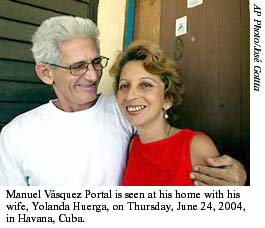
Two imprisoned journalists granted medical parole
New York, June 24, 2004—Authorities granted medical parole to imprisoned journalists Manuel Vázquez Portal and Carmelo Díaz Fernández within the last week. The two men, who suffer from several health conditions, were among the 29 journalists imprisoned in Cuba since March 2003. Vázquez Portal, a writer with the independent news agency Grupo de Trabajo Decoro,…
CPJ condemns journalist’s murder
Dear Mr. Elorduy Walther: The Committee to Protect Journalists (CPJ), a New York-based nonprofit organization that works to safeguard press freedom worldwide, condemns the murder of Mexican journalist Francisco Javier Ortiz Franco, who was killed yesterday in the border city of Tijuana, in Baja California state.
Journalist jailed after sentence upheld
New York, June 23, 2004—The Polish Supreme Court yesterday upheld the three-month jail sentence of a journalist found guilty of libeling a local official in November 2003 and ordered that he be jailed immediately. Andrzej Marek, editor in chief of the weekly Wiesci Polickie (Police News) in the western town of Police, was convicted in…
CPJ condemns deportation of independent journalist
Your Excellency, The Committee to Protect Journalists (CPJ) condemns yesterday’s deportation of Mikhail Podolyak, a Ukrainian journalist, by the Belarusian security service (KGB). Early yesterday morning, agents forced Podolyak out of his home in the capital of Minsk and put him on a train to Odessa, Ukraine, according to local and international reports.
CPJ concerned about recent closures of independent media outlets
Your Excellency: The Committee to Protect Journalists (CPJ) is deeply concerned about recent closures of independent media outlets in Ukraine. We believe that these closures are part of a sweeping campaign to eliminate voices that are critical of the government and to block public access to independent sources of information in the run-up to presidential elections scheduled for October.
Breakthrough in Gongadze case met with deep suspicion
New York, June 22, 2004—Ukraine’s prosecutor-general, Gennady Vasilev, announced yesterday that investigators are questioning a suspect who admitted to killing independent journalist Georgy Gongadze, local reports said. The citizen, identified only as K, is a convicted murderer already in prison for several other killings that involved decapitation, the manner in which Gongadze was killed four…
Director of television channel in Dagestan wounded
New York, June 21, 2004—Tagib Abdusalamov, director of the Dagestani bureau of the Russian state radio and television company GTRK, was shot and wounded on Friday, June 18, by unknown assailants, according to local and international reports. Abdusalamov is in critical condition at the hospital in Dagestan’s capital, Makhachkala. The Committee to Protect Journalists (CPJ)…
CPJ CALLS ON AZERBAIJANI GOVERNMENT TO END REPRESSIVE MEDIA POLICIES
Baku, June 18, 2004—The Committee to Protect Journalists (CPJ) today held a press conference in Azerbaijan’s capital, Baku, to call on Azerbaijani President Ilham Aliyev to end his government’s repression of independent and opposition media. In Baku, CPJ Executive Director Ann Cooper, Europe & Central Asia Program Coordinator Alex Lupis, and Senior Editor Amanda Watson-Boles…