Captors threaten to kill Romanian journalists
April 22, 2005, New York—The captors of three Romanian journalists and a translator threatened to kill their prisoners within four days unless Romania withdraws its troops from Iraq, according to a videotape that was broadcast today on the Arabic satellite channel Al-Jazeera. The video, which aired without sound, showed reporter Ovidiu Ohanesian, of the daily…
SUDAN
APRIL 21, 2005 Posted: May 17, 2005 Mohamed Taha Mohamed Ahmed, Al-Wifaq LEGAL ACTION Al-Wifaq CENSORED Ahmed, an editor, was tried on criminal charges of insulting the Prophet Mohammed after publishing an April 21 article in the daily Al-Wifaq. The article, by the well-known Muslim historian Al-Maqrizi, called into question the Prophet Mohammed’s lineage, according…
CPJ seeks release of Yemeni media workers
Your Excellency: The Committee to Protect Journalists is deeply concerned about the ongoing detention of three Yemeni media support staff, who have been held without charge since early this month. On April 3, Yemeni authorities detained freelance reporters James Brandon and Shane Bauer; bothers Munif Damesh and Munaf Damesh, who were working as fixers; and their uncle, Naif Damesh, who was working as the driver. The five men were detained at an army checkpoint while leaving the northern Yemeni city of Saada, where they had been reporting on fighting between the Yemeni army and fighters loyal to rebel Badreddine al-Hawthi. They were then taken to the offices of Yemen’s Political Security Organization in the capital Sanaa.
Photographer dies while covering protests
New York, April 21, 2005 Photographer Julio Augusto García Romero died Tuesday evening, after inhaling tear gas while covering a demonstration in downtown Quito, Ecuador’s capital. The demonstration, organized to protest the now-ousted President Lucio Gutiérrez, was moving toward the Palacio de Carondelet, the seat of the executive branch, when police fired water cannons…
CAMEROON
APRIL 20, 2005 Posted: May 12, 2005 Guibaï Gatama and Abdoulaye Oumaté L’Oeil du Sahel LEGAL ACTION. On April 20, a court in Maroua, the capital of Cameroon’s Far North Province, sentenced Guibaï Gatama, publication director of the independent weekly L’Oeil du Sahel, and Abdoulaye Oumaté, a journalist for the paper, to five months in…
SOMALIA
APRIL 20-28, 2005 Posted: May 4, 2005 Shacab HARASSED Abdirashid Qoransey, Shacab Abdi Farah Nur, Shacab HARASSED, LEGAL ACTION Security forces in the autonomous Puntland region attacked the premises of the weekly newspaper Shacab (Voice of the People) in the town of Garowe, breaking the front gate and damaging the editor’s car and other property,…
TOGO
APRIL 20, 2005 Posted: May 3, 2005 Kanal FM CENSORED The High Audiovisual and Communications Authority (HAAC) suspended Kanal FM, an.independent radio station in the capital, Lomé, for one month because of an April 18 editorial titled “Autopsy of an Electoral Campaign.” The editorial accused members of the ruling party of committing widespread human rights…
ZIMBABWE
APRIL 20, 2005 Posted: April 27, 2005 Davison Maruziva, The Standard HARASSED, LEGAL ACTION Savious Kwinika, The Standard HARASSED, LEGAL ACTION Police brought criminal charges against Standard editor Maruziva. The following day they also brought charges against reporter Kwinika. Both journalists were charged in connection with an April 10 story alleging election irregularities—specifically for deliberately…
Private broadcasters barred from election coverage
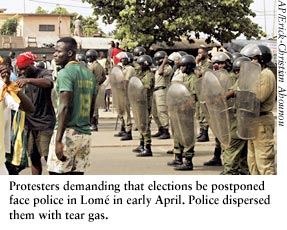
New York, April 20, 2005—The Committee to Protect Journalists is deeply troubled by a new Togolese government order that bars private radio and television stations from reporting on the presidential election campaign, which is now in its final days. A directive issued Friday by Togo’s High Audiovisual and Communications Authority (known by its French acronym,…
MADAGASCAR
APRIL 19 Posted: May 31, 2005 Rolland Rasoamaharo, La Gazette de la Grande IleJames Ramarosaona, La Gazette de la Grande Ile LEGAL ACTION Rasoamaharo, publication director of the private, daily La Gazette de la Grande Ile, and editor Ramarosaona, were each sentenced on April 19 to one month in jail for criminal defamation in connection…