Web log shuts down after government threat of legal action
New York, May 5, 2005—The threat of legal action has prompted Singaporean blogger Jiahao Chen to shut down his site and post an apology for comments criticizing a government agency and its chairman. The Committee to Protect Journalists said today it is alarmed that the threat of defamation lawsuits is being used to inhibit criticism…
BRAZIL
MAY 4, 2005 Posted: June 9, 2005 André Lima, Diário do Nordeste ATTACKED Military police officers attacked Lima, a photographer for the daily newspaper, while he was covering a demonstration in Fortaleza, the capital of northeastern Ceará state. The protesters opposed efforts by a public utility to install a high-voltage power line inside a poor…
CHILE
MAY 4, 2005 Posted: May 17, 2005 Paola Briceño Verdina, Radio Bío-Bío HARASSED, ATTACKED Radio reporter Briceño Verdina was beaten and detained by national police agents after covering a student protest in Santiago. Local press reports said a large number of university students gathered in Santiago to protest a bill that would give private banks…
PERU
MAY 4, 2005 Updated December 12, 2005 Sally Bowen, freelance LEGAL ACTION, HARASSED In May 2005, Judge Alfredo Catacora Acevedo found British freelance journalist Sally Bowen guilty of criminal defamation and ordered her and her publisher to pay $10,000 Peruvian soles (US$3,000) to businessman Fernando Zevallos. Catacora also sentenced Bowen to one year of probation…
INDONESIA
MAY 4, 2005 Posted: May 17, 2005 Darwin Ruslinur, KoridorBudiono Saputro, Koridor LEGAL ACTION Using antiquated criminal laws dating back to Indonesia’s colonial era, a district court in the city of Lampung on the island of Sumatra found the two journalists guilty of criminal defamation and sentenced them to nine months in prison. Darwin Ruslinur,…
PHILIPPINES
MAY 4, 2005 Posted: May 5, 2005 Klein Cantoneros, DXAA-FM KILLED—UNCONFIRMED Cantoneros, a radio broadcaster known for denouncing corruption, died after being shot as many as seven times by motorcycle-riding gunmen in Dipolog City on the southern island of Mindanao. The Committee to Protect Journalists is investigating the circumstances of the case to determine whether…
Investigators name chief suspect in murder of opposition editor
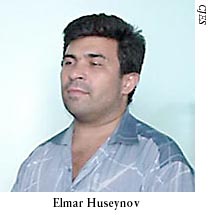
New York, May 4, 2005—Investigators in Azerbaijan’s capital, Baku, said late yesterday that a 46-year-old Georgian citizen is the chief suspect in the March 2 murder of Elmar Huseynov, founder and editor of the opposition news magazine Monitor. The National Security Ministry (MNB), which is conducting the inquiry into Huseynov’s killing, identified the suspect as…

Philippine radio journalist slain
New York, May 4, 2005—A radio broadcaster known for denouncing corruption died today after being shot as many as seven times by motorcycle-riding gunmen in Dipolog City on the southern island of Mindanao. Klein Cantoneros succumbed to his injuries at around 11 p.m., according to the ABS-CBN news Web site. The Committee to Protect Journalists…
CHINA
MAY 3, 2005 Posted: May 3, 2005 Cheng Yizhong, Nanfang Dushi Bao and Nanfang Tiyu HARASSED Chinese authorities refused to allow Cheng to receive a United Nations press freedom award on May 3. Cheng, who was imprisoned for five months in 2004 after his aggressive investigative journalism angered local officials, was ordered not to attend…