Journalists in prison, 2004
Around the world, 122 journalists were in prison at the end of 2004 for practicing their profession, 16 fewer than the year before. International advocacy campaigns, including those waged by the Committee to Protect Journalists, helped win the early release of a number of imprisoned journalists, notably six independent writers and reporters in Cuba.
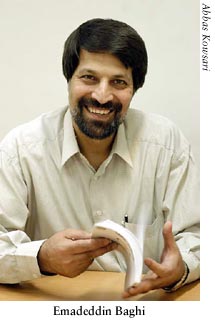
Barred from international travel, writer misses Courage Award ceremony
New York, October 12, 2004—The Committee to Protect Journalists strongly protests a travel ban imposed on Iranian journalist and human rights activist Emadeddin Baghi, who was due to be honored here today with an award recognizing his courage in fighting injustice. Iranian officials confiscated Baghi’s passport at Tehran’s airport on October 4, and prevented him…
CPJ condemns deportation of independent journalist
Your Excellency, The Committee to Protect Journalists (CPJ) condemns yesterday’s deportation of Mikhail Podolyak, a Ukrainian journalist, by the Belarusian security service (KGB). Early yesterday morning, agents forced Podolyak out of his home in the capital of Minsk and put him on a train to Odessa, Ukraine, according to local and international reports.
CPJ calls on Azerbaijan to allow journalist to return to country
Your Excellency: The Committee to Protect Journalists (CPJ) is deeply concerned that Azerbaijani journalist Irada Huseynova, who lives and works in Moscow, cannot attend an international meeting of freedom of expression groups in Azerbaijan in mid-June because she faces arrest on criminal defamation charges should she return to the capital, Baku. Huseynova was invited by the Toronto-based International Freedom of Expression Exchange (IFEX), which will hold its meeting in Baku beginning June 14.
2003 prison census: 138 journalists jailed
There were 138 journalists in prison around the world at the end of 2003 who were jailed for practicing their profession. The number is the same as last year. An analysis of the reasons behind this is contained in the introduction on page 10. At the beginning of 2004, CPJ sent letters of inquiry to…
Attacks on the Press 2003: Kuwait
In the lead-up to the U.S.-led war in Iraq, hundreds of international journalists assembled in Kuwait, the main launching pad for the U.S. invasion. Although journalists were able to report freely within the country, those seeking to cross the border into Iraq encountered stiff resistance from the Kuwaiti military.
Attacks on the Press 2003: Nigeria
In Nigeria’s first successful transfer between civilian administrations since independence in 1960, President Olusegun Obasanjo was re-elected in a landslide victory that also saw his ruling People’s Democratic Party (PDP) make significant gains in polls across the country. Despite the relatively peaceful conduct of the election, opposition parties and election observers alleged widespread fraud, irregularities,…
Attacks on the Press 2003: Thailand
For the last two years, Thailand’s powerful and freewheeling media have been reeling from the effects of a popular and savvy prime minister who seems intent on using his absolute majority in Parliament to control the press. The process has been as subtle as it has been painful, with journalists saying that most pressure is…
Attacks on the Press 2003: Zimbabwe
Despite widespread international criticism of Zimbabwe’s appalling human rights record, President Robert Mugabe and his ruling Zimbabwe African National Union-Patriotic Front (ZANU-PF) continued to silence voices of dissent in 2003. During the last four years, the government has pursued a relentless crackdown on the private press through harassment, censorship, and restrictive legislation. 2003 saw the…