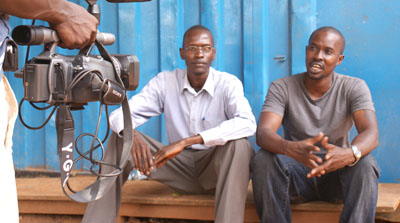
Freedom of information laws struggle to take hold in Africa
In Uganda, a ruling this week in a landmark case of two journalists seeking to compel their government’s disclosure of multinationals oil deals highlighted the challenges to public transparency just before media leaders, press freedom advocates, officials, and former U.S. President Jimmy Carter gather in Ghana next week at the African Regional Conference on the Right…
Free Maziar Bahari: 100 global journalists petition Iran
Your Excellency: We are writing to express our grave concern at the detention of our esteemed fellow journalist Maziar Bahari and to request his immediate release. Mr. Bahari has been detained since June 21. No charges have been brought against him, and he has not been granted access to a lawyer. As one of the most impartial and committed journalists in his field, he has reported regularly over the past decade from the Middle East, principally from Iran and Iraq, and provided consistently balanced and insightful reports. As an award-winning documentary filmmaker, he has earned global respect for his work.
CPJ, JFO cite press freedom abuses in Iraq
Dear Prime Minister al-Maliki: The Committee to Protect Journalists (CPJ) and the Journalistic Freedoms Observatory (JFO) would like to bring to your attention several issues that harm press freedom in Iraq. In recent months, our organizations have documented a number of assaults and instances of harassment committed by government officials against journalists in various parts of the country under the control of Iraq’s central government.
Attacks on the Press in 2008: Iraq
Eleven journalists were killed because of their work, making Iraq the most dangerous nation for the press for the sixth consecutive year. Nevertheless, the figure was the lowest yearly toll since the U.S.-led invasion in 2003–and two-thirds lower than the annual figures for 2007 or 2006.
Attacks on the Press in 2008: Israel and the Occupied Palestinian Territory
With a shaky six-month truce coming to an end in late year, Hamas rocket attacks on Israel were met with the largest bombardment of the Gaza Strip since 1967. The headquarters of Hamas-controlled Al-Aqsa TV was destroyed and at least two journalists were injured amid massive airstrikes by the Israel Defense Forces (IDF). As 2008…
Attacks on the Press in 2008: Lebanon
This deeply divided country reached the brink of full-scale conflict in mid-year after political and religious leaders used the news media to inflame sectarian divisions and failed to abide by the consensual style of government agreed upon at the end of the 1975-1990 civil war. A battle of words that began in December 2006 with…
Attacks on the Press in 2008: Morocco
Morocco continued to backslide on press freedom as independent journalists and news outlets were targeted in a series of politicized court cases. In May, the National Syndicate for Moroccan Press noted a “dangerous trend” in which authorities were “imposing exaggerated fines in defamation cases, resorting to preventive arrest of journalists … banning newspapers and instructing…
Attacks on the Press in 2008: Tunisia
The September abduction of writer Slim Boukhdhir was a chilling reminder of the insecurity that critical journalists face in this North African nation. President Zine El Abidine Ben Ali, in power since 1987, continued to operate a virtual police state, despite the moderate image his government vigorously promoted to the rest of the world.
Attacks on the Press in 2008: Yemen
Journalists worked in precarious conditions in which they were subjected to politicized criminal charges and censorship from government officials. A harsh press law set restrictions on coverage of the presidency, state security, and religion. Authorities kept particularly tight control on coverage of an insurgency led by tribal and religious figures in the northwestern Saada region.